 Wei Chen
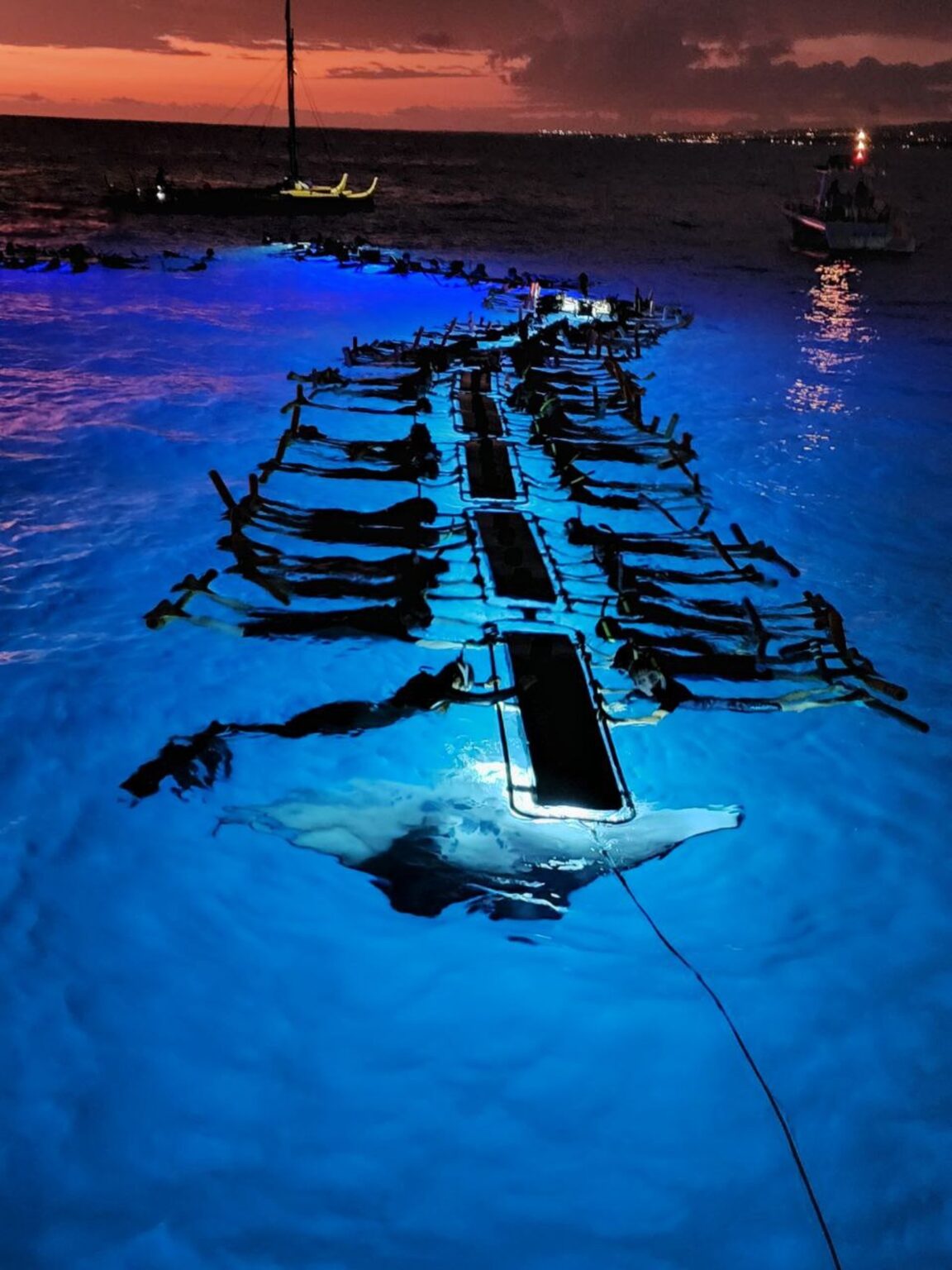
The Kona manta ray night snorkel works like this: after sunset you float face down at the surface, holding a lighted board, while lights shining into the water draw plankton, and reef manta rays, some with wingspans wider than a car is long, loop and barrel roll through the beam below you to feed. You do not chase them, dive to them or touch them. You hold still, keep your legs up, and let animals that may pass within inches choose the distance. Two sites host the encounter, Manta Village at Keauhou Bay in the south and Garden Eel Cove near Keahole Point in the north, and choosing between them, by harbour, swell and operator, is the main decision of the trip.
Quick Facts
- Where: The Kona Coast of Hawaii Island. Manta Village off Keauhou Bay, boats from Keauhou. Garden Eel Cove, also called Manta Heaven, at Makako Bay near Keahole Point, boats from Honokohau Harbor.
- The animal: Reef manta rays, Mobula alfredi, filter feeders with no sting and no teeth that matter to you. Individuals are identified by the spot patterns on their undersides.
- The setup: Snorkelers float at the surface holding a light board, lights down. Divers, on dive boats, kneel on the bottom with lights up. Plankton gathers in the light, mantas follow the plankton.
- The rules: No touching, ever. No diving down, no chasing, no blocking a ray’s path. Hands on the board, fins still, legs floating behind you.
- Time in the water: Typically about 30 to 45 minutes, on trips of roughly two hours dock to dock.
- Track record: Sea Paradise, operating from Keauhou Bay since 1985 and listed on Go Hawaii, reports an 85 to 95 percent sighting rate at Manta Village and a free return trip within 7 days if no mantas appear, space permitting.
- Catalogue: More than 450 individual manta rays have been documented on the Kona Coast in work with the Manta Pacific Research Foundation, per the same operator listing.
Keauhou or Honokohau: which site should you choose?
Manta Village, at Keauhou Bay, is where the encounter began: hotel lights shining on the water drew plankton, the plankton drew mantas, and operators have run snorkel trips to the lights since the early 1990s. Boats ride a few minutes from Keauhou, which makes it the convenient site if you are staying in south Kona, and the busier one, with several boats sharing the lights on a good night. Garden Eel Cove, the northern site by Makako Bay near Keahole Point and the airport, is served from Honokohau Harbor and has a long record of large gatherings; its basin is more sheltered, while Keauhou is more open to a south swell, which matters on the nights the ocean is restless. University of Hawaii survey work at the two sites, summarised by Kona operators, found the rays move between the coves and that gathering sizes track zooplankton density, which is the honest science behind every sighting rate: the mantas come for food, not for you. Choose by where you are staying, by the swell forecast, and by the operator’s terms for a no show night, not by promises. A good operator tells you its rebook policy before it takes your money; the Go Hawaii listing for Sea Paradise, the Keauhou operator that pioneered the large vessel manta snorkel, states its 85 to 95 percent sighting rate and its free return within 7 days in plain text.
What actually happens in the water?
You check in before sunset, ride out as the light fails, and get a briefing that covers manta biology, the light board and the rules while the boat runs to the site. In the water you wear a wetsuit, the Pacific at night cools everyone over half an hour, a mask and snorkel and a flotation aid, and you take your place along the edge of a raft like board fitted with lights, face down, legs stretched and floating behind you. Below, on dive boats sharing the site, divers kneel on the sand with their lights pointed up, so the water column between the two light sources fills with plankton, visible as drifting snow in the beam. Then the mantas arrive, mouths open, the horn like cephalic fins at the front unrolled to funnel food, and they feed in loops: a slow pass through the light, a barrel roll back through the densest plankton, again and again. They may pass directly beneath the board, close enough that you see the gill slits and the unique spot pattern on the white underside, the fingerprint researchers use to identify individuals. Your whole job is to be furniture: hands on the board, breathing slow, fins quiet.
Why is the no touch rule absolute?
Because your hand harms the animal and ruins the encounter for everyone after you. A manta’s skin carries a protective mucus layer that guards it against bacteria and infection, and a touch rubs that layer away at exactly the places where contact repeats nightly. Touching, chasing or diving at a ray also breaks its feeding path; a ray that veers off feeds less, and a site where rays are harassed is a site they use less. Kona’s operators, guides and researchers have built shared viewing standards around passive observation: snorkelers stay at the surface, divers stay on the bottom, nobody occupies the middle of the water column where the rays feed, and hands stay off. Treat the rule as the price of admission. The ray that brushes past you has chosen that distance itself, and the correct response is to hold still and let it turn away on its own line. Hawaii also restricts sunscreens containing oxybenzone and octinoxate, so use the wetsuit the operator provides and save reef safe sunscreen for the daytime.
What is the surge reality, and who should not go?
The sites are open ocean, and the water moves. On calm nights the board barely stirs; when a swell is running, the whole raft of snorkelers rises and falls, lines strain, and the Keauhou site in particular can feel its exposure to the south. This is the part brochures skip: seasickness on the ride out claims more evenings than empty water does, and cold follows at about the half hour mark even in a wetsuit. You need to be a genuine swimmer, comfortable in the ocean in the dark, able to climb a boat ladder, and honest about it at booking, because operators separate confident swimmers from beginners and some departures are reserved for the confident. Non swimmers, anyone pregnant, and anyone with recent surgery or serious mobility limits should take the boat ride only options some operators offer, or watch from shore at Keauhou, where the lights and the feeding shadows are visible from the point on good nights. Book the manta night early in your stay, so a weather cancellation or a no show rebook still fits the trip, the same insurance logic as booking a sunrise at Haleakala on your first Maui morning. And budget the state’s visitor costs into the trip as a whole, as our explainer on Hawaii’s green fee and lodging tax sets out.
How do you choose an operator?
On four tests. Group size: smaller rafts mean less kicking and better water, and the established operators publish their caps. Briefing quality: the rules and the biology should be explained before anyone gets wet, not shouted over the stern. Standards: look for operators that follow the Kona manta viewing standards and carry recognised eco credentials, Sea Paradise, for example, is Hawaii Ecotourism Association certified per its Go Hawaii listing and works with the Manta Pacific Research Foundation’s identification catalogue. And terms: a written no manta policy, a free re ride within a set window, is the mark of an operator confident in its site. Price follows those four; the cheapest boat at the busiest site on a Saturday is rarely the bargain it looks.
Frequently Asked Questions
Can I touch a manta ray if it swims right up to me?
No. Keep your hands on the light board. Touching strips the protective mucus from a manta’s skin and exposes it to infection, and it breaks the animal’s feeding path. The close passes are the ray’s choice; your job is to stay still and let it choose the distance both ways.
Which is better, Keauhou or Garden Eel Cove?
Both sites draw the same population of reef mantas, and the rays move between them. Keauhou’s Manta Village is the original site, a short ride from Keauhou Bay and convenient for south Kona stays, but more open to south swell and often busier. Garden Eel Cove, reached from Honokohau Harbor, is more sheltered and known for large gatherings. Pick by your base, the swell and the operator’s rebook terms.
What happens if no mantas appear?
It depends on the operator, which is why you read the terms before booking. Sea Paradise, the long running Keauhou operator listed on Go Hawaii, reports an 85 to 95 percent sighting rate at Manta Village and offers a free return trip within 7 days if no mantas are seen, space permitting. Book early in your stay so a re ride is actually usable.
Do I need to be able to swim?
Yes. You float in open ocean at night, holding a board, in a wetsuit and flotation aid, and you must be able to climb back up a boat ladder. Operators ask about swimming ability at booking and some departures are for confident swimmers only. Non swimmers should ask about ride along places instead.
How long are you in the water, and will I get cold?
Typically about 30 to 45 minutes in the water on a trip of roughly two hours. Most people cool down towards the end of that time even in the wetsuit operators provide, which is normal and manageable. The bigger comfort risks are seasickness on the ride and surge at the site on swell nights; take precautions before you board if you are prone to either.
Are manta rays dangerous?
No. Reef mantas are filter feeders that eat plankton. They have no sting and do not bite, and the Kona encounter is built around watching them feed. The risks of the night are ordinary ocean risks, cold, swell and seasickness, managed by the briefing, the wetsuit and the guides in the water with you.
Featured image: Snorkelers holding a lighted board at Manta Village at dusk as a manta ray passes beneath the lights, Keauhou, Kona. Photo: Sea Paradise, via seaparadise.com, used with credit.