 Wei Chen
Basel Fasnacht begins at 4am on the Monday after Ash Wednesday, when the fourth chime of St Martin’s church sounds, every light in the old town goes out, and thousands of masked pipers and drummers step into the dark behind hand painted lanterns at the command Morgestraich, vorwaerts, marsch. It then runs for exactly 72 hours, through two great afternoon parades, a children’s afternoon, a night of brass bands and two evenings of satirical songs, until the final march at 4am on Thursday. The next edition opens on Monday 15 February 2027. Base in the old town, buy the carnival badge, and plan your sleep around the 4am start rather than pretending it will not hurt.
Quick Facts
- Where: Basel old town, Switzerland, on both banks of the Rhine, with the busiest Morgestraich streets around Barfuesserplatz, Marktplatz and Freie Strasse.
- When: From 4am on the Monday after Ash Wednesday for exactly 72 hours. The 2026 edition ran 23 to 25 February 2026; the next Morgestraich is Monday 15 February 2027.
- The start: Morgestraich. Lights out at 4am, cliques march with illuminated lanterns, drums and piccolos.
- The parades: The Cortege, Monday and Wednesday, 1.30pm to 6pm, with around 10,000 costumed participants in the official Basel Tourism count.
- The badge: The Blaggedde, sold from mid January, funds the cliques. Recent editions priced copper at CHF 10, silver CHF 20, gold CHF 50 and the bijou version CHF 100.
- Cost to watch: The street programme is free. Your money goes on the badge, food, drink and a hotel room you will barely sleep in.
- Status: Inscribed on the UNESCO Representative List of the Intangible Cultural Heritage of Humanity on 7 December 2017.
What actually happens at 4am?
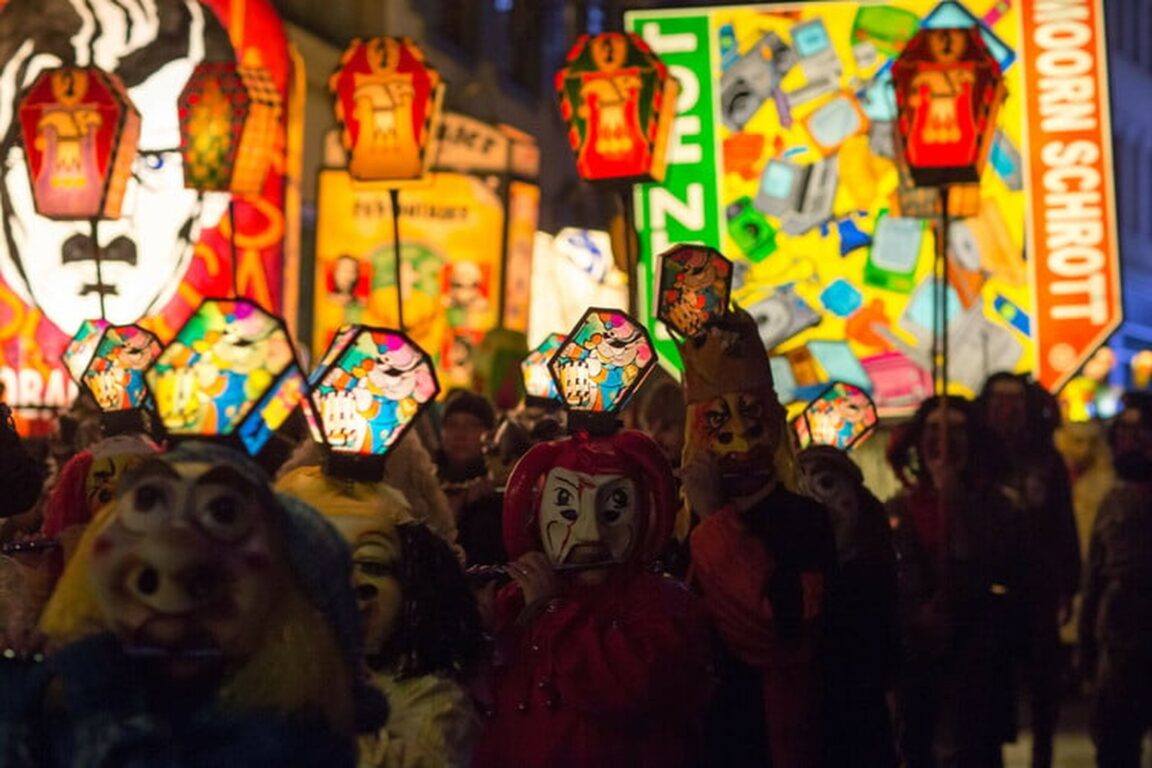
The Morgestraich is one of Europe’s great openings, and Basel Tourism’s official carnival page describes the mechanics precisely. At the fourth chime of St Martin’s church, all the lights go off in the inner city. At the drum majors’ command, the alleys spring to life with hundreds of piccolos and drums, every clique opening with the Morgestraich march, a tune played only on this occasion. The only light comes from the lanterns: a large painted procession lantern carrying each clique’s theme, and smaller head lanterns worn by the marchers. Spectators stand in near darkness as the columns pass at a measured military pace, a rhythm Basel Tourism traces back to the guild musters of the sixteenth century. The busiest ground is Barfuesserplatz, Marktplatz, Ruelinsplatz, Falknerstrasse and Freie Strasse; the same page points quieter watchers to Leonhardskirchplatz, Martinskirchplatz, Nadelberg and Muensterplatz. Afterwards the town eats: the classic Morgestraich breakfast is flour soup, onion tart and cheese tart, served in restaurants that open for the marchers and the frozen spectators alike.
How do the two Cortege afternoons work?
The Cortege is the daylight counterpart: a set route parade through the city centre on Monday and Wednesday from 1.30pm to 6pm, in which every Fasnacht formation takes part, cliques large and small, floats, horse drawn carriages, individual maskers and the Gugge brass bands. Basel Tourism puts the field at around 10,000 costumed revellers. Each clique performs its sujet, its chosen theme for the year, usually satirical and often political, and the theme is readable from a distance because the great lantern goes first, followed by the vanguard, the pipers, the drum major and the drummers. Expect to be given things: flowers, oranges and sweets are thrown to the crowd, and confetti, Raeppli in Basel dialect, is thrown at anyone who looks too clean. One rule matters. Do not wear a cheap shop bought mask or costume as a spectator, and never join the march. Fasnacht is performed by its registered groups; visitors watch, and the distinction is the festival’s social contract.
What happens on Tuesday?
Tuesday belongs to the children and the brass. In the afternoon, Kinderfasnacht fills the centre with Binggis, children in imaginative costumes with drums, small handcarts and their own witty leaflets, handing out sweets and confetti in a looser, family version of the parades, while adults take the day in free formations wearing their favourite personal masks. In the evening the pipers and drummers yield the squares to the Guggenmusik. Around 60 brass bands, in Basel Tourism’s count, gather at Exhibition Square at about 6.30pm and parade through Clarastrasse to stages on Barfuesserplatz, Marktplatz and Claraplatz, where the Gugge concerts run from 7.30pm to 11pm. Gugge music is deliberately, gloriously rough: popular hits played loud on trumpets, trombones, tubas and drums, a wall of sound that is the exact opposite of the disciplined piccolo and drum corps. Between the set pieces, Monday afternoon’s lanterns are displayed on Muensterplatz in the lantern exhibition, lit again after dark, where you can read the year’s satire at walking pace.
What are the Schnitzelbank songs and the clique cellars?
On Monday and Wednesday evenings, and on Tuesday in the clique cellars and private houses, the Schnitzelbank singers do their rounds of restaurants and theatres. Each singer or small group performs rhymed, satirical verses on the year’s events, holding up a painted illustration, a Helge, for each verse, which hints at the theme without giving away the punchline. It is Fasnacht’s literary heart, mostly in Basel dialect, and even visitors who follow only the pictures and the laughter get the shape of it. The clique cellars, the Cliquenkeller where groups rehearse all year, open their doors during Fasnacht for drinks and Schnitzelbank visits, and finding one down an old town stair is the insider experience visitors hope for. Behave as a guest: these are the groups’ own rooms, kept for members and their visitors, not bars with a theme.
What does it cost, and what is the Blaggedde?
Watching costs nothing: the Morgestraich, the Cortege, the lantern exhibition and the Gugge concerts all happen on public streets. The one purchase every visitor is expected to make is the Blaggedde, the brooch like carnival badge with a new design each year, introduced in 1911 so the Fasnachts Comite could finance the festival and still sold to subsidise the cliques. Basel Tourism notes it is available at the Tourist Information office from mid January. In recent editions the four versions have been priced at CHF 10 for copper, CHF 20 for silver, CHF 50 for gold and CHF 100 for the bijou, which can be worn as a pin or a pendant. Buy one and wear it visibly: it is your contribution to a festival with no tickets and no sponsor hoardings, and the Waggis figures on the floats are famous for singling out spectators who have not bought one. Beyond the badge, budget for hotel prices at their annual peak, restaurant meals at festival hours, and the Sunday marches that follow on the three Sundays after Fasnacht, when the cliques parade again without costumes. For a comparison with Italy’s great pre Lenten carnival, see our Venice Carnival guide, and for another festival where the city itself is the stage, our Diwali in Jaipur guide.
Where should you base, and how do you pace 72 hours?
Stay in or beside the old town on the Grossbasel side if you can, because the festival’s hours punish commuting: you need to be on a dark street before 4am on Monday, and the walk home at 5am is part of the experience. Kleinbasel, across the Mittlere Bruecke, is the livelier, more local bank and a fine base a short walk away. Sleep in shifts. Nap after the Morgestraich breakfast, because Monday’s Cortege starts at 1.30pm; nap again on Tuesday afternoon if you want the Gugge night; and treat Wednesday’s Cortege and the final night, which builds to the Endstraich at 4am on Thursday, as the climax it is. Dress in warm layers with no costume, carry ear protection if you are sensitive to drums at close range, the Comite gives it away free at its Marktplatz, Barfuesserplatz and Claraplatz stands, and keep your camera flash off during the Morgestraich, when the darkness is the point.
Frequently Asked Questions
When is Basel Fasnacht in 2027?
It opens with the Morgestraich at 4am on Monday 15 February 2027, the Monday after Ash Wednesday, and ends 72 hours later at 4am on Thursday 18 February 2027. The date follows the church calendar, so it moves between mid February and mid March each year.
Is Basel Fasnacht free to watch?
Yes. The Morgestraich, the Cortege parades, the lantern exhibition and the Guggenmusik concerts are all free street events. Visitors are expected to buy the Blaggedde badge, which funds the cliques; recent editions priced it from CHF 10 for copper to CHF 100 for the bijou version.
Can visitors dress up or join the parade?
No. Fasnacht is performed by its registered cliques and groups, and spectators watch from the street. Wearing a novelty costume as a spectator marks you out as a tourist who has not done the reading. Wear warm normal clothes and the badge.
What is a clique?
A clique is a Fasnacht group, organised like a club, that marches with pipers and drummers behind a painted lantern on a theme, its sujet. Cliques rehearse all year, keep their own cellars in the old town, and are subsidised by badge sales through the Fasnachts Comite.
Where is the best place to watch the Morgestraich?
For density and atmosphere, Barfuesserplatz, Marktplatz and Freie Strasse. For room to breathe, Basel Tourism suggests Leonhardskirchplatz, Martinskirchplatz, Nadelberg and Muensterplatz. Arrive well before 4am, because the streets fill in the dark and the lights out moment is the whole point.
What should I eat during Fasnacht?
The Morgestraich breakfast of flour soup with onion tart or cheese tart is the ritual meal, served from 4am in old town restaurants. Through the three days, look for the same carnival baking in bakeries across the centre, and eat where the cliques eat, in the restaurants hosting Schnitzelbank rounds in the evenings.
Featured image: Masked clique members with illuminated head lanterns and great painted lanterns during the Morgestraich, Basel Fasnacht. Photo: Basel Tourism, via basel.com, used with credit.