 Elena Vasquez
Jaipur is the Diwali trip worth building a journey around because the whole walled city lights itself: the merchant associations of Johari, Bapu, Tripolia and Kishanpole bazaars compete in a municipal illumination contest, the Hawa Mahal and Albert Hall facades are floodlit, and the result is a walkable old city wrapped in coordinated light for the full festival window. In 2027 the main Diwali night, Lakshmi Puja, falls on Friday, October 29, with Dhanteras on Wednesday, October 27 opening the window and Govardhan Puja following on Saturday, October 30. Base inside or beside the walled city, book rooms months ahead, walk the bazaars after dark in a set order, and watch the whole city at once from Nahargarh Fort before the crowds peak. Everything a first festival visit needs, dates, bases, costs and the facade route, is settled below.
Quick Facts
- Festival: Diwali, the festival of lights, in Jaipur, Rajasthan, India
- Main night 2027: Friday, October 29, 2027, Lakshmi Puja, per the Hindu calendar published by Drik Panchang and checked on November 20, 2026
- Festival window: Dhanteras Wednesday, October 27, Choti Diwali Thursday, October 28, main Diwali Friday, October 29, Govardhan Puja Saturday, October 30, with Bhai Dooj closing the cluster in the following days
- Lakshmi Puja window in Jaipur: Approximately 6.44 p.m. to 7.07 p.m. IST on October 29, per the Jaipur panchang timings published for 2027
- Signature event: The municipal illumination competition between the walled city bazaar merchant associations
- Key bazaars: Johari Bazaar for jewellery, Bapu Bazaar for textiles, Tripolia Bazaar for brass and lac bangles, Kishanpole Bazaar for fabrics
- Best panorama: Nahargarh Fort above the city, and the Hawa Mahal frontage at Badi Chaupar in the old city
- Booking lead time: Hotels in and near the walled city sell out for Diwali week; book as early as possible, ideally months ahead
- Prices checked: November 20, 2026, against Rajasthan Tourism and calendar sources. Festival week room rates are set by each hotel and rise sharply, so this guide gives booking strategy rather than a fixed rate
When is Diwali in Jaipur in 2027, and which nights matter most?
The calendar is the first decision, because Diwali moves with the Hindu lunisolar year and Jaipur rewards being present for the right evenings rather than the whole cluster. The dates for 2027 are set out by Drik Panchang, the standard published Hindu calendar: Dhanteras on Wednesday, October 27, the day considered most auspicious for buying gold and silver, Choti Diwali on Thursday, October 28, main Diwali and Lakshmi Puja on Friday, October 29, and Govardhan Puja on Saturday, October 30. A traveller with three nights should take October 27 to 29. A traveller with two should take October 28 and 29, because the bazaar illumination is complete by Choti Diwali evening and the main night carries the puja, the fireworks and the fullest streets.
The lighting itself runs wider than the ritual days. Jaipur’s bazaar associations build their displays in the days before Dhanteras and the illuminated facades typically stay up through the festival window, so the evenings of October 27, 28 and 29 are the reliable peak for a visitor. Plan the big walking route for October 28, when the displays are complete and the streets are festive without the main night’s maximum density, and keep October 29 for a shorter, earlier circuit and a fixed viewpoint for the puja hour. That split, full route on the Thursday, anchor point on the Friday, is the single most useful planning choice in this guide.
What makes Jaipur’s Diwali different from everywhere else in India?
Scale organised as competition. Many Indian cities light their homes, temples and markets for Diwali, but Jaipur’s municipal government runs an official illumination competition between the merchant associations of the walled city’s historic bazaars, and the associations respond with themed, street length lighting designs that change every year. Johari Bazaar, the jewellers’ market, traditionally glows gold. Bapu Bazaar runs long, bright textile street displays. Tripolia and Kishanpole compete on the same terms, and the heritage frontages between them, the Hawa Mahal, the City Palace gates and the Albert Hall Museum outside the walls, are illuminated as part of the same civic effort. Rajasthan Tourism, the state authority, promotes Jaipur’s Diwali lighting as one of the state’s signature festival sights, and the walled city itself is a UNESCO World Heritage Site, inscribed in 2019, which is why the canvas for the lights is a complete eighteenth century planned city rather than a single square.
The practical consequence is that Jaipur’s Diwali is walked, not watched. There is no ticket, no single venue and no official start time for the street displays. The experience is an evening route through lit market streets that are also doing their busiest trade of the year, because Dhanteras and Diwali are peak shopping days for jewellery, textiles, sweets and gifts. Visitors are inside the festival rather than in front of it, which is the appeal and also the reason the crowd advice below matters.
What is the best walking route through the lit bazaars?
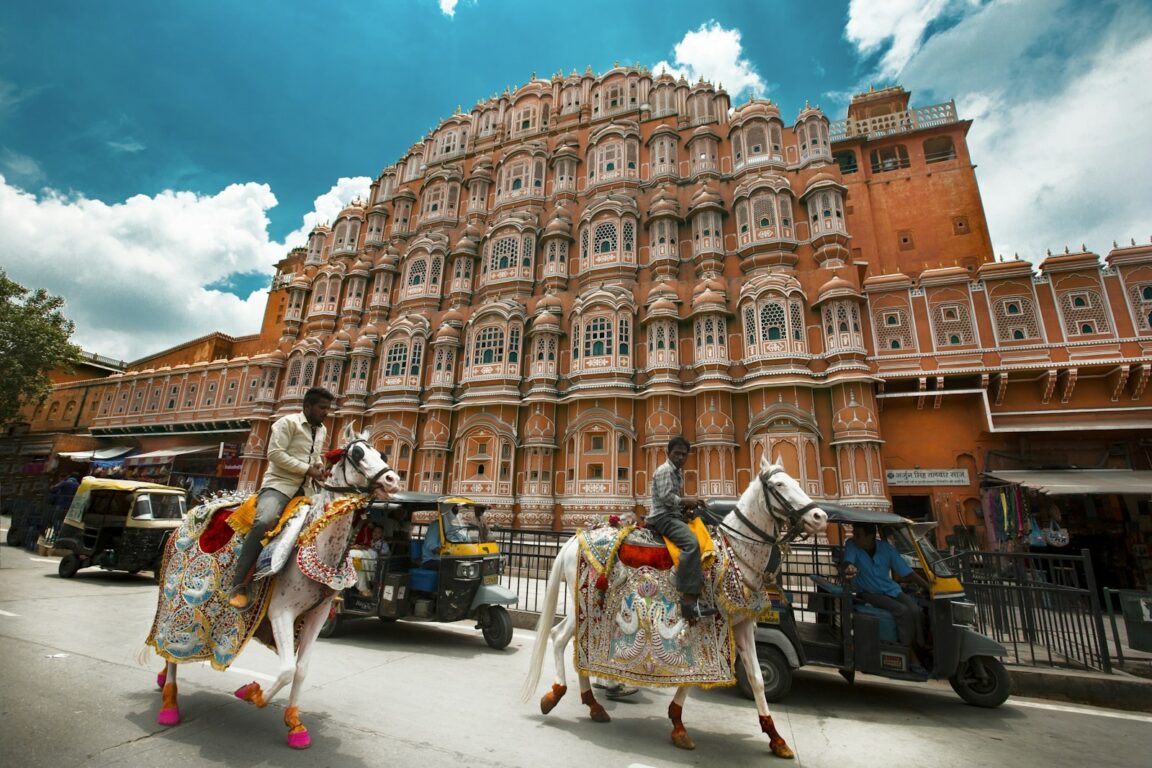
Start at the Hawa Mahal frontage at Badi Chaupar as the light fades, because the palace facade is the old city’s visual anchor and photographs best in the last blue minutes before full dark. The Hawa Mahal, built in 1799 with 953 small windows, faces directly onto the junction where Johari Bazaar begins, so the route assembles itself. Walk Johari Bazaar first, slowly, for the jewellery displays and the densest lighting. Cross to Bapu Bazaar for textiles, mojari shoes and the broader market energy. Continue through Tripolia Bazaar, the brassware and lac bangle market beside the City Palace, and finish toward Kishanpole if energy remains. The full circuit is roughly 2 kilometres of market streets and takes 3 to 4 hours at festival pace with stops.
Build in two elevated pauses. Rooftop cafes opposite the Hawa Mahal sell the classic view of the lit facade with the bazaar below, and they fill early on the main nights, so arrive before sunset or accept the street level view, which is hardly a hardship. The second pause is the Albert Hall, south of the walled city, whose floodlit Indo Saracenic facade is one of the most photographed Diwali sights in Jaipur and sits in the Ram Niwas Garden away from the densest lanes. Readers pairing the festival with India’s wider food cities can extend the trip with our Mumbai food guide, which covers the Irani cafe and street stall circuit in the same street first spirit.
Where should visitors base, and when should they book?
Base for walking, not for resort facilities. Diwali week in Jaipur in October 2027 is an evening festival in one district, so the right address is inside the walled city in a heritage haveli hotel, or just outside its gates in the Bani Park and MI Road areas, which keep the old city within a short ride while offering larger, quieter rooms. Staying far south near the airport or in the new suburbs converts every evening into a traffic negotiation at exactly the hours when the walled city restricts vehicles and the crowds peak. Heritage properties inside the walls are the first to sell out, and Diwali is one of the busiest weeks of the Jaipur year, so the booking rule is simple: reserve as soon as the trip is decided, on a cancellable rate if plans are fluid, and treat a good walled city address in festival week as the trip’s main purchase.
Costs follow that demand. Rooms across all categories price up for the Diwali window, restaurants and cafes near the bazaars run festival crowds without festival menus, and the bazaars themselves are ordinary market priced, which is part of the pleasure: the lighting is free, the walking is free, and spending goes on shopping, sweets and rooftop teas rather than tickets. Carry cash in small notes for market purchases, expect card machines to be busy rather than absent, and buy mithai, the festival sweets, from the famous old city sweet houses early in the day before the evening queues form. Festival travel at this scale rewards the same discipline as any great civic celebration, a point our Up Helly Aa festival guide makes for Shetland’s fire festival from the opposite climate.
How should the main night itself be handled?
Go early, pick one anchor, and let the city come past. On Friday, October 29, the Lakshmi Puja window in Jaipur runs approximately 6.44 p.m. to 7.07 p.m. IST, when homes and shops perform the worship of Lakshmi, the goddess of wealth, and the evening then opens into fireworks across the city. Be in position before that window: either on the Johari Bazaar route with a rooftop seat already claimed, or at Nahargarh Fort above the city, where the panorama of the whole lit grid, the fort walls and the fireworks is the definitive Jaipur Diwali image. Nahargarh requires a car or taxi up the hill road and an early arrival, because half the city has the same idea by 7 p.m.
Ground rules for the streets: dress modestly and for walking, keep valuables zipped and forward, agree taxi and auto rickshaw fares before moving or insist on the meter, and expect pedestrian only stretches and diversions inside the walls on the peak evenings. Firecrackers are part of the soundscape at street level, which families with small children and anyone sensitive to smoke should plan around by favouring rooftops and the fort over the densest bazaar junctions after 9 p.m. None of this diminishes the festival. It is simply a working city’s biggest night, and it rewards visitors who move with its grain.
Frequently Asked Questions
When is Diwali in Jaipur in 2027?
The main Diwali night is Friday, October 29, 2027. The festival window opens with Dhanteras on Wednesday, October 27 and continues through Govardhan Puja on Saturday, October 30, with the bazaar illumination at its peak on the evenings of October 27, 28 and 29.
Which bazaar has the best Diwali lighting?
Johari Bazaar is the traditional leader, with the jewellers’ gold toned displays along a full market street, but the honest answer is the circuit: Johari, Bapu, Tripolia and Kishanpole bazaars compete against each other, and walking all four is the experience Jaipur is famous for.
Where is the best viewpoint for the whole lit city?
Nahargarh Fort, on the ridge above Jaipur, gives the full panorama of the illuminated walled city grid and the fireworks. Inside the old city, the rooftops opposite the Hawa Mahal give the best facade level view. Arrive before sunset on the main nights for either.
How far ahead should hotels be booked for Diwali week?
As early as possible. Diwali is one of Jaipur’s busiest weeks, heritage hotels inside the walled city sell out first, and festival week rates rise across the city. Book a cancellable rate months ahead if the trip is likely, rather than waiting for prices to settle. They do not settle.
Is there a ticket or entry fee for the bazaar lighting?
No. The illumination competition is a street display across public market streets and heritage facades. There is nothing to book and no gate. Costs are the ordinary costs of being in the city: transport, food, shopping and any rooftop cafe seat.
Featured image: The Hawa Mahal in Jaipur, its pink sandstone facade of tiered windows above the bazaar street, with decorated horses passing in front. Photo via Unsplash (photo 1477587458883-47145ed94245), Unsplash License, used with credit.