 Elena Vasquez
Seville’s Feria de Abril is open to everyone and private at the same time, and understanding that split is the whole visit: the fairground streets, the horse parade, the funfair and a set of public casetas belong to any visitor who walks in, while most of the thousand plus striped casetas are private tents entered by invitation only. The next edition runs from Tuesday, April 13 to Sunday, April 18, 2027, opening with the alumbrao, the lighting of the great gate, at midnight on Monday, April 12, two weeks after a Semana Santa that falls early, from March 21 to 28, 2027. Base in or beside Los Remedios or across the river in Triana or the old town, book rooms early, go at midday for the horses and again at night for the dancing, and never assume an open caseta doorway means an open invitation. The caseta rules, the daily rhythm and the booking order are settled below.
Quick Facts
- Festival: Feria de Abril, the April Fair, Seville, Andalusia, Spain
- Next dates: Tuesday, April 13 to Sunday, April 18, 2027, confirmed by Seville City Council and checked on November 20, 2026
- Opening moment: The alumbrao at midnight on Monday, April 12, 2027, after the traditional pescaito dinner of fried fish in the casetas
- Local holiday: Wednesday, April 14, 2027, Feria Wednesday, is a local holiday in Seville
- Fairground: The Real de la Feria, in Los Remedios, across the Guadalquivir from the old town, a temporary grid of streets named for bullfighters
- Scale: More than 1,000 casetas, plus the Calle del Infierno funfair and the daily paseo de caballos horse parade
- Caseta rule: Most casetas are private and entry is by invitation from a member. District and municipal casetas are public and open to all
- Entry cost: The fairground itself is free to enter. Food, drink and funfair rides are paid as consumed
- Closing moment: Fireworks over the Guadalquivir at midnight on Sunday, April 18, 2027
When is the Feria de Abril in 2027, and why does it move?
The Feria has no fixed calendar date because it is chained to Easter. The fair traditionally begins two weeks after Easter Sunday, so when Semana Santa comes early, the Feria lands in mid April, and when Easter is late, the fair can slide toward May. In 2027 Easter Sunday falls on March 28, with Semana Santa running from March 21 to 28, which places the Feria from Tuesday, April 13 to Sunday, April 18, 2027, dates confirmed by Seville City Council and published by the city’s official tourism channels, including Visita Sevilla, the city tourism site. The week opens before it opens: on the evening of Monday, April 12, caseta members sit down to the cena del pescaito, the fried fish dinner, and at midnight the alumbrao switches on the Portada, the vast illuminated fairground gate, rebuilt to a new design every year, and the thousands of lanterns along the fairground streets.
That two festival spring is the defining feature of Seville’s calendar. Semana Santa is solemn, processional and centred on the old town’s churches. The Feria, a fortnight later, is its deliberate opposite, a week of dancing, horses, sherry and noise in a temporary city built for the purpose. Visitors who can only choose one should choose by temperament. Visitors planning the Feria should understand that the city treats the pair as one season, which is why hotels price the whole period, not just the fair week, at the top of the year. The reference calendar at Andalucia.com’s Feria page tracks the council confirmed dates for each edition and is the practical cross check before flights are booked.
Public or private: how do the casetas actually work?
A caseta is a striped canvas tent with a bar, a kitchen hatch, tables and a small dance floor, and there are more than a thousand of them in rows across the Real. Most belong to families, groups of friends, companies, brotherhoods and associations whose members pay annual fees for the plot, the build and the week’s staffing. Entry to those casetas is by invitation, full stop. The doorway stands open because the tent needs air and the music needs an audience, not because the public is expected inside, and walking into a private caseta uninvited is the one reliable way to get a Feria visit wrong. Members and their guests eat, drink manzanilla sherry and its lemonade mix, rebujito, and dance sevillanas inside, in shifts that run from lunch until the small hours.
The public alternative is real and generous. The city and its districts maintain public casetas, larger tents open to everyone without invitation, serving the same food and drink at prices the city sets, with the same dancing. Trade unions, political parties and some associations also open their casetas to the public. The practical strategy for a visitor without a Seville host is to build the week on the public casetas, the fairground streets and the funfair, and to accept any private invitation that arrives through a hotel concierge, a tour contact or a new acquaintance as a bonus rather than a plan. A visitor who does receive an invitation should arrive when invited, bring appetite rather than gifts, and learn the first figure of the sevillanas quickly, because participation is the thank you.
What does a Feria day actually look like?
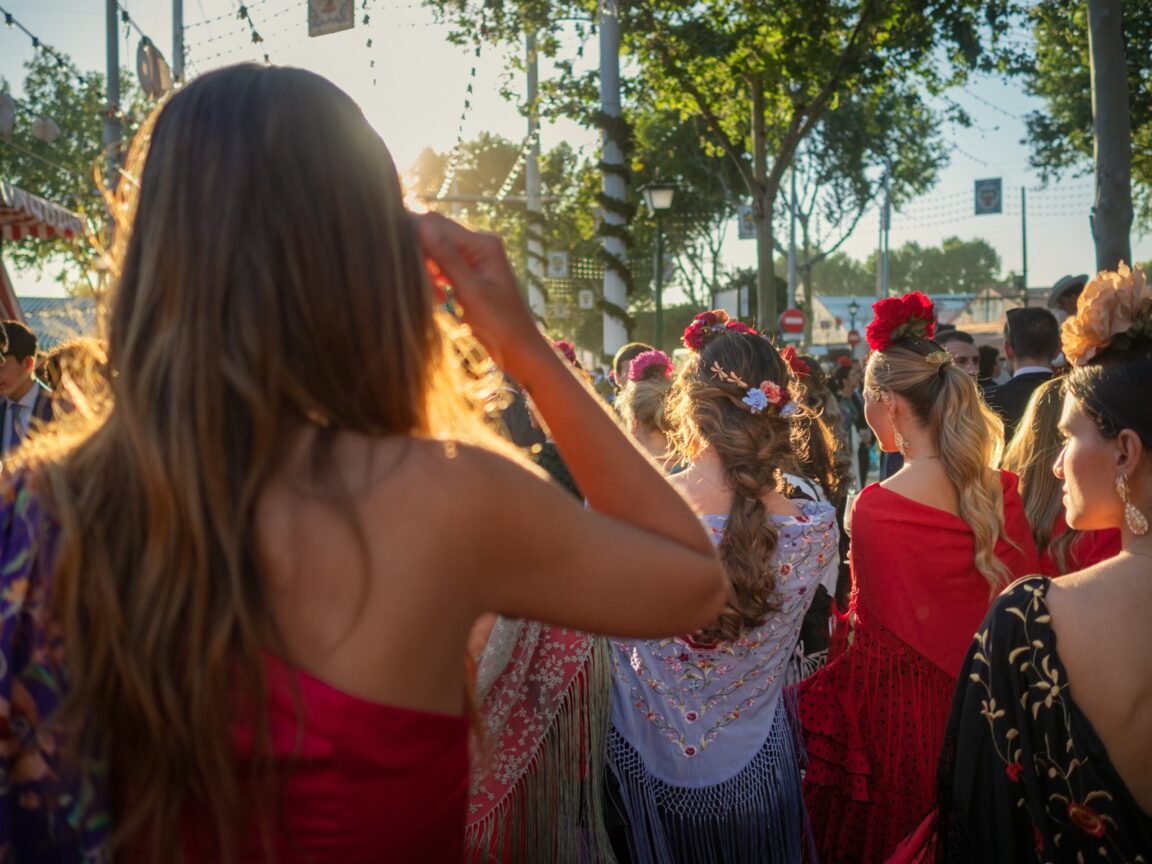
The day has two peaks and a valley. From around midday the paseo de caballos fills the fairground streets: riders in traje corto, short jackets and riding boots, carriages with bells and plaited manes, and women in traje de flamenca, the ruffled Feria dress that changes with fashion every year. Horses have the streets until the evening, traditionally 8 p.m., after which they leave the Real and the night session builds. Lunch inside the casetas is long and serious, the afternoon thins in the heat, and from about 9 p.m. the fairground reaches full density, dancing in every tent, queues at the public casetas and the Calle del Infierno funfair lit and loud until late. On the biggest nights the fair runs to 6 a.m., and the following day simply starts later.
Dress is part of the machinery. The traje de flamenca is not a costume but the city’s formal wear for the week, bought, altered and debated months ahead, and visitors in ordinary summer clothes are welcome but visibly underdressed by Feria standards. The useful compromise is smart, cool clothing and shoes that can survive albero, the yellow sand that surfaces the fairground streets and dusts everything. Rental of a flamenca dress in Seville is a real trade in Feria season for visitors who want to join the look, and it should be arranged weeks ahead, like everything else in this week. Readers extending an Andalusia trip beyond the fair can pair this guide with our Alhambra visiting guide for Granada, where the same book early discipline applies to a very different monument.
Where should visitors base, and what should be booked first?
Base for the walk home. The Real sits in Los Remedios, on the west bank of the Guadalquivir, so the shortest nights belong to hotels in Los Remedios itself and in Triana, just across the bridges, with the old town and Santa Cruz a longer but beautiful walk or a short taxi ride beyond them. During Feria week the city runs special bus services and the metro extends its hours, and taxis queue at set ranks at the fairground edges, but at the 3 a.m. peak every system is stretched, which is why the walkable address wins. Book rooms as early as possible, because Feria week is, with Semana Santa, the highest demand period of the Seville year, and expect minimum stays and prepayment terms that do not appear in quieter months.
The booking order after the room is short because the Feria itself needs no tickets. Reserve one good lunch or dinner in the old town for the arrival or departure day, when a seated restaurant meal feels like a luxury. Arrange any dress rental and any sevillanas class, both of which exist for visitors in the pre Feria weeks, well ahead. Then leave the fairground days unscripted. The Feria punishes itineraries and rewards presence: arrive at midday for the horses at least twice, stay for one full night session, watch the alumbrao from the Portada crowd on the Monday if the dates allow, and be on a bridge over the Guadalquivir for the closing fireworks at midnight on Sunday, April 18. The same public festival logic, free ground, private tents, one great illuminated gate, has a northern cousin in the festival calendar covered by our San Sebastian pintxos guide for travellers eating their way across Spain in the same trip.
Frequently Asked Questions
When is the Feria de Abril in 2027?
From Tuesday, April 13 to Sunday, April 18, 2027, confirmed by Seville City Council. The alumbrao opening is at midnight on Monday, April 12, after the pescaito dinner, Wednesday, April 14 is a local holiday in Seville, and closing fireworks end the fair at midnight on Sunday, April 18.
Can visitors enter the casetas?
Only the public ones freely. Most of the thousand plus casetas are private, run by families, firms and associations, and entry is by invitation from a member. The district and municipal public casetas are open to everyone, serve the same food and drink at city set prices, and are where visitors should base their Feria.
Does it cost anything to enter the Feria?
No. Entry to the Real de la Feria fairground is free, including the streets, the horse parade and the atmosphere. Visitors pay for what they eat and drink in the public casetas, for funfair rides in the Calle del Infierno, and for transport.
What should a visitor wear?
Smart, cool clothes and shoes that can handle the albero sand of the fairground streets. Sevillanas wear the traje de flamenca and many men wear a jacket or the traje corto, so ordinary tourist shorts stand out. Dress rental is available in Seville in Feria season if booked ahead.
Where is the best place to stay for the Feria?
Los Remedios, the fairground’s own district, and Triana, across the bridges, give the shortest walks home. The old town is a longer walk or a taxi ride. Book months ahead, because Feria week and Semana Santa are Seville’s highest demand weeks of the year.
Featured image: Women in Feria dress, embroidered shawls and flowers in their hair, in late light on the fairground streets of the Feria de Abril in Seville. Photo by Manu Trillo for Contursa, from Visita Sevilla, the city’s official tourism website (visitasevilla.es), used with credit. Native 1500px wide, upscaled to exactly 1600px.