 Wei Chen
Sukhothai celebrates Loy Krathong where Thai tradition says the festival began: inside Sukhothai Historical Park, among the floodlit ruins of the first Siamese capital, with krathongs floated on the ancient ponds in front of Wat Mahathat. The 2026 festival runs for ten nights, 15 to 24 November 2026, ending on Loy Krathong night itself, Tuesday 24 November, the full moon of the twelfth lunar month. Its ticketed centrepiece is the light and sound show at Wat Mahathat, nightly at 7pm with seats at 500, 900 and 1,200 baht, booked through the organiser’s Line account. Base in the Old City beside the park, float a krathong made of banana leaf and flowers, and give the festival at least two nights: one for the show, one for the ponds.
Quick Facts
- Where: Sukhothai Historical Park, Mueang Kao, the Old City, about 12 km west of modern Sukhothai town, Thailand.
- When: 15 to 24 November 2026. Loy Krathong night, the full moon finale, is Tuesday 24 November 2026.
- The centrepiece: The light and sound show at Wat Mahathat, nightly at 7pm, with an extra show at 8.30pm on 24 November.
- Show tickets: 500, 900 and 1,200 baht, limited seating, sold via Line ID @ST2026 or by phone on 06-1242-8555, per the official Thailand.go.th event listing.
- The ritual: Float a krathong, a small banana leaf float with flowers, a candle and incense, on the park’s ponds to thank the water goddess and let go of the year’s bad luck.
- Getting there: No railway station in Sukhothai. Trains on the Northern Line stop at Phitsanulok, then a bus of about an hour. Bangkok Airways flies to Sukhothai’s own airport.
- Park basics: The historical park is a UNESCO World Heritage Site, inscribed in 1991, and its zones are ticketed separately at the gates. Take cash.
Why is Sukhothai the home of Loy Krathong?
Because the festival’s founding stories are set here. Loy Krathong falls on the full moon night of the twelfth month of the Thai lunar calendar, when people across Thailand float krathongs to honour Phra Mae Khongkha, the goddess of water, and to release sorrow and bad luck with the current. Sukhothai’s claim is written into its stones: the Ramkhamhaeng Inscription, from the kingdom that ruled here in the thirteenth century, mentions candle lighting and fire festivities, and the legend of Nang Noppamas, a court lady said to have made the first lotus shaped krathong for King Phra Ruang, places the invention at this court. The modern provincial festival, whose full name translates as Loy Krathong, Burning Candles and Playing with Fire, is staged by the province inside the historical park, with the Fine Arts Department, which manages the park, confirming the 2026 dates of 15 to 24 November. The result is a festival where the setting is not a backdrop but the subject: lotus bud chedis, standing columns and great Buddha images, lit at night and doubled in black pond water. Full programme details are published on the festival’s official site at sukhothailoykrathong.com.
What happens across the ten nights?
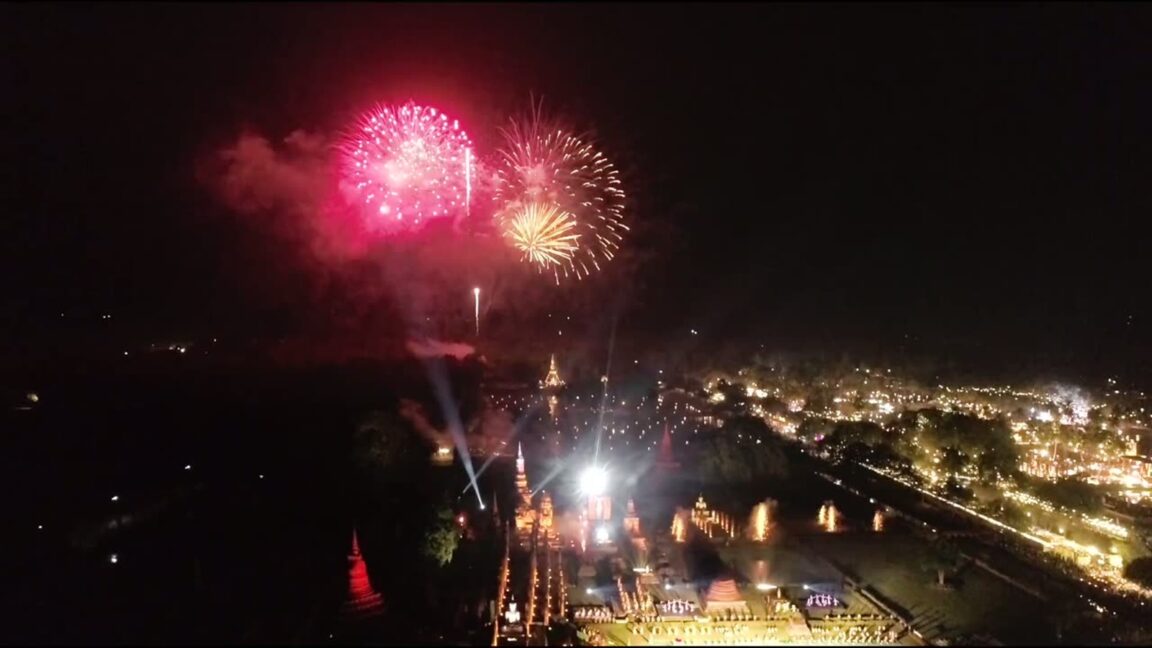
The festival opens on 15 November with a ceremony in front of Wat Sa Si at 4pm, followed by processions of large and small krathongs, hanging lanterns and the Nang Noppamas figure through the park. Every evening then follows a rhythm. The Talat Laek Bia, the Cowrie Shell Market near Yai Phoeng Pond, opens from 4pm, a period market where food and crafts are traded in the old style. The light and sound show plays at Wat Mahathat at 7pm, a staged retelling of the Sukhothai kingdom with a war elephant procession, performed against the illuminated monuments and their reflections, which the official Thailand.go.th listing calls the festival’s main highlight. Fireworks close most nights at about 10pm. Early risers get their own ceremony: Welcome the Dawn of Happiness at Wat Traphang Thong, at 5am on 15 November and 6am on the following mornings, a quiet merit making start that shows the festival’s devotional side. On the final day, 24 November, the programme peaks with district processions from 4pm, the candle lighting ceremony, the Royal Floating Lamp Ceremony on the ponds, a second show at 8.30pm and the closing fireworks at 11.30pm.
How do you take part, and what is the krathong materials rule?
You take part with your hands: buy or make a krathong and float it yourself. The traditional krathong is a slice of banana trunk wrapped in folded banana leaf, decorated with flowers and carrying a candle and three incense sticks. In the historical park, natural materials are the rule that matters. Krathongs sold around the ponds are made from banana leaf, flowers and other plant materials that break down in the water; foam floats, plastic decoration and bread krathongs, which foul the water for the park’s fish, are the wrong choice in a protected monument’s ponds, and park staff steer visitors to the natural versions. Light the candle and incense, make the wish the ritual asks for, gratitude to the water and a letting go of bad luck, and set the float down gently at the pond edge rather than throwing it. Wat Mahathat’s pond and the pond at Wat Sa Si, where the great Buddha reflects in the water, are the classic places to float. Dress respectfully, because the park is a religious site as well as a festival ground: shoulders and knees covered for the temple areas, and no climbing on the monuments for a better view.
Where do you base, and how do you arrive in the right order?
Base in the Old City, Mueang Kao, the village that wraps the park’s eastern gate, so the festival is a walk or a short cycle from your door and the late finish costs you nothing in transport. Modern Sukhothai town, with more hotels and the bus station, is about 12 km east, a workable base only if you accept a ride home after the fireworks each night. The arrival order runs through Phitsanulok for most travellers. Sukhothai has no railway station: State Railway of Thailand trains on the Northern Line from Bangkok’s Krung Thep Aphiwat Central Terminal stop at Phitsanulok, from where buses run on to Sukhothai in about an hour. Direct buses from Bangkok and Chiang Mai serve Sukhothai town, and Bangkok Airways flies into Sukhothai’s small airport. However you arrive, do the park once in daylight before your first festival night: the central zone opens from 6.30am, and an hour among the ruins in the morning makes the floodlit version at night legible. The park’s zones are ticketed separately, central, north for Wat Si Chum and west for the Aranyik temples, with different hours by zone, so carry cash and keep each zone ticket for the day. If your Thailand trip pairs the festival with the capital, our first time in Bangkok itinerary and our guide to Capella Bangkok cover the Bangkok end of the journey.
How do you pace the festival itself?
Two nights is the honest minimum, three is better. Give the first night to the market, the ponds and the light and sound show, booked ahead, because seats are limited and the final nights sell first. Give the second night to floating your own krathong slowly, temple by temple, ending at Wat Sa Si. If you can be there for 24 November itself, expect the fullest programme and the biggest crowds, and book rooms and show seats as early as they can be booked; if you prefer the festival with air around it, the middle nights, 17 to 20 November, carry the same nightly show and market with a fraction of the finale’s pressure. One Saturday in the park has a bonus outside festival season too: the central zone stays open until 9pm with the monuments lit, the weekly rehearsal, in effect, for what Loy Krathong does for ten nights straight.
Frequently Asked Questions
When is Loy Krathong in Sukhothai in 2026?
The provincial festival runs 15 to 24 November 2026 at Sukhothai Historical Park. Loy Krathong night itself, the full moon of the twelfth lunar month, is Tuesday 24 November 2026, when the programme ends with the candle lighting ceremony, the Royal Floating Lamp Ceremony and late fireworks.
How much are tickets for the light and sound show?
Seats are priced at 500, 900 and 1,200 baht, with limited seating, per the official Thailand.go.th event listing. The show plays nightly at 7pm from 15 to 24 November, with an additional 8.30pm show on 24 November. Book through Line ID @ST2026 or by phone on 06-1242-8555. Floating a krathong and walking the festival grounds are free beyond the park’s own zone tickets.
What is a krathong, and what should it be made of?
A krathong is a small float, traditionally a banana trunk base wrapped in folded banana leaf with flowers, a candle and incense, floated to thank the water goddess and release bad luck. In the historical park, choose natural materials only; the krathongs sold by the ponds are made to that standard, and foam or plastic versions do not belong in the monument ponds.
How do I get to Sukhothai from Bangkok?
There is no railway station in Sukhothai. Take a Northern Line train to Phitsanulok and a bus of about an hour from there, take a direct long distance bus to Sukhothai town, or fly with Bangkok Airways to Sukhothai airport. The historical park and its Old City hotels are about 12 km west of the modern town.
Where should I stay for the festival?
In the Old City, Mueang Kao, beside the park gates, so you can walk back after the fireworks. The Old City is small and its rooms fill for the festival, especially for the final weekend, so book early. Modern Sukhothai town, 12 km east, has more choice but adds a nightly ride.
Is the historical park open at night outside the festival?
The central zone normally opens from 6.30am to 7.30pm, and on Saturdays it stays open until 9pm with the monuments floodlit. During Loy Krathong the festival programme runs later, with fireworks at about 10pm on most nights and 11.30pm on the final night.
Featured image: Fireworks over the illuminated ruins and ponds of Sukhothai Historical Park during the Loy Krathong festival finale, aerial still from the festival’s official film. Photo: Sukhothai Loy Krathong Festival, via sukhothailoykrathong.com, used with credit.