 Elena Vasquez
Setenil de las Bodegas is a white village in the province of Cadiz where the houses are not built against the rock but under it: along Calle Cuevas del Sol and Calle Cuevas de la Sombra, the gorge wall of the Rio Trejo forms the roof, and front doors, bars and shops sit in the shade of a single overhanging cliff. The visit orders itself: walk the two cave streets first, one sunny and one in permanent shadow, climb to the castle keep and the Mirador del Carmen second, and eat late under the rock. Park outside the gorge, because the cave streets cannot take cars, and pair the village with Ronda, about 20 minutes away by road, for one of the easiest double header days in Andalusia.
Quick Facts
- Where: Setenil de las Bodegas, province of Cadiz, Andalusia, Spain, a village of about 2,600 people in the gorge of the Rio Trejo (the Guadalporcun river)
- Status: The old town is a declared Conjunto Historico, a protected historic ensemble, recognised in 1985
- Signature streets: Calle Cuevas del Sol, sunny, lined with bars and terraces under the rock; Calle Cuevas de la Sombra, where the rock closes overhead into a natural tunnel
- Upper town: The Torre del Homenaje (castle keep), the Arab cistern, the Iglesia de Nuestra Senora de la Encarnacion and the Mirador del Carmen viewpoint
- Time needed: One hour covers the two cave streets; three hours adds the keep, the viewpoints and lunch
- Getting there: About 20 minutes by car from Ronda; about 96 kilometres and roughly 1 hour 20 minutes from Malaga; no practical train service to the village itself
- Parking: On the edge of the village only, free street parking in the upper town around Calle San Sebastian and paid parking at Los Canos by the Olvera exit
- Official source: Turismo de Setenil, the municipal tourism office site at turismodesetenil.com; facts checked November 21, 2026
What makes Setenil different from every other pueblo blanco?
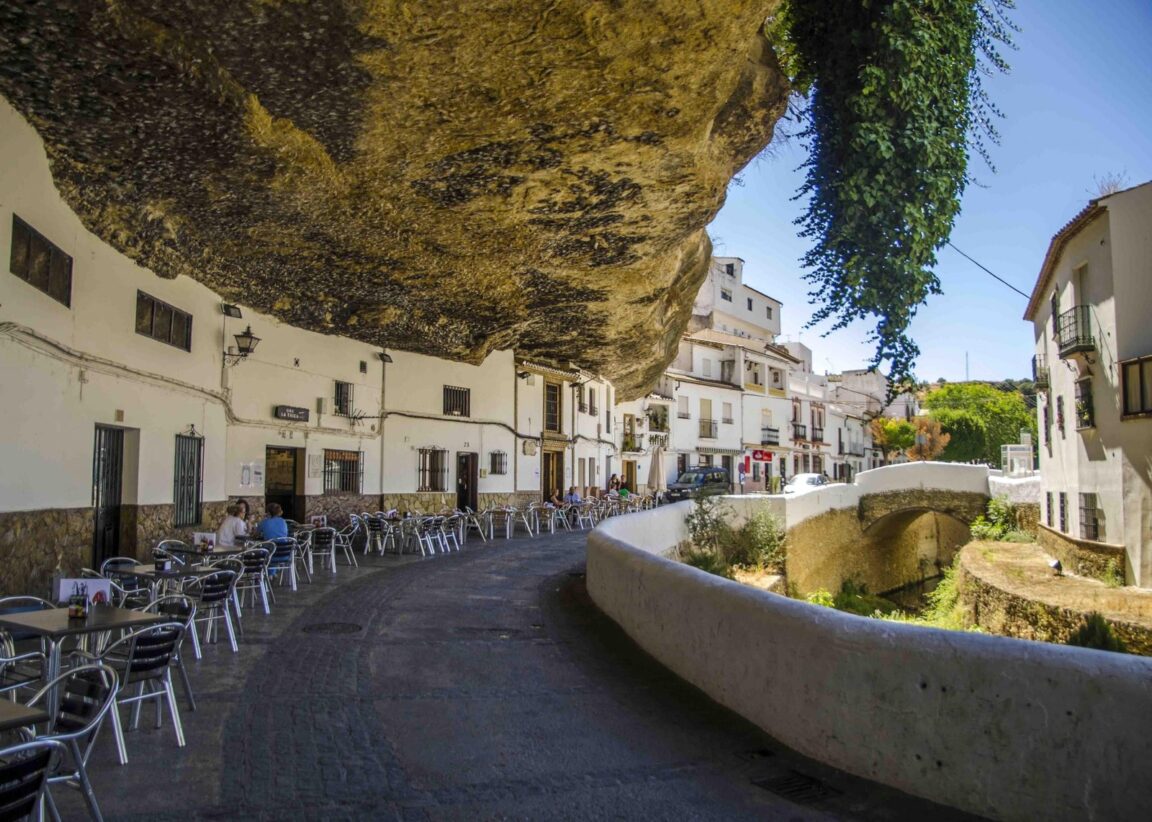
Most white villages in Andalusia are built on rock. Setenil is built into it, and the distinction is physical, not poetic. The river cut a gorge through the stone, erosion hollowed the base of its walls, and the village grew into the shelters that left behind: houses whose back walls are the cliff itself and whose roofs, on the famous streets, are the overhang. These are not caves dug by hand in the manner of a troglodyte settlement elsewhere; they are ordinary village houses that use the gorge as architecture, which is why the streets feel domestic rather than primitive, with bar terraces, shopfronts and washing lines all sitting under several metres of stone. The official Turismo de Setenil guide to what to visit builds its whole route, the Ruta de las Calles Cueva, around that single idea, linking the cave streets into one walk.
The name carries the history in compressed form. Local tradition derives Setenil from the Latin septem nihil, seven times nothing, for the seven sieges the Christian forces needed before the stronghold fell in the late fifteenth century; the de las Bodegas half refers to the wine cellars, bodegas, that once anchored the local economy. The fortress above the gorge was a Nasrid stronghold, and unusually, the medieval street pattern inside its walls survives, which is a large part of why the old town holds its protected status. Travellers building a wider Andalusian loop can set Setenil against the region’s bigger set pieces, the Alhambra palace city covered in our Alhambra tickets and visiting guide and the Picasso museums and Alcazaba of the coast in our two days in Malaga guide, and find that Setenil is the stop people describe first when they get home.
Cuevas del Sol or Cuevas de la Sombra: which street first?
Start with Cuevas del Sol, the street of the caves of the sun. It runs along the side of the gorge that catches the light, and it is the village’s living room: the rock hangs over the houses on one side, the river runs along the other, and the ground floors are given over to bars, restaurants and shops whose terraces sit in the open air while their back rooms sit under the cliff. It is the liveliest street in Setenil and the one from every postcard, and walking it first, ideally in the morning before the day trip groups arrive, gives the clearest read of how the village works.
Cross the river and the temperature drops. Calle Cuevas de la Sombra, the street of the caves of the shadow, is where the rock does not merely overhang but closes overhead completely, forming a natural tunnel of stone with houses and bars beneath it. Almost no direct sun reaches it, which made it practical storage and living space long before it made it a sight. The two streets take about an hour together at a wandering pace, and the smaller cave streets repay the extra half hour: Herreria, with its steep slope and the corner plaque that invites a kiss; Calcetas and Calanas, climbing away from the river; Jaboneria and Cabrerizas, quieter and more residential, where the under rock houses are homes first and scenery second. That residential quality is the thing to respect: these are people’s front doors, and the village asks, reasonably, that visitors treat the streets as a neighbourhood rather than a film set.
What is there above the gorge?
A compact upper town that most photo stop visitors never reach. The Torre del Homenaje, the keep of the old Nasrid fortress, stands at the top of the village with its Arab cistern beside it; the fortress once carried some 530 metres of wall and around 40 towers, and the keep is the surviving vertical statement of it. A small entry fee applies to the keep, and the tourism office in Calle Villa, housed in the old town hall that was itself a gate tower of the fortress, is the place to confirm current opening hours, which vary by season. Next to the fortress story sits the Casa de la Damita, the small museum named for its star object, a stone venus figure dated to around 5,000 years ago, evidence that the caves of Setenil were lived in long before they were a village.
The Iglesia de Nuestra Senora de la Encarnacion, the parish church built over the site of the old mosque, anchors the upper streets, and the viewpoints repay the climb on their own terms. The Mirador del Carmen, reached by steps from above Cuevas del Sol by the chapel of the Virgen del Carmen, looks down the gorge over the cave street rooftops; the viewpoint at Lizon, at the foot of the keep, reads the whole village in one frame, white houses, gorge, river and olive country beyond. Allow the upper town a full hour. The pattern that works is cave streets in the cool of the morning, the climb and the keep before lunch, then a long table back down under the rock on Cuevas del Sol, where the local table runs to cured meats, cheeses and olive oil from the Sierra de Cadiz, and the village’s own signature soup, sopas cortijeras, made with bread, olive oil, asparagus and a poached egg.
Where do you park, and how does the Ronda pairing work?
You do not park in the gorge. The cave streets are narrow, partly one way and effectively closed to visitor traffic in any practical sense, and every sensible route leaves the car on the edge and walks in, with nothing in the village more than 10 to 15 minutes on foot from the car parks. The working options are free street parking in the upper town around Calle San Sebastian, from which steps drop toward the centre; paid parking at Los Canos, at the bottom of the village on the road out toward Olvera, which sits on the far side of town from the Ronda approach and catches out drivers who expect it by the caves; and the esplanade parking used by tour buses near the entrance, the flattest walk in. Passengers with limited mobility can be dropped at the entrance to Calle Cuevas del Sol itself, which saves the walk in. At weekends and on holidays the edge car parks fill, so the pairing order matters.
That order is Setenil in the morning, Ronda in the afternoon. The two are about 20 kilometres apart, roughly 20 minutes by car, and they complement rather than repeat each other: Setenil is small, strange and best early, while Ronda, with its gorge bridge, bullring and old town, carries a full afternoon easily and has the restaurants for the evening. Drivers coming from further away should budget about 1 hour 20 minutes from Malaga and up to two hours from Seville, and treat Setenil as a road trip, since buses are limited and the railway station named Setenil sits kilometres from the village on a line with restricted service. An evening in Seville at the end of such a loop pairs naturally with the tablao scene covered in our flamenco in Seville guide.
Frequently Asked Questions
How long do you need in Setenil de las Bodegas?
One hour covers the two famous cave streets, Cuevas del Sol and Cuevas de la Sombra. Three hours is the better allowance: it adds the castle keep and cistern, the Mirador del Carmen viewpoint and a relaxed lunch under the rock. Setenil also works as a half day paired with Ronda, about 20 minutes away by car.
Do you have to pay to see the cave streets?
No. The cave streets are public village streets and free to walk at any hour. The chargeable sight is the castle keep, the Torre del Homenaje, which has a small entry fee; the municipal tourism office in Calle Villa confirms current prices and opening hours, which change with the season.
Where is the best place to park in Setenil?
Outside the gorge, always. Free street parking sits in the upper town around Calle San Sebastian, paid parking at Los Canos by the Olvera exit, and there is esplanade parking near the village entrance with the flattest walk in. Every option leaves a 10 to 15 minute walk to the cave streets, and the car parks fill at weekends, so arrive early.
Can you visit Setenil without a car?
With difficulty. Buses are very limited, mainly weekday services, and the railway station called Setenil is several kilometres from the village. Most visitors drive, or join one of the day tours from Malaga, Seville or Ronda that combine Setenil with Ronda and other white villages. Ronda, 20 minutes away, is the nearest practical railhead.
What should you eat in Setenil?
Eat under the rock on Calle Cuevas del Sol, where the bars serve tapas of local cured meats, cheese and olive oil from the Sierra de Cadiz. The village dish is sopas cortijeras, a soup of bread, olive oil, asparagus and poached egg. Terraces fill at lunchtime, especially at weekends, so sit down before 1pm or after 3.30pm.
When is the best time of year to visit Setenil?
Spring and autumn give the best combination of mild gorge weather and manageable crowds, with March to May and October to November the comfortable windows. Summer afternoons are hot in the upper town, though the shaded cave streets stay cool. The village feria falls in August and Semana Santa is a major local festival, both busy and atmospheric.
Featured image: Calle Cuevas del Sol in Setenil de las Bodegas, white houses and cafe terraces sitting under the overhanging gorge rock, with the river bridge at the end of the street. Photo from Turismo de Setenil, the village’s official municipal tourism site (turismodesetenil.com), used with credit.