 James Wolfe
Three days in Valletta work best when the city is treated as a harbour base rather than a checklist. Day one stays inside the walls for the fortress core and the noon gun at the Saluting Battery. Day two crosses the Grand Harbour by ferry to the Three Cities, the older, quieter shore that Valletta was built to face. Day three slows down inside Valletta in the morning and finishes with an evening in Mdina, Malta’s former capital, after the day groups have gone. This itinerary sequences those three days in that order, with the transport, timing and booking details that make each one run cleanly.
Quick Facts
Base: Valletta, Malta’s capital, a fortified peninsula city between Grand Harbour and Marsamxett Harbour, founded by the Knights of St John from 1566.
Day 1: City Gate, Republic Street, St John’s Co-Cathedral, the Grandmaster’s Palace and the Upper Barrakka Gardens for the Saluting Battery.
Saluting Battery: Fires at 12:00 and 16:00, Monday to Saturday, below the Upper Barrakka Gardens. Entry to the battery itself is 3 euros for adults and 1 euro for ages 5 to 15; watching from the gardens above is free.
Day 2: Barrakka Lift down to Lascaris Wharf, then the harbour ferry to Cospicua for Birgu (Vittoriosa), Senglea (Isla) and Fort St Angelo. Ferries run about every 30 minutes; a ferry ticket includes same-day use of the Barrakka Lift.
Day 3: A slow Valletta morning, then a direct bus from Valletta terminus to Rabat for an evening in Mdina, returning after dinner.
Getting around: Valletta is walked. Buses run from the terminus outside City Gate, and the harbour ferries and the Barrakka Lift handle the Grand Harbour crossing.
Facts checked: 21 November 2026, against Visit Malta, the Saluting Battery operator’s published times and Malta Public Transport ferry information.
How should day one inside Valletta’s walls be sequenced?
Start at City Gate and walk straight down Republic Street, the city’s main spine, while the streets are still quiet. Valletta is a grid on a ridge, so almost everything on day one sits within a few streets of that line. The overview of how the fortress capital fits together in our Valletta destination guide is worth reading before this day, because the itinerary assumes the layout and spends its time on order and timing instead.
The morning belongs to St John’s Co-Cathedral. From the outside it is a plain fortress church; inside it is one of the great Baroque interiors of Europe, with a painted vaulted ceiling, inlaid marble tombstones covering the floor and, in the oratory, Caravaggio’s Beheading of St John the Baptist. Go early in the day, because the cathedral is a working church with sightseeing hours fitted around services, and the queue builds once the harbour cruise passengers arrive. Dress codes for a place of worship apply, and the visit rewards an unhurried hour rather than a twenty-minute circuit.
From the cathedral, continue to the Grandmaster’s Palace on Republic Street, the seat of the Grand Masters of the Order and now the office of the President of Malta, with state rooms and the palace armoury as its visitor draw. Keep the morning loose after that: the side streets falling away on both sides of Republic Street are the real Valletta, steep stepped lanes of limestone facades and closed wooden balconies, and they are best taken without a target.
What time should you reach the Upper Barrakka Gardens?
Aim to be in the Upper Barrakka Gardens by about 11:45. The gardens sit on the bastion at the harbour end of the city and give the defining Valletta view: straight across the Grand Harbour to the Three Cities, with Fort St Angelo below on the Birgu point and the harbour mouth running out to the breakwater. The gardens themselves are free and are the city’s front balcony, the place the whole three-day plan keeps returning to.
Directly below the terrace is the Saluting Battery, the Order’s ceremonial battery, which fires a gun salute at 12:00 and again at 16:00, Monday to Saturday. Watching from the gardens costs nothing. Going down into the battery itself, beside the uniformed gunners, costs 3 euros for adults and 1 euro for children aged 5 to 15, and the operator recommends arriving about 15 minutes before a firing. The report is loud at close range, which matters with small children. There is no firing on Sundays, so a Sunday day one should swap the battery for the 16:00 firing on another day or watch the harbour from the gardens without it.
Use the afternoon for the harbour level. The Barrakka Lift, beside the gardens, drops about 58 metres down the bastion wall to Lascaris Wharf in seconds, which is both a practical shortcut and the link to tomorrow’s ferry. At the bottom, the Valletta waterfront and the cruise port area give the city from below: the bastions you were standing on, read from the water they were built to defend. Ride back up in the lift at the end of the day and finish with the gardens again at sunset, when the light crosses the harbour onto the Three Cities and day two’s destination explains itself.
How does the Three Cities ferry day work?
Day two starts with the same lift. Take the Barrakka Lift down to Lascaris Wharf and walk the short distance to the ferry landing, where harbour ferries cross to Cospicua, the innermost of the Three Cities, about every 30 minutes through the day. The crossing is short, a matter of minutes on the water, and it is the correct way to arrive: the Three Cities were the Order’s first home in Malta, older than Valletta itself, and they read properly from a boat. A valid ferry ticket includes use of the Barrakka Lift on the same day, which closes the loop neatly at the end of the day.
The Three Cities are Birgu, also called Vittoriosa; Senglea, also called Isla; and Cospicua, also called Bormla. Each carries both a Maltese name and a title of honour, which is why maps and ferry signs seem to disagree. Start in Birgu, a short walk from the Cospicua landing. Birgu is the oldest and most atmospheric of the three: the Collachio, the knights’ quarter, is a knot of narrow lanes, and the waterfront runs along the marina to Fort St Angelo, the great fort on the point that held during the Great Siege of 1565 and still anchors the harbour view from Valletta. The Malta Maritime Museum on the Birgu waterfront, in the old naval bakery, covers the island’s seafaring story in the building that fed the fleet.
Give Senglea the middle of the day. Its spine runs out to a point watched over by the vedette, the small carved watchtower at the tip of the gardens, with views back to Valletta that reverse the day one photograph. Senglea is the most residential of the three, and lunch here is a local affair rather than a visitor set piece. Cospicua, the largest and most fortified, is best read on the walk back to the ferry: its double lines of fortifications, the Margherita and Cottonera Lines, explain why this shore was worth defending so heavily. Return on the ferry in the late afternoon, ride the lift up on the same ticket, and the evening is Valletta’s again.
Why save Mdina for the evening of day three?
Because Mdina in the middle of the day and Mdina in the evening are different places. Mdina, the fortified former capital on its hilltop in the middle of the island, receives day groups from late morning. By early evening they have gone, the lanes empty, and the city returns to the quiet that earned it the name the Silent City. An evening visit is not a compromise version of the trip; it is the better version, and it fits day three because the first two days have already covered the harbour.
Spend day three’s morning slowly in Valletta first: the Lower Barrakka Gardens on the other side of the city, the siege bell memorial, and the streets you rushed on day one. Then take a direct bus from Valletta’s terminus, outside City Gate, to Rabat, the town at Mdina’s foot; Mdina’s gate is a short walk from the Rabat stops. Time the arrival for late afternoon. Enter through Mdina Gate, the Baroque main gate, and walk the city as the light drops: St Paul’s Cathedral, on the site where tradition holds that St Paul met the Roman governor Publius after the shipwreck recorded in Acts, the bastion viewpoints over the island’s farmland, and lanes of palazzi that narrow to single file.
Stay for dinner in Mdina or in Rabat below the walls, and return by bus to Valletta afterwards. Two practical notes. First, Mdina’s cathedral and museums keep daytime hours, so an evening visit is about the streets, the walls and the atmosphere; anyone set on the cathedral interior should swap the order and go in the morning instead. Second, check the return bus times before dinner rather than after, because evening frequencies thin out. If a fourth day appears, the natural extension is the ferry from the other side of Valletta to Sliema, or the full day across to the sister island covered in our Gozo guide.
Frequently Asked Questions
Is three days enough for Valletta?
Yes for the city and its harbour. Three days cover Valletta’s interiors, the Three Cities and an Mdina evening without rushing. Malta beyond the harbour, including Gozo, the prehistoric temples and the Blue Lagoon, needs extra days on top.
What time does the Saluting Battery fire, and what does it cost?
The guns fire at 12:00 and 16:00, Monday to Saturday. Watching from the Upper Barrakka Gardens above is free. Entering the battery itself costs 3 euros for adults and 1 euro for ages 5 to 15, and arriving about 15 minutes early is recommended.
How do you get from Valletta to the Three Cities?
Take the Barrakka Lift from the Upper Barrakka Gardens down to Lascaris Wharf, then the harbour ferry to Cospicua, which runs about every 30 minutes. Birgu and Senglea are walkable from the Cospicua landing, and a ferry ticket includes same-day use of the lift.
Why visit Mdina in the evening?
The day groups leave by late afternoon, and the fortified city becomes quiet, which is when its lanes and bastion views are at their best. The trade-off is that the cathedral and museums keep daytime hours, so an evening visit is about the city itself rather than its interiors.
Do you need a car for this itinerary?
No. Valletta is walked, the Three Cities are reached by ferry and lift, and Mdina is served by direct buses from Valletta terminus to Rabat. A car adds parking problems in all three places without saving meaningful time.
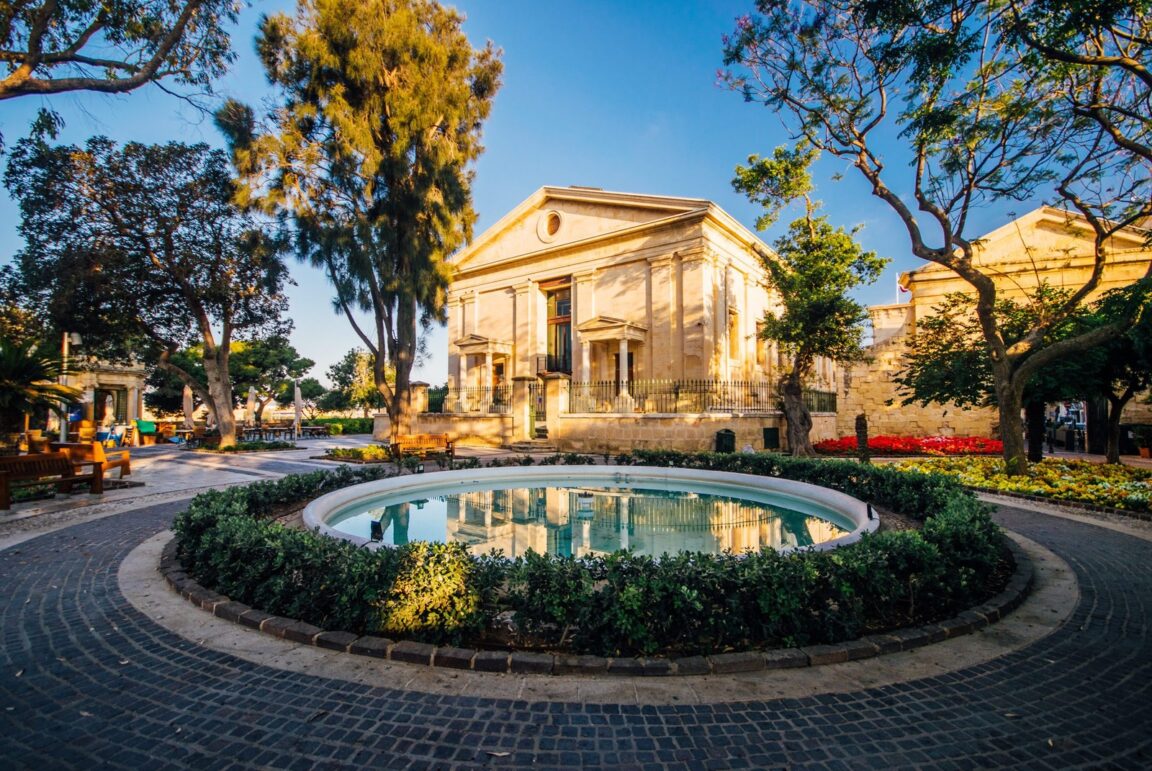
Featured image: The Upper Barrakka Gardens, Valletta, looking across the garden fountain to the Malta Stock Exchange building. Photo by Visit Malta, Malta’s official tourism authority (visitmalta.com), used with credit.