 Jordan Ellis
Sleeping Bear Dunes works best planned as two small bases with different jobs: Empire, at the south end, holds the Philip A. Hart Visitor Center and the park pass desks, while Glen Arbor, to the north, sits closest to the Dune Climb and the Pierce Stocking Scenic Drive. One pass covers everything, $25 per private vehicle for seven days, bought by card only. Two facts shape every itinerary right now: the scenic drive takes vehicles only from about late May to late October, and the Manitou Island ferry is not running in 2026 at all, because the Park Service is relocating both island docks. Plan the mainland properly and the closed islands stop being a disappointment and become a reason to give the dunes the days they deserve.
Quick Facts
- Where: Sleeping Bear Dunes National Lakeshore, on the Lake Michigan shore of Michigan’s Leelanau and Benzie counties, west of Traverse City, with gateway villages at Empire in the south and Glen Arbor in the north.
- Park pass: $25 per private vehicle for 1 to 7 days, $20 per motorcycle, $15 per person on foot or bicycle aged 16 and over, and $45 for the Sleeping Bear Dunes annual pass, per the National Park Service. The park is cashless; in-person sales are credit and debit card only.
- Dune Climb: On M-109 about 5 miles north of Empire. A picnic area sits at the base, the top gives a view of Glen Lake, and Lake Michigan, about 2 miles away, cannot be seen from the top.
- Pierce Stocking Scenic Drive: A 7.4 mile one-way loop with 12 numbered stops, open to vehicles generally from late May until late October, per the National Park Service. Trailers are not allowed on the drive.
- Manitou Islands: Closed in 2026. The Manitou Island Transit ferry will not operate because there is no safe docking location on either island during the dock relocation project, per the National Park Service.
- Best bases: Empire for the visitor center, passes and the southern beaches; Glen Arbor for the Dune Climb, Glen Haven and the scenic drive entrance.
Should you base in Empire or Glen Arbor?
The two villages split the lakeshore into a southern half and a northern half, and most visitors do best picking one base and driving to the other rather than splitting nights. Empire is the park’s front desk. The Philip A. Hart Visitor Center stands there, selling passes, holding the exhibits and answering the questions that decide a day, and the southern trailheads and beaches spread out from it. Empire is the calmer, more local of the two villages, and the natural base for anyone arriving from the south or building days around the Platte River end of the park.
Glen Arbor is the action base. The Dune Climb stands on M-109 between Glen Arbor and the historic village of Glen Haven, the Pierce Stocking Scenic Drive entrance is just south of Glen Lake, and the Sleeping Bear Heritage Trail, which leaves from the base of the Dune Climb itself, ties the northern sites together for cyclists. Glen Arbor also carries the denser run of cafes, outfitters and lodging, which matters on a trip where sand fills every shoe and appetites run large. Travellers who like a gateway town that organises the whole trip will recognise the pattern from Ely, Minnesota, the Boundary Waters gateway town, where one small street of outfitters and cafes services a very large landscape.
How hard is the Dune Climb, honestly?
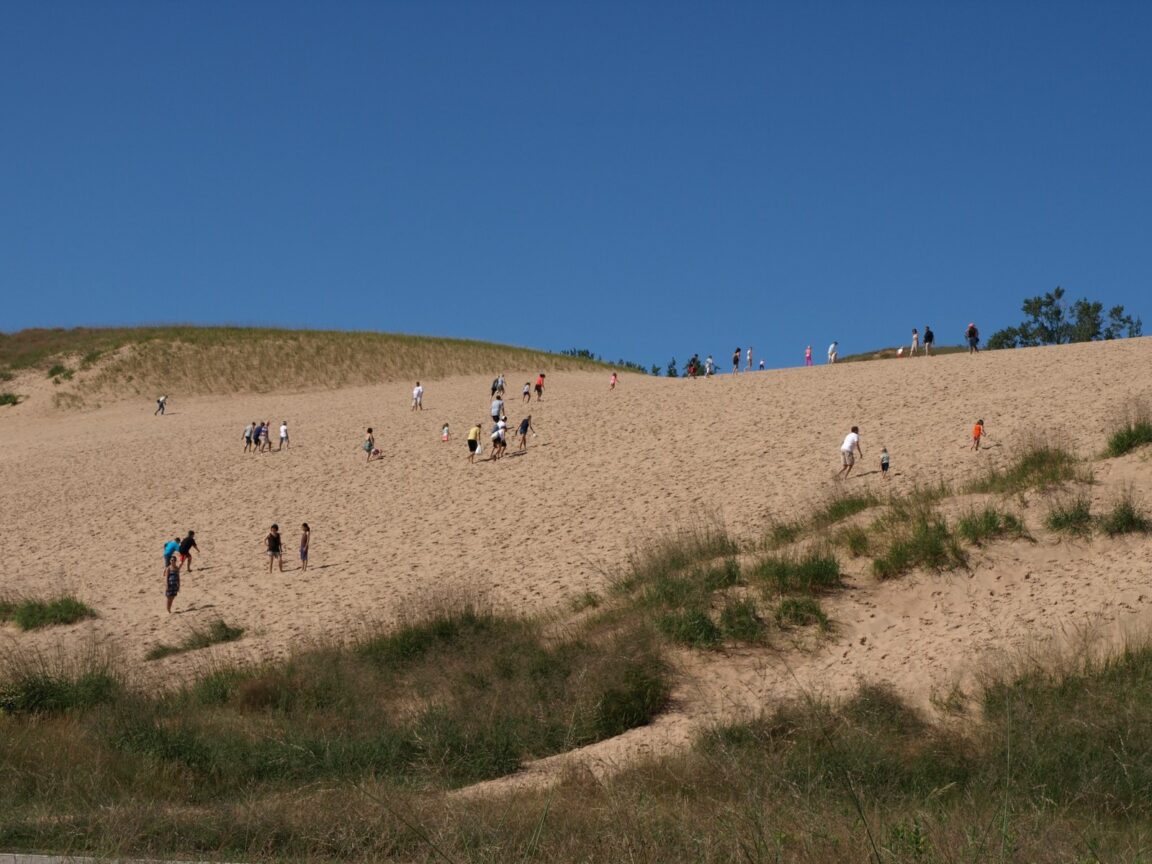
Harder than it looks from the car park, and more forgiving than the park’s bluffs. The Dune Climb is a single broad face of pure, wind-blown sand rising from a picnic area on M-109, about 5 miles north of Empire. The National Park Service is blunt about it: climbing to the top is strenuous, and visitors should judge their own fitness before starting. The mercy of the place is the exit. Anyone who fades halfway up can simply turn around and come back down, with gravity helping, to the picnic tables at the base. There is no commitment and no fee beyond the park pass.
The trap is what lies beyond the crest. From the top of the climb the view is of Glen Lake behind you and more dunes ahead; Lake Michigan is still about 2 miles away and cannot be seen from the top. The marked Dunes Trail continues over a series of steep dunes to the lake and back, roughly 3.5 miles in total, and the Park Service allows 3 to 4 hours for the round trip, walking up and down in loose sand the whole way. That is a hike to provision, not a stroll to extend: carry water, agree a turnaround time and a meeting plan before anyone sets off, and keep children in sight, because the dune field is disorienting once the car park drops out of view. Trail posts with blue tops mark the park’s dune routes and are the line to follow. The Dune Center bookstore and restrooms sit just south of the picnic area, and the Heritage Trail departs from the north end of the base for anyone who prefers their exercise on a firmer surface.
What is the right order for the Pierce Stocking Scenic Drive?
The drive answers its own question: it is a one-way loop, so the order is fixed, and the skill is in knowing where to linger and where to keep moving. The 7.4 mile Pierce Stocking Scenic Drive runs through forest and dune country south of Glen Lake, with 12 numbered stops and a free interpretive guide available at the visitor center in Empire or at the drive’s entrance. A park pass is required, trailers are not permitted, and the road is open to vehicles generally from late May until late October. Outside that season the drive closes to cars and opens to hiking and walk-in recreation, which is its current state in late November.
The stops build deliberately. Stop 1 is the Covered Bridge, Pierce Stocking’s own flourish at the start of the road he built in the 1960s. Stop 2, the Glen Lake Overlook, turns the car inland toward the turquoise lake the Dune Climb overlooks. Stop 3, Picnic Mountain and the Dune Overlook, is the drive’s most accessible panorama: a ramped deck on two levels with benches, taking in the dune field, Glen Lake and the Manitou Islands offshore. Then the road returns to the shore for the pair everyone comes for. Stop 9, the Lake Michigan Overlook, stands on the bluff some 450 feet above the water, and Stop 10 faces the Sleeping Bear Dune itself. Neither Stop 9 nor Stop 10 is accessible; both require a steep asphalt path and loose sand, and the bluff edge is no place to test a head for heights. Stop 11, the North Bar Lake Overlook, softens the ending with a fairly flat picnic area. Drive it early or late in the day for the easiest parking and the best light, and give Stop 3 the time casual visitors give Stop 9; the inland dune view is the stranger and quieter of the two.
Why are there no Manitou ferry days in 2026?
Because, for once, the honest answer is that the islands are closed. North and South Manitou Islands, the two offshore pieces of the lakeshore, are normally reached by the Manitou Island Transit passenger ferry from the Fishtown dock in Leland, north of Glen Arbor. The National Park Service is relocating the docks on both islands to safer, more sheltered locations, a project that also repairs storm and high-water damage and failing infrastructure. Until the work is complete, all facilities, docks and utilities on both islands remain closed, and the ferry will not operate because there is no safe docking location on either island during construction. Private boats cannot dock either; boaters must anchor offshore and come ashore by a smaller vessel, and charter boats need a federal Commercial Use Authorization.
So the ferry day comes off the itinerary entirely for 2026, and the mainland absorbs it well. The islands are still in the trip as scenery: they sit in the view from the Dune Overlook at Stop 3 and from the Lake Michigan Overlook at Stop 9, and reading the crossing you cannot make is part of understanding this coast. Spend the freed day on the northern mainland instead, in Glen Haven’s preserved port village, on a Lake Michigan beach below the bluffs, or walking a second dune trail at a slower pace. Anyone building a longer Michigan lakeshore trip can pair Sleeping Bear with the Upper Peninsula in the same week: Marquette as a Lake Superior base covers the northern shore, and the cliffs an hour beyond it are planned in the Pictured Rocks first-timer guide. Check the Park Service’s current conditions page before building any 2027 island plan; a reopening season is a projection until the docks are finished, not a date to book against.
How many days does Sleeping Bear actually need?
Two full days is the honest minimum, and three is better. Day one belongs to the north: the Dune Climb in the cool of the morning, before the sand heats up and the car park fills, then Glen Haven and a Lake Michigan beach in the afternoon. Day two belongs to the drive: the Pierce Stocking loop taken slowly, with the long version of Stops 3, 9 and 11, and the visitor center in Empire fitted around it. A third day is where the park opens out, a full Dunes Trail hike to Lake Michigan and back, a Heritage Trail ride, or a return to whichever overlook the weather shortchanged. A single day can hold the Dune Climb and the drive back to back, but it turns both into stops rather than experiences, and it leaves no slack for the wind and cloud that Lake Michigan produces on its own schedule.
When is the best time to visit?
The full park exists from about late May to late October, when the scenic drive carries vehicles and the whole mainland is in season; that is the window to aim a first trip at. Summer brings the warmest lake and the longest days, along with the heaviest demand at the Dune Climb and the drive entrance. Autumn trades swimming for colour in the beech and maple forest behind the dunes and thinner crowds at every stop. Winter is a different, quieter park: the scenic drive closes to vehicles and becomes a route for hiking and skiing, the Dune Climb stands open under a much emptier sky, and Empire and Glen Arbor run on local hours. Whenever you go, buy the pass question first, card in hand, and remember that one $25 vehicle pass covers a full week of returns, which rewards the unhurried plan this lakeshore keeps asking for.
Frequently Asked Questions
How much does it cost to enter Sleeping Bear Dunes?
A private vehicle pass costs $25 and is valid for 1 to 7 days, covering everyone in the car. Motorcycles pay $20, visitors aged 16 and over arriving on foot or by bicycle pay $15 each, and the Sleeping Bear Dunes annual pass costs $45. The park does not accept cash; passes are sold by credit or debit card at the Philip A. Hart Visitor Center in Empire, the campgrounds and the scenic drive entrance, and the 7-day pass can be bought in advance through Recreation.gov.
Can you take the ferry to the Manitou Islands in 2026?
No. The National Park Service is relocating the docks on both North and South Manitou Island, all island facilities, docks and utilities are closed until the work is complete, and the Manitou Island Transit ferry will not operate because there is no safe docking location during construction. Private boats cannot dock either and must anchor offshore. Check the park’s current conditions page before planning an island trip for a later season.
Can you see Lake Michigan from the top of the Dune Climb?
No. The top of the Dune Climb looks out over Glen Lake, and Lake Michigan lies about 2 miles beyond, out of sight. Reaching it means continuing on the marked Dunes Trail across a series of steep dunes, roughly 3.5 miles round trip, which the Park Service says can take 3 to 4 hours in loose sand.
Is the Pierce Stocking Scenic Drive open in winter?
Not to vehicles. The drive is open to cars generally from late May until late October and is closed to vehicles for the winter and spring, when it remains open for hiking and walk-in recreation. In season it runs as a 7.4 mile one-way loop with 12 numbered stops, and trailers are not allowed.
Which village is the better base, Empire or Glen Arbor?
Empire suits visitors who want the visitor center, pass sales and the southern end of the park on their doorstep, and a quieter village at night. Glen Arbor suits visitors building days around the Dune Climb, Glen Haven and the scenic drive, with more cafes, outfitters and lodging in walking distance. The two are close enough that one base and a short drive covers both halves of the lakeshore.
Photo: Visitors climbing the Dune Climb at Sleeping Bear Dunes National Lakeshore, Michigan. Credit: Kerry Kelly, National Park Service (NPS Photo), via npgallery.nps.gov, the park’s official National Park Service gallery.