 Wei Chen
The Azores ferry map rewards travellers who read it as three separate answers rather than one network. In the central group, Atlânticoline runs a genuine year round web: the Blue Line shuttles between Horta on Faial and Madalena on Pico in about 30 minutes several times a day, and the Green Line extends the same triangle to Velas on São Jorge and São Roque on Pico. Around that core, the White, Purple and Orange lines are seasonal summer services linking the triangle to Graciosa and Terceira. The western pair, Flores and Corvo, have their own short Pink Line hop. And the eastern group, São Miguel and Santa Maria, has no inter-island ferry at all: every journey between groups is a flight. When inter-island flights fill in high season, the ferries save a central group itinerary, and they do nothing at all for an itinerary built on the wrong group.
Quick Facts
- The operator: Atlânticoline is the sole scheduled inter-island ferry company in the Azores. Every route in this guide is theirs.
- The year round core: The Blue Line (Horta to Madalena, about 30 minutes) and the Green Line (Faial, Pico and São Jorge) run all year, with reduced winter frequencies.
- The seasonal lines: White, Purple and Orange lines extend the network to Graciosa and Terceira roughly from June to September or October, and disappear entirely in winter.
- The western hop: The Pink Line links Santa Cruz das Flores and Vila Nova do Corvo in about 40 minutes.
- The gap: São Miguel and Santa Maria have no ferry service. There are no ferries between the three island groups in any season.
- Vehicles: The triangle crossings carry vehicles on the larger vessels, but summer vehicle spaces sell out first and must be booked well ahead.
- The rule: Build the itinerary inside one group for the ferry days, and fly between groups. Check the live timetable on Atlânticoline’s site before fixing hotel nights.
How does the Faial, Pico and São Jorge triangle actually run?
The triangle is the backbone because the three islands sit within sight of each other across short, sheltered crossings. Horta to Madalena is the busiest link in the archipelago: around 30 minutes, several sailings a day all year, frequent enough in summer to use almost like a bus. A traveller sleeping in Horta can breakfast on Faial, walk Pico’s vineyard coast before lunch and be back for dinner, and day trips in the other direction work just as easily. The Green Line then stitches São Jorge into the pattern, connecting Horta and Madalena with Velas and with São Roque, Pico’s second port on the north coast, so a three island loop does not force backtracking through a single harbour.
Crossing times on the longer triangle legs are the ones to plan around: Horta to Velas runs to roughly two hours and a quarter on the direct pattern, and Velas to Madalena around an hour and twenty minutes, with exact times set by which ports a given sailing calls at. The practical habit is to read the timetable by ports, not by island names. Madalena and São Roque are both Pico, Velas and Calheta are both São Jorge, and choosing the wrong port can add an hour of island driving to a short sea leg. Travellers who enjoy this kind of port by port planning will find the same discipline pays off on the very different northern routes in the Faroe Islands ferry and Smyril Line guide.
What do the White and Yellow season lines add in summer?
Older guides name a Yellow Line as the summer circuit, and the current Atlânticoline pattern expresses the same idea through its seasonal White and Purple lines: from about June into the autumn, sailings extend beyond the triangle to Graciosa and Terceira, turning a three island hop into a five island central group circuit. The Purple Line runs on set days, typically Tuesdays and Saturdays in season, linking Faial, Pico, São Jorge and Terceira. The White Line casts wider still, adding Graciosa and calling at Praia da Vitória on Terceira. The Orange Line is the short seasonal connector between Pico and São Jorge on its own pattern.
These are expedition sailings rather than shuttles. A full White Line run takes hours, calls are not daily, and the lines simply do not appear in the winter timetable, in some cases not even displayed on the operator’s site until the season approaches. The summer traveller gains real freedom: Terceira’s Angra do Heroísmo and Graciosa’s quiet lanes become reachable by sea, and a one way ferry leg paired with a flight out of Terceira makes an elegant open jaw. The winter traveller who builds the same plan on a blog post written in July will find the route does not exist. Season first, itinerary second, is the order this network demands.
Which islands have no ferry, and what does that force?
São Miguel, the archipelago’s largest island and main international gateway, has no inter-island ferry, and neither does Santa Maria. There are no ferries between the eastern, central and western groups in any month of the year. The distances explain it: the groups are separated by long stretches of open Atlantic that a small island ferry cannot serve on a useful schedule. Every inter-group leg is a SATA flight, and those flights are the capacity pinch point of an Azores summer. When they fill, there is no boat underneath them as a safety net, which is precisely why the triangle matters: a traveller based in the central group can keep moving by sea even when the flight map is sold out.
The Flores and Corvo pair makes the same point in miniature. The Pink Line crosses between Santa Cruz das Flores and Corvo in about 40 minutes and is the western group’s only sea link. It is weather sensitive, and Corvo, the smallest island, is a place to build slack around rather than a tight connection. Travellers assembling a multi-group trip should sequence it as the airlines do: fly the long legs, ferry the short ones, and never let a same day ferry to flight connection carry the whole holiday. The shoulder season version of this discipline, applied to another ferry archipelago, is covered in the Greek island ferry shoulder season packing guide.
How do vehicle bookings and cancellations change the plan?
Foot passengers have the easiest life on this network: turn up with a booked ticket on the frequent triangle sailings and the system absorbs you. Vehicles are the constraint. The larger triangle vessels carry cars, and in July and August the vehicle decks on popular sailings fill days or weeks ahead, while foot passenger space remains. A traveller touring with a hire car should book the car onto each sailing at the same time as booking the crossing itself, and should think hard about whether the car needs to travel at all: hiring separately on Pico and São Jorge, and crossing as a foot passenger, is often simpler than fighting for deck space with the car in the middle.
Weather is the second constraint, and the Atlantic sets it. Crossings are cancelled in heavy seas, most often in winter but possible in any month, and the short Horta to Madalena hop is the most resilient sailing while the long seasonal legs to Graciosa and Terceira are the most exposed. Build the itinerary so a cancelled sailing costs a reshuffled day rather than a missed flight: put the ferry days in the middle of the trip, keep the night before an intercontinental departure on the departure island, and check the operator’s live timetable and notices the evening before each crossing. The full route and timetable picture is maintained by this Azores ferry travel guide and summarised by Azores Getaways’ ferry overview, but Atlânticoline’s own timetable is the document that counts on the day.
Frequently Asked Questions
Is there a ferry from São Miguel to the other Azores islands?
No. São Miguel and Santa Maria have no inter-island ferry service in any season, and there are no ferries between the Azores’ three island groups. Inter-group travel is by SATA flight.
How long is the ferry from Faial to Pico?
About 30 minutes between Horta and Madalena on the Blue Line, with several sailings a day all year. It is the shortest and busiest crossing in the archipelago.
Which Azores ferry routes run all year?
The Blue and Green lines in the central group, covering Faial, Pico and São Jorge, plus the Pink Line between Flores and Corvo. The White, Purple and Orange lines are summer only.
Can I take a car on the Azores ferries?
Yes, on the larger central group vessels, but vehicle spaces are the first thing to sell out in summer. Book the vehicle onto each sailing when you book the crossing, or hire separately on each island and cross on foot.
How do I reach Graciosa and Terceira by ferry?
On the seasonal White and Purple lines from the Faial, Pico and São Jorge triangle, roughly June to September or October. Outside the season, fly.
Are Azores ferries ever cancelled?
Yes, in heavy seas, most often in winter. Keep ferry days away from flight days, and check Atlânticoline’s live timetable and notices the evening before each crossing.
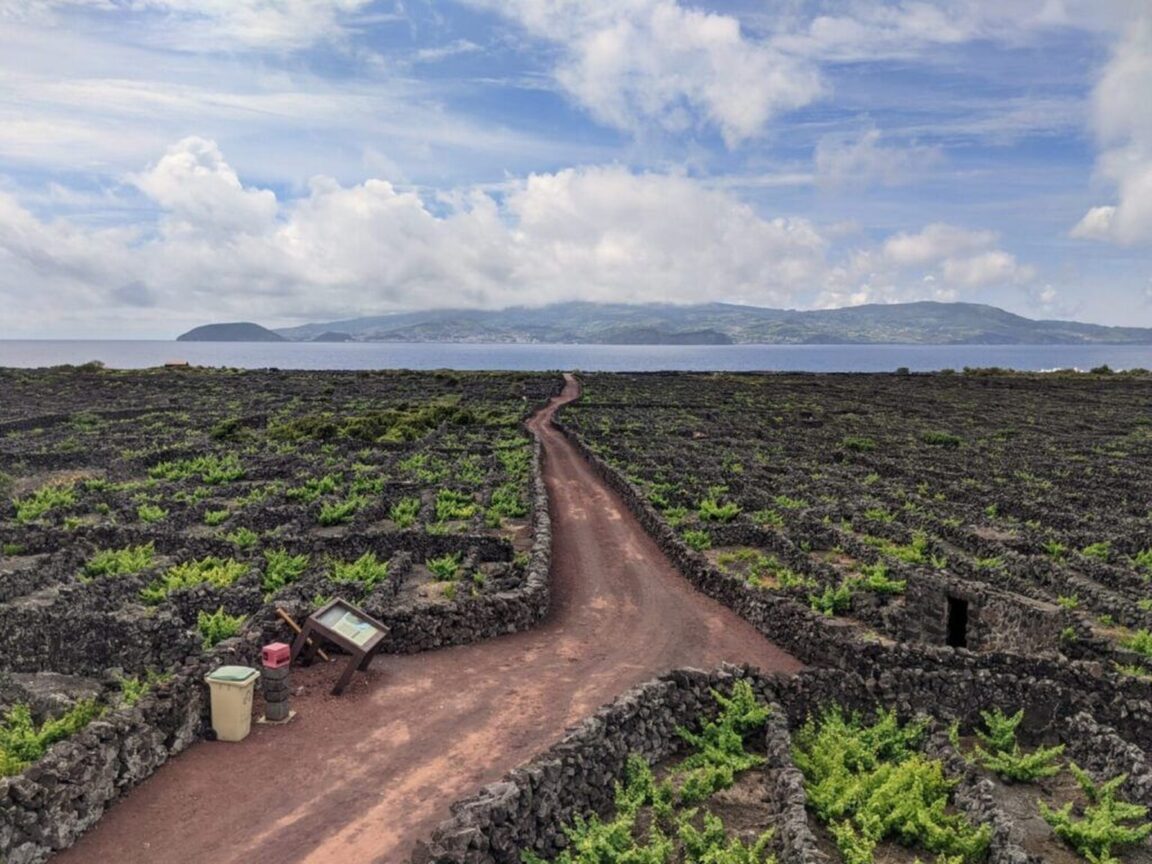
Photo: Pico Island’s black lava vineyard plots, the currais, looking across the channel towards São Jorge in the Azores. Credit: David Magalhaes, via Unsplash.