 Lucas Meyer
Pack for a Greek island ferry hop in May or October as if three trips share one bag: a windy crossing on an open deck, a cool village evening that needs a real layer, and a harbour taverna dinner where beach clothes will not do. The shoulder season bag is not the high summer bag with a jumper thrown in. Meltemi wind can cut across a ferry deck even on a bright morning, island evenings drop fast once the sun leaves a whitewashed lane, and the one bag has to survive ramps, gangways and cobbled port streets without a porter. Build it around a windproof shell, a warm mid layer, one smart dinner outfit that resists creasing, and shoes chosen for wet decks first and photographs second.
Quick Facts
Season: Shoulder season, May and October, when ferries run full networks but weather swings between swim days and wind days
Core problem: Open deck wind chill and spray on crossings, cool evenings ashore, and one bag carried on and off every ferry
Bag: One soft sided carry on sized bag or backpack, wheeled only if it can be carried up a gangway and across cobbles
Key layers: Windproof and water resistant shell, one warm fleece or light insulated layer, merino base layers that rewear cleanly
Dinner solution: One crease resistant smart outfit, worn or packed flat, that works in every village taverna on the route
Deck kit: Sunglasses with a strap, sun cream for exposed crossings, a dry pouch for phone and tickets, and a scarf or buff against wind
Facts checked: 22 November 2026
Why does shoulder season packing differ from a high summer beach bag?
July packing is subtraction: swim, cover, repeat. May and October packing is insurance. The Aegean in shoulder season delivers genuine beach afternoons and, on the same trip, a crossing where the wind over an open deck makes an hour feel like a winter ferry in miniature, followed by an evening in a port town where dinner outside needs sleeves, closed shoes and sometimes a hat. Travellers who pack the summer bag spend the trip buying emergency fleece in harbour shops. Travellers who pack for the swing carry slightly more and think about weather not at all.
The second difference is the ferries themselves. Shoulder season crossings are busy enough to reward boarding early and travelling light, and the classic Greek ferry day, with its vehicle deck boarding, steep stairs and open upper decks, punishes hard suitcases and spare bags. One bag, carried on your back or in one hand, turns every port call into a ten minute pleasure instead of a logistics exercise. Our earlier Greek island ferry one bag guide covers the summer system; this is its cooler, windier sibling.
What is the layering system for meltemi wind days?
Build three layers that all earn their place ashore as well as on deck. Next to the skin, merino or synthetic tops that can be worn two or three days, dry overnight in a cabin and never smell like a ferry. In the middle, one genuinely warm layer: a fleece or a light insulated jacket that compresses into its own pocket, because shoulder season wind chill is a warmth problem before it is a rain problem. On top, a windproof shell with a hood, water resistant enough for deck spray and a passing shower, long enough to cover the hips when seated on a windy bench.
Legs need the same thinking. One pair of light trousers that block wind for crossings and evenings, one pair of shorts or a skirt for the warm afternoons that will certainly come, and leggings or long underwear only for travellers who feel cold easily on night crossings. A buff or light scarf is the highest value item in the bag: neck warmth on deck, a head covering in a monastery visit, a pillow cover on a long crossing. Gloves are overkill for most, but a warm hat weighs nothing and transforms an exposed top deck at sunset.
How do you pack one smart outfit for village dinners?
Island dinners in May and October are taverna dinners: grilled fish, village wine, a table outside if the wind allows and inside if it does not. The dress code is effort, not formality. One outfit solves it: dark crease resistant trousers or a midi dress, a collared shirt or a fine knit that has not spent the day on a ferry deck, and the same closed shoes worn for travel, cleaned by being decent shoes in the first place. Pack the outfit flat against the back of the bag or wear the knit to travel, and hang it in the bathroom steam on arrival.
Keep the rest of the wardrobe ruthlessly plain so everything mixes: two or three tops in a tight colour family, swimwear for the brave afternoons, sleepwear, and underwear for the days plus one spare set in the daypack in case a bag travels separately on a busy crossing. Shoulder season laundry dries slower in cool rooms, so choose quick dry fabrics and plan one sink wash mid trip rather than packing ten days of clothes for a ten day hop.
What belongs in the deck daypack on every crossing?
Separate the crossing kit from the main bag before boarding, because main bags on Greek ferries often go to racks or the vehicle deck while the passenger decks are reached by stairs. The daypack carries tickets and ID, phone and charger, the dry pouch for spray on open decks, sunglasses with a strap against the wind, sun cream, water, a paperback or downloaded films for long legs, seasickness tablets for travellers who need them, and the warm layer and shell if the plan is to sit outside. Add snacks bought in the port: ferry cafes vary, and a windy crossing is no place to discover the kitchen queue.
Footwear for boarding deserves its own rule. Decks are metal, ramps are steep and spray makes both slippery, so board in closed shoes with grip, never in the flip flops that will serve perfectly well ashore an hour later. Keep flip flops and swim kit in the top of the main bag for the first swim on arrival. Travellers combining the hop with the mainland can pair this system with our 3 days in Athens itinerary, since most shoulder season routes start or end with a Piraeus or Rafina crossing and a night in the capital.
What should be left out of the shoulder season bag?
Leave the beach towel, since island rooms and hotels supply towels and a microfibre travel towel covers ferry swimming stops. Leave the second smart outfit, the hair tools that need adapters and hope, and any shoe that only works in one outfit. Leave hard shell luggage itself: wheels fail on cobbles, gangways and the stepped lanes of island choras, and a soft bag stows in ferry racks, small room corners and the back of a hire car without argument. The test for every item is the shoulder season triple: does it work on a windy deck, on a cool evening and in a village lane? If it only works on a beach, it belongs to the July bag, not this one.
Frequently Asked Questions
How cold does a Greek ferry deck get in May or October?
Cold enough to need a windproof shell and a warm mid layer, especially on open decks at speed, on early morning departures and on sunset crossings. The meltemi wind adds serious chill even on sunny days, so dress for the deck, not for the harbour.
Can I do a shoulder season island hop with carry on only?
Yes, and it is the recommended system. One soft carry on sized bag plus a small daypack for crossings handles a ten day hop if fabrics are quick dry, colours mix and one sink wash is planned mid trip. Soft bags also board ferries, gangways and cobbled lanes far better than hard cases.
What shoes should I pack for Greek ferries in shoulder season?
One pair of closed shoes with real grip for wet decks, ramps and village lanes, worn to travel, plus light sandals or flip flops for beaches and rooms. Board every ferry in the closed shoes, because metal decks and spray are slippery.
Do I need swimwear in May or October in Greece?
Pack one swimsuit. Shoulder season brings genuine swim days, especially in sheltered bays and in early October when the sea holds its summer warmth, and the suit weighs almost nothing. Just do not build the whole bag around the beach.
How do I dress for taverna dinners without packing formal clothes?
One crease resistant smart outfit is enough: dark trousers or a midi dress, a collared shirt or fine knit kept fresh for evenings, and your closed travel shoes. Island taverna dressing rewards effort and neatness, not jackets or heels.
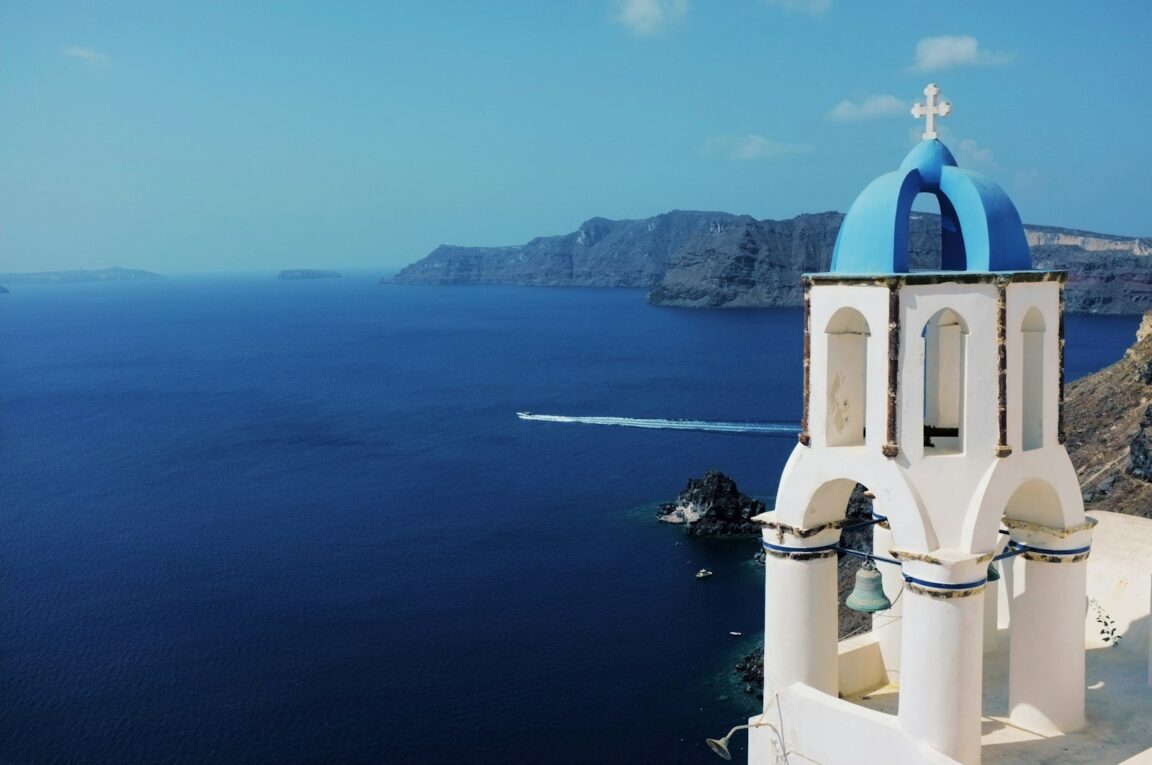
Featured image: a blue domed church bell tower above the Santorini caldera, with a boat wake crossing the Aegean below. Photo via Unsplash, Unsplash License.