 Camille Baptiste
Careyes is not a resort in the usual sense and was never meant to be one. Founded in 1968 by the Italian banker and artist Gian Franco Brignone on a stretch of Jalisco jungle coast he had spotted from the air, it is a private, low density settlement of colour coded casitas, cliff top castles and thatched palapa roofs scattered between small bays on Mexico’s Costalegre, entered from Highway 200 at kilometre 53.5. There is one hotel, El Careyes Club and Residences, a handful of restaurants around the Plaza de los Caballeros del Sol, and one unmistakable monument: La Copa del Sol, a monumental concrete bowl on the cliff above Playa Teopa, built from one of Brignone’s dreams and still used for sunset gatherings, meditation and sound baths. The nearest scheduled airport is Manzanillo (ZLO), about an hour and a half south by car, with Puerto Vallarta (PVR) roughly two and a half to three hours north.
Quick Facts
- What it is: A private art and architecture settlement on the Costalegre coast of Jalisco, founded in 1968 by Gian Franco Brignone, rather than a single resort property.
- Where: On Highway 200 between Puerto Vallarta and Manzanillo, with the entrance at kilometre 53.5, beside the Chamela-Cuixmala Biosphere Reserve.
- Nearest airport: Manzanillo (ZLO), about 1.5 hours by car. Puerto Vallarta (PVR) is about 2.5 to 3 hours and has far more flights.
- Signature monument: La Copa del Sol, a concrete bowl about 27 metres across on the headland above Playa Teopa, used for sunset gatherings and sound baths.
- The name: Careyes takes its name from the carey, the hawksbill turtle that nests on these beaches, and Playa Teopa hosts the Careyes Foundation’s sea turtle sanctuary.
- Where most visitors sleep: El Careyes Club and Residences is the settlement’s hotel; most other stays are privately owned casitas, villas and the cliff top castles, booked individually.
- Polo season: The Careyes Polo Club plays from November to April, with the Copa Agua Alta tournament around Easter.
Is Careyes a resort or a village?
It helps to arrive with the right mental model. Careyes has no town centre in the ordinary sense, no grocery store and no strip of competing hotels. What Brignone built from 1968 onwards was a settlement organised around art and architecture: houses designed as sculptures, each painted in saturated colour against the green jungle, with curved walls, open sided living rooms and pools cut into the cliff edge. The shared spaces are few and deliberate. The Plaza de los Caballeros del Sol works as the cultural square, with the gallery, shops and restaurants gathered around it, and the beaches below the headlands do the rest of the social work.
That structure explains the title problem every guide to Careyes runs into. Earlier stays on this coast, including the much written about Hotelito Desconocido further along the Costalegre, trained travellers to think in terms of a single property with a front desk. Careyes is the coast that grew up around that idea and then moved past it: a whole bay system run as one aesthetic project, where the successor experience is not a new hotel but the settlement itself. Travellers who like the model tend to love it. Travellers who want a resort’s predictability, with everything bookable in one place, should read the logistics sections below carefully before committing.
What are the colour coded casitas and castles?
The architecture is the attraction, and it follows a loose colour code that locals use as an address system. The casitas cluster in painted groups above the bays, small houses in blues, yellows, pinks and oranges, each oriented to catch the sea breeze through open walls under palapa roofs. Above them sit the castles, the large cliff top houses that made Careyes famous in design magazines. The best known grouping is Casa Mi Ojo, Brignone’s own house, flanked by Sol de Oriente in yellow and Sol de Occidente in pale blue, two sculptural houses that face each other across the water to catch the sunrise and the sunset respectively.
Most of these houses are private homes. A portion are let through the settlement’s own channels and through villa agencies, usually with staff, and the practical consequence is that no two Careyes stays are alike: one group cooks in a casita kitchen stocked on the drive in, another takes every meal at the beach restaurant on Playa Rosa. The official Careyes website’s castles page is the right place to start reading the housing stock, because it shows the scale of the cliff top houses honestly rather than dressing them up as hotel suites.
What is La Copa del Sol, and can anyone visit it?
La Copa del Sol, the Cup of the Sun, is the settlement’s monument and its logo in three dimensions: a vast concrete bowl, roughly 27 metres in diameter and about 11 metres high, sitting on the cliff above Playa Teopa. Brignone said the form came to him in a dream, of a man and a woman united by the cosmos in the light of the setting sun, and the bowl was built to hold exactly that moment. Visitors climb to its rim for the sunset, and the interior is used for meditation and for sound baths, where the curved concrete throws singing bowl tones back at the group sitting inside it.
Access is arranged locally rather than sold at a gate, which is typical of Careyes. Guests staying in the settlement book the Copa through their house manager or the concierge, and the sound bath sessions are scheduled rather than walk up. Pair it with the beach below: Playa Teopa is the long, wild strand under the headland, home to the Careyes Foundation’s sea turtle sanctuary, where nesting turtles are protected and hatchling releases are organised in season. The combination, monument at golden hour and turtle beach below, is the single most Careyes afternoon available.
How do you actually get to Careyes?
There are two airport choices and neither is close, which is the honest price of this coast. Manzanillo’s airport (ZLO) is the nearer, about an hour and a half by car, but it has a thin schedule. Puerto Vallarta (PVR) is the bigger airport by far, with the drive running two and a half to three hours south on Highway 200. The Careyes entrance sits at kilometre 53.5 on that highway, and most stays arrange the transfer through the house or hotel rather than leaving it to chance at arrivals, because the last stretch is winding jungle road that is far pleasanter in daylight.
Once inside, distances are deceptive. The settlement spreads across headlands and bays, and a car matters: the polo club, the beaches and the Copa are separate stops, not a stroll. Travellers comparing this coast with Mexico’s other slow wine and surf regions will find a useful contrast in Valle de Guadalupe, Mexico’s wine country two hours from the border, which is built around driving between small producers in much the same way. Careyes rewards the same rhythm: one or two anchors a day, long lunches, and no attempt to collect the whole coast in a weekend.
What is there to do besides look at the houses?
The days organise themselves around water and the calendar. Boats run out along the coast to sea caves and quieter coves that cannot be reached by road, and in the winter months the same boats watch for humpback whales offshore. Horseback riding follows jungle trails between the bays and along Playa Teopa. Yoga and wellness sessions run at the houses and at the Copa. The polo is real rather than decorative: the Careyes Polo Club, just south of the settlement, plays a full season from November to April, with tournaments over the Christmas and New Year period and the Copa Agua Alta around Easter, and spectators are part of the social season.
Nature frames all of it. The settlement sits beside the Chamela-Cuixmala Biosphere Reserve, a protected tract of tropical dry forest, and the jungle that fills the view from every casita terrace is that forest running down to the sea. Travellers who know Mexico’s Caribbean side can calibrate expectations against the best beach resorts in Tulum, by travel style: Tulum sells a scene, Careyes sells seclusion and design, and the Pacific water here is wilder, with the long Teopa strand better for walking and turtle watching than for placid swimming. A fuller orientation to the bays and houses is kept current in the Costalegre Villas guide to Careyes, which is useful for the beach by beach detail.
Who should choose Careyes, and who should not?
Careyes suits travellers who treat architecture as a destination, who are happy provisioning a house or booking staff with it, and who want the Pacific coast without a resort strip. It suits design literate couples, small groups renting a castle together, and anyone whose ideal day is a boat, a long lunch and a monument at sunset. It does not suit travellers who need a kids club, a nightlife strip, a swimmable calm bay at the door, or a single checkout bill. There is no grocery store inside the settlement, so self caterers stock up on the drive in, and the whole place runs on arrangements made a day ahead rather than walk in availability. Read that as the settlement’s character rather than a flaw: Careyes has been deliberately hard to drop into since 1968, and the houses, the Copa and the turtle beach are what the effort buys.
Frequently Asked Questions
How far is Careyes from the nearest airport?
About an hour and a half by car from Manzanillo airport (ZLO). Puerto Vallarta airport (PVR) is roughly two and a half to three hours away and offers many more flights, so many visitors accept the longer drive for the better schedule.
Can you stay in Careyes without renting a whole villa?
Yes. El Careyes Club and Residences is the settlement’s hotel, and individual casitas are also let. The castles and larger villas are booked as whole houses, usually with staff arrangements made through the booking channel.
What is La Copa del Sol?
A monumental concrete bowl, about 27 metres across, built on the cliff above Playa Teopa from a dream of founder Gian Franco Brignone. Visitors climb to the rim at sunset, and sound baths and meditation sessions are held inside by arrangement.
When is polo season in Careyes?
The Careyes Polo Club plays from November to April, with tournaments around Christmas and New Year and the Copa Agua Alta around Easter.
Is there a town or grocery store in Careyes?
No. Careyes is a private settlement with a plaza, gallery, shops and restaurants, but no grocery store. Self catering guests provision on the drive in or arrange for their house team to shop before arrival.
What does the name Careyes mean?
It comes from the carey, the Spanish name for the hawksbill turtle that nests on these beaches. Playa Teopa, below La Copa del Sol, hosts the Careyes Foundation’s sea turtle sanctuary.
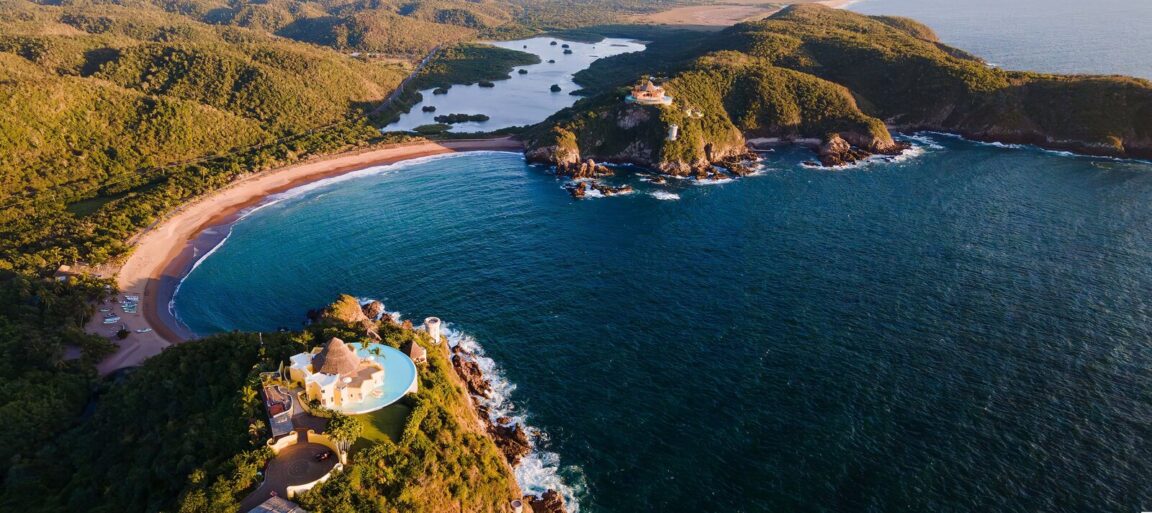
Photo: An aerial view over the Careyes coastline at Careyitos, with a cliff top castle and its pool in the foreground and the turtle beach bays beyond. Credit: Karla Cifuentes, via careyes.com, the official Careyes website.