 Priya Nair
The Green River through Desolation and Gray Canyons is an 84 mile wilderness float from Sand Wash to Swaseys Rapid in eastern Utah: four to six days of Class II to III whitewater, more than 60 rapids, beach camps under cottonwoods, Fremont rock art and historic ranch sites, in a canyon the river has cut some 5,000 feet down into the Tavaputs Plateau. It is managed by the Bureau of Land Management’s Price Field Office, a permit is required year round, and peak season launches from 1 May to 30 September are allocated by lottery, with applications accepted only from 1 December to 31 January on Recreation.gov. John Wesley Powell named the canyon on his 1869 expedition, and the Desolation Canyon National Historic Landmark now protects a mile of country on either side of the river for much of the run.
Quick Facts
- Route: 84 miles on the Green River from Sand Wash put in to Swaseys Rapid take out, near the town of Green River, Utah.
- Rapids: Class II to III, more than 60 rapids in total, with the biggest water, including Joe Hutch Canyon, Wire Fence, Three Fords and Coal Creek, concentrated in the second half.
- Permit: Required year round. The BLM lottery covers launches from 1 May to 30 September; applications run 1 December to 31 January, results are emailed on 15 February, and winners must accept by 14 March.
- Launches: Six groups a day launch from the single ramp at Sand Wash in peak season.
- Trip length: Most groups take five to six days. Commercial trips commonly fly guests from Green River to the Sand Wash airstrip above the put in.
- Left bank rule: The east bank is Ute Tribal land. Landing, camping and hiking there are prohibited, so camps are planned on the BLM managed right bank.
- Managing office: BLM Price Field Office, phone (435) 636-3600. Permits and the lottery run through Recreation.gov.
How does Desolation compare with Cataract Canyon?
Utah rafters usually frame the choice as Desolation or Cataract, and the two trips are built differently. Cataract Canyon, on the Colorado River through Canyonlands, is the famous one: bigger, more technical whitewater at high water, motorised rigs that can compress the run, and flatwater bookends reached by boat. Desolation is the quieter proposition. The rapids are Class II to III, engaging without being intimidating, and they build as the canyon deepens, so a competent first time multi day boater grows into the hardest water, Joe Hutch Canyon, Wire Fence and Three Fords, in the later days rather than meeting it on day one.
The other difference is solitude, and it is structural. Desolation has one put in, Sand Wash, and six launches a day in peak season, which spreads groups along 84 miles of river. Beach camps are roomy, side hikes reach Fremont petroglyph panels and granaries and the remains of historic ranches and outlaw era sites, and the canyon keeps deepening until Rock Creek and the later gorges drop more than a mile below the plateau rim. Travellers building a wider Utah canyon itinerary can pair the river logic with the road based country in Capitol Reef beyond the Scenic Drive, Cathedral Valley, the Burr Trail and the Fruita orchards, which covers the same plateau country from the rim side.
How does the permit lottery actually work?
The calendar is the trip’s first rapid, and it arrives months before the water. Per the BLM’s Desolation Gray permit page, lottery applications are accepted from 1 December to 31 January for launches in the coming season, and the lottery covers every launch date from 1 May to 30 September. Notifications are emailed on 15 February. Successful applicants must accept their awarded date by 14 March; dates not accepted are cancelled on 15 March, and from 8.00 am MST that day every unawarded and cancelled date goes on general sale on Recreation.gov. Dates before 1 May and after 30 September sit outside the lottery and can be reserved from 1 December for the coming season.
Two practical consequences follow. First, a Desolation trip is planned in winter, not spring: a group that starts thinking about the river in March is shopping for cancellations, which appear on Recreation.gov at random after 15 March with no queue and no alerts. Second, the permit is not the end of the paperwork. The trip leader carries a physical copy of the permit and photo ID for the ranger check at Sand Wash, group size and craft details can be edited until the permit is printed, and standard desert river requirements apply, including a durable metal fire pan and portable toilet system. Current fees are listed on the Recreation.gov Desolation Gray permit page at booking, so confirm them there rather than trusting any figure quoted in an older guide.
Why do commercial trips start with a scenic flight?
Sand Wash is genuinely remote: a primitive ramp, an eight site campground, a ranger station and no water or trash service, reached by long dirt road driving. That remoteness is why the classic commercial itinerary begins with a small plane. Outfitters based in Green River or Moab fly guests, typically 45 minutes from Green River, to the Sand Wash airstrip on the plateau, walk them down to the ramp, and launch the same morning, while the trip’s vehicles are shuttled to the take out at Swaseys. Private groups drive it instead, and should take the access seriously: check the current road alerts on Recreation.gov before choosing a route in, because construction and conditions on the approach roads change, and the BLM directs boaters to the river rangers with questions.
Sand Wash has one more reputation to plan around: mosquitoes, worst in the early season high water weeks. The put in offers four screened cabins that permit holders can rent for the night before launch, and experienced groups treat that booking as part of the permit strategy rather than an upgrade. Spring launches also bring rising water, wind and a real chance of rain or snow; the classic season runs through the summer heat, when the river is the coolest place in the canyon and the beach camps come into their own.
What does a day on the river look like?
Most groups float 12 to 18 miles a day, which leaves the afternoons for the canyon itself. The side hikes are the point of the slower pace: short walks reach petroglyph panels and Fremont granaries tucked into alcoves, historic ranch buildings from the river’s working past, and viewpoints as the canyon walls step down through the Wasatch Formation’s coloured bands. Camps are on broad sand beaches, often under cottonwoods, and the routine sets itself, boats unloaded, kitchen up, dinner as the light leaves the rim. Because the east bank is Ute Tribal land where landing, camping and hiking are prohibited, camps and hikes are planned on the BLM side, and a good trip leader briefs that boundary on day one rather than at the first tempting beach on the wrong shore.
Packing follows desert river rules rather than backpacking rules, since the boats carry the weight: sun protection that survives a full day of glare, layers for cold mornings on spring launches, and dry storage for everything. The land based version of the same discipline is covered in packing for a desert national parks road trip on the Utah and Arizona loop, and the overlaps, water, shade and temperature swings, are exactly the ones that matter at Sand Wash.
Who should pick Desolation over the famous runs?
Desolation suits boaters who want a real wilderness week rather than a whitewater highlight reel: families with older children, first time multi day rafters with solid basic skills, and experienced groups who value empty beaches and archaeology over big drops. It also suits travellers who missed the Grand Canyon and Idaho lotteries and want a permitted river that still feels unhurried. It does not suit anyone who needs a short trip, because four days is a hurry here and five to six is the honest pace, or anyone whose calendar cannot bend to a December to January lottery for a summer launch. Win the date, fly or drive into Sand Wash, and the canyon does the rest, deepening a little more every day until Swaseys.
Frequently Asked Questions
When is the Desolation Canyon permit lottery?
Applications are accepted from 1 December to 31 January for launches from 1 May to 30 September. Results are emailed on 15 February, winners must accept by 14 March, and unaccepted and unawarded dates are released on Recreation.gov from 15 March.
How long is the Desolation Canyon rafting trip?
The float is 84 miles from Sand Wash to Swaseys Rapid. Most private and commercial groups take five to six days, floating roughly 12 to 18 miles a day with time for side hikes.
How hard are the rapids in Desolation Canyon?
Class II to III, with more than 60 rapids. The largest, including Joe Hutch Canyon, Wire Fence, Three Fords and Coal Creek, come in the second half of the trip as the canyon deepens.
Do I need a permit outside the lottery season?
Yes. A permit is required year round for the Desolation Gray section. Dates before 1 May and after 30 September are reserved outside the lottery, starting 1 December for the coming season, and winter travel needs a direct conversation with the BLM Price Field Office because the river can freeze.
Why do trips fly into Sand Wash?
Sand Wash is a remote put in reached by long dirt roads. Commercial outfitters commonly fly guests from Green River to the airstrip above the ramp to save the drive, while private groups drive in and shuttle vehicles to the Swaseys take out.
Can we camp on both sides of the river?
No. The east bank is Ute Tribal land and landing, camping and hiking there are prohibited. Camps and hikes are planned on the BLM managed side of the river.
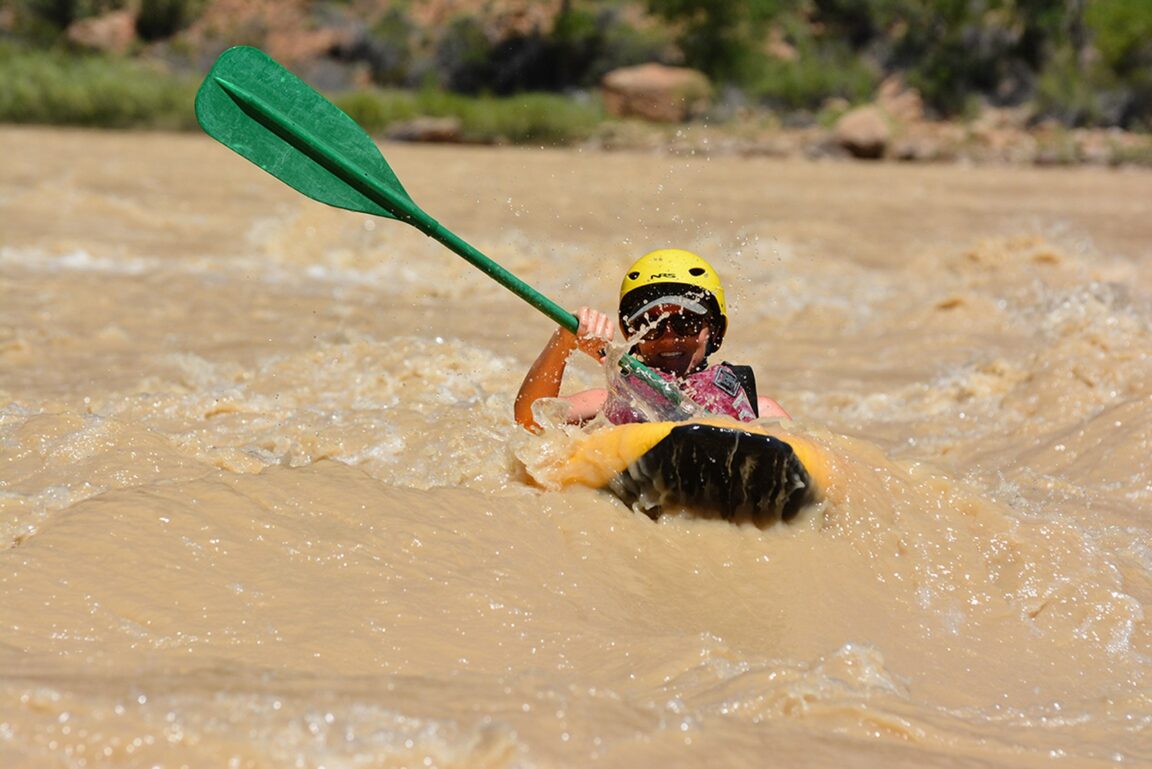
Photo: A paddler in an inflatable kayak running muddy whitewater on the Green River’s Desolation Gray reach. Credit: Bureau of Land Management (BLM), via blm.gov, the river’s managing agency.