 James Wolfe
The Hotel Chelsea is a working luxury hotel inside New York’s most storied artists’ residence, and those two facts are in permanent negotiation. The red-brick landmark at 222 West 23rd Street, built in 1883 and 1884 as one of the city’s first cooperative apartment houses, reopened in 2022 after an eleven-year closure and a restoration that kept its wrought-iron balconies, marble staircase and art-covered walls. You can now book it like any other hotel, in room types from a Petite Chelsea to a two-bedroom suite, eat in three restaurants including a Spanish institution that has traded on the ground floor since 1930, and sleep in a building that still houses long-term residents alongside paying guests. Book it for the building and the history, in full knowledge of the compromises a 140-year-old structure imposes, and it rewards you. Book it expecting a silent, standardised five-star box, and it will puzzle you. This guide separates the legend from the lodging, from the hotel’s own published details and the public record, checked on November 24, 2026.
Quick Facts
- Address: 222 West Twenty-Third Street, New York, NY 10011, between Seventh and Eighth Avenues in Chelsea. Phone 212.483.1010.
- The building: built 1883 to 1884 to designs by Philip Hubert, in Queen Anne Revival and Victorian Gothic styles, originally a housing cooperative and converted to a hotel in 1905. A New York City designated landmark and listed on the National Register of Historic Places.
- The modern hotel: closed in 2011, taken over by BD Hotels in 2016 and reopened in 2022, with 155 units in total, comprising hotel rooms and suites in individually configured layouts inherited from the original apartments.
- Room types: the hotel’s own listings run from the Petite Chelsea and standard Chelsea rooms through lofts and grand suites to a two-bedroom suite sleeping four. No two historic layouts are alike.
- Dining: El Quijote, the Spanish restaurant on the ground floor since 1930; Cafe Chelsea, a French bistro; and Teruko, a Japanese restaurant on the lower level.
- The honest caveats: long-term residents still live in the building, entry rooms can be compact, and rooms facing West 23rd Street face a busy crosstown artery. Ask about position, not just category, when you book.
What survived the restoration, and what is genuinely new?
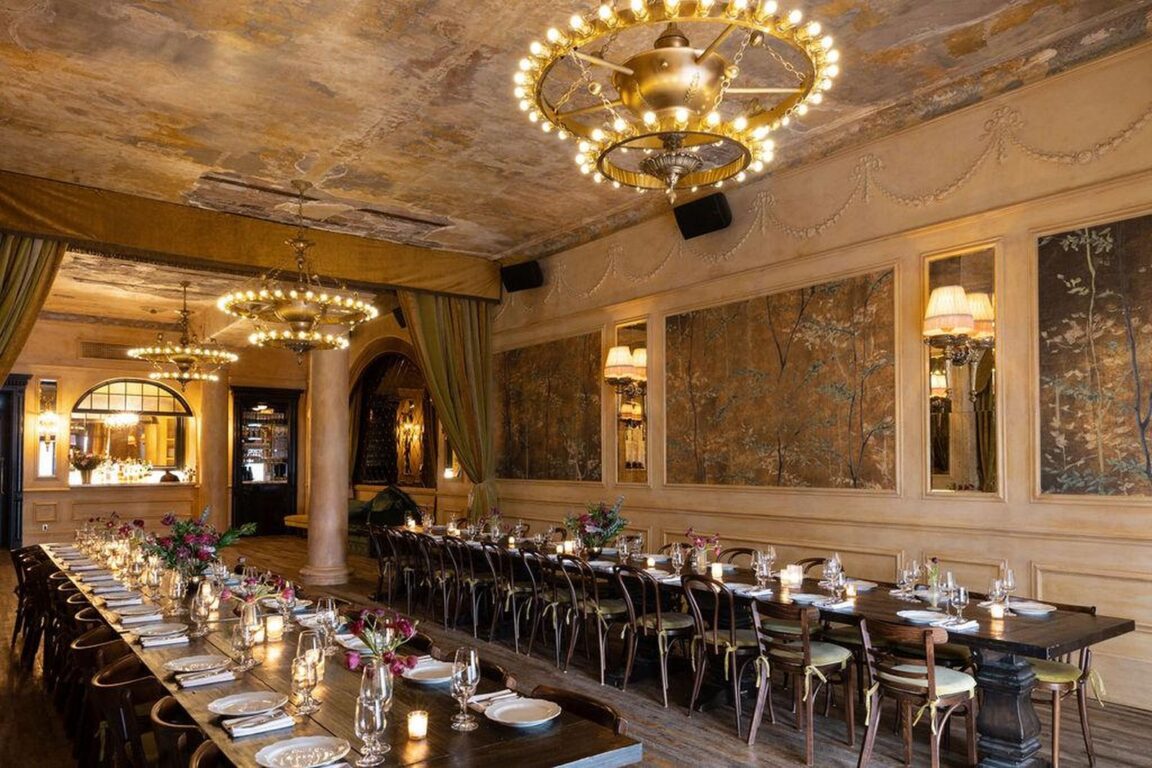
The restoration’s achievement is that the Chelsea still looks and feels like the Chelsea. The facade’s iron balconies, the marble floors and the great Victorian staircase survived, along with the accumulated artwork that generations of residents famously gave long-serving manager Stanley Bard in place of rent. The events spaces the hotel now sells tell the same story in miniature: the Tea Room sits inside the original general manager’s office, just off the lobby, and keeps its original fireplace and detailed ceilings, while the Bard Room, named for Stanley Bard himself, is a ballroom of antique brass chandeliers and historic architectural detail holding 100 guests. Even the newest restaurant is in dialogue with the past: Teruko, on the lower level, is built around a backbar brought from Tokyo’s famed Hotel Okura and original artwork by Teruko Yokoi.
What is new is the machinery of a modern luxury stay layered into that fabric: individually designed rooms mixing restored fireplaces and stained glass in the upper categories with contemporary bathrooms and bedding, a Piano Room functioning as a grand, European-style living room off the Lobby Bar with a baby grand and an attached glass solarium, and a reservations operation that sells the building’s irregularity as the product. Travellers comparing downtown houses in our Greenwich Village small hotels guide will find the Chelsea a different species altogether: bigger, louder with history, and far less predictable room to room.
Which room should you actually book?
Book size before romance. The original apartments were all different, the subdivisions of the twentieth century were all different again, and the restored room stock inherits that variety honestly. The entry categories, the Petite Chelsea and the standard Chelsea rooms, suit a solo traveller or a couple who will be out in the city all day and want the address at the lowest entry point. Travellers who work in the room, stay beyond two nights, or simply need space to unpack should step up to the loft, grand and suite categories, where the historic layouts become an asset instead of a constraint, and where restored fireplaces and stained glass survive in the top rooms. The two-bedroom suite, sleeping four, is the family’s and the longer stay’s answer, in a neighbourhood where true two-bedroom hotel inventory is scarce.
Then ask the position question. West 23rd Street is a working crosstown artery, with the bus routes, deliveries and refuse collections that status implies, and a landmark 1884 building was not engineered for modern acoustic isolation. Light sleepers should request a room facing away from 23rd Street or set high in the building, and should make that request at booking, directly with the hotel, rather than at check-in when the inventory has gone. The hotel’s own team can also match rooms to interests in a way an anonymous booking cannot, in a house where individual rooms carry individual art and individual histories.
How does the Chelsea eat and drink?
Unusually well for a hotel of 155 keys, because the restaurants predate the relaunch and answer to the neighbourhood as much as to the house. El Quijote has occupied the ground floor since 1930 and became, in the hotel’s own words, a watering hole for the building’s eccentric figures from the 1960s onward; its restored room now doubles as the Cervantes Room for private events. Cafe Chelsea covers the French bistro register from morning to night, with its Cave a Vin private dining room and adjoining Solarium Bar, mahogany panels, brass and a glass ceiling, seating dinners of up to 32. Teruko brings the third cuisine, Japanese, in the lower level. A guest can eat three genuinely different dinners without leaving the building, and a non-guest can book all three, which keeps the public rooms alive in a way residents-only hotel dining never is.
Who is the Chelsea for, and who should book elsewhere?
The Chelsea is for travellers who read the guest list as an amenity: Mark Twain, Dylan Thomas, Arthur Miller, Bob Dylan, Janis Joplin, Leonard Cohen, Arthur C. Clarke, Patti Smith and Robert Mapplethorpe all lived or stayed in this building, and no renovation has laundered that charge out of the corridors. It is for travellers who value a Chelsea gallery-district base, the 1 train at 23rd Street, and evenings that begin in a lobby bar with a century of ghosts in it. It is not for travellers whose trip depends on silence, square footage per dollar, a pool, or a hushed corporate floor; Manhattan sells those virtues elsewhere, at this price and below it. Nor is it a museum you sleep in by accident: a small number of long-term residents still live their ordinary lives in the building, and a guest who treats their home as part of the exhibit has misunderstood the place. Stay here as a participant in a continuing building, pair it with a morning at the Metropolitan Museum for the full arc of New York culture in one trip, and the Chelsea is what its legend promises. Just book the bigger room, and ask for the quiet side.
Frequently Asked Questions
Where is the Hotel Chelsea, exactly?
At 222 West 23rd Street, New York, NY 10011, between Seventh and Eighth Avenues in the Chelsea neighbourhood of Manhattan. The hotel’s own contact number is 212.483.1010.
When did the Hotel Chelsea reopen?
In 2022, after closing in 2011 and passing through several ownership changes before BD Hotels took over in 2016 and completed the restoration. The building itself dates to 1883 and 1884 and is a designated New York City landmark.
How many rooms does the Hotel Chelsea have?
155 units in total, split between hotel rooms and suites, in individually configured layouts that descend from the original cooperative apartments. Room types run from the Petite Chelsea to a two-bedroom suite sleeping four.
What restaurants are in the Hotel Chelsea?
Three: El Quijote, the Spanish restaurant on the ground floor since 1930; Cafe Chelsea, a French bistro with a private Cave a Vin and Solarium Bar; and Teruko, a Japanese restaurant on the lower level built around a backbar from Tokyo’s Hotel Okura.
Is the Hotel Chelsea noisy?
Rooms facing West 23rd Street face a busy crosstown artery, and the 1884 structure predates modern sound insulation. Light sleepers should request a rear-facing or high-floor room when booking, directly with the hotel.
Do people still live in the Hotel Chelsea permanently?
Yes. A small number of long-term residents remain in apartments within the building alongside the hotel operation, a continuity that is part of the Chelsea’s character and worth respecting as a guest.
Image: The Bard Room at the Hotel Chelsea, set for a dinner beneath its antique brass chandeliers, with restored plasterwork and mural panels. Photo: The Hotel Chelsea, via hotelchelsea.com, the hotel’s official website, used with credit.