 LeVar Thomas
The Metropolitan Museum of Art defeats first timers who treat it as a list, so treat it as a route instead: enter on Fifth Avenue, start with the Egyptian collection and the Temple of Dendur while your eyes are fresh, cross to European Paintings for the Vermeers, Rembrandt and Van Gogh, take the American Wing and the Astor Court as your second wind, and use the Greek and Roman galleries as the cool down before you leave. Go on a Friday or Saturday if you can, when the museum stays open until 9 pm and the evening crowd is a fraction of the midday one. And make the Cloisters a separate half day uptown, not an afterthought, because the same ticket covers it only on the same date and the trip north deserves its own morning.
Quick Facts
- Address: The Met Fifth Avenue, 1000 Fifth Avenue at 82nd Street, New York
- Hours: Sunday, Monday, Tuesday and Thursday 10 am to 5 pm; Friday and Saturday 10 am to 9 pm; closed Wednesday
- Closed days: Thanksgiving, December 25, January 1 and the first Monday in May, plus every Wednesday
- Admission: Adults $30, seniors 65 and over $22, students $17, children 12 and under free; New York State residents and New York, New Jersey and Connecticut students pay what they wish
- Tickets: Advance tickets are not required, and one ticket covers both the Fifth Avenue building and The Met Cloisters on the same date
- Scale: More than 5,000 years of art from around the world in one building; nobody sees it all, so plan a route
- Best slot: Friday or Saturday evening, when late opening thins the crowds
What order should a first visit follow?
Start where the building starts, with Egypt. The Egyptian galleries run in a clear chronological line, the crowds at opening are still forming, and the route delivers you to the Temple of Dendur, the museum’s great room: an Egyptian temple of the Roman period, completed by about 10 BCE, reassembled in a glass walled hall flooded with daylight. It is the single most memorable space in the museum and it rewards an early, unhurried visit. From Egypt, climb to European Paintings, the heart of the collection for most first timers. The density here is absurd, so choose a spine rather than a sweep: Vermeer’s Young Woman with a Water Pitcher, Rembrandt’s 1660 Self-Portrait, Bruegel’s The Harvesters of 1565, Monet’s Bridge over a Pond of Water Lilies, and Van Gogh’s Self-Portrait with a Straw Hat. Five rooms, five anchors, and the galleries between them become context instead of noise. Then take the American Wing for scale and contrast, Emanuel Leutze’s Washington Crossing the Delaware and the wing’s light filled courtyard, and pause in the Astor Chinese Garden Court, the museum’s quietest beautiful room, before the final stretch.
How do Friday nights change the visit?
They are the first timer’s cheat code. The Met Fifth Avenue stays open until 9 pm on Fridays and Saturdays, and the character of the building changes after about 5 pm: tour groups leave, the Great Hall loosens, and the headline galleries that were shoulder to shoulder at noon become walkable. The museum runs its date night programming in these hours, with the building’s bars and music turning the visit social, but the practical point for a first timer is simpler: an evening ticket buys you the same art with half the friction. Structure a Friday as a late start, arrive in the mid afternoon for the Egyptian wing, take European Paintings as the light fades, and finish in the American Wing courtyard. If your trip has no Friday, the equivalent trick is opening time on a Sunday or Monday, in the door at 10 am and straight to Dendur before the school groups land. Our New York in 3 days itinerary places the Met inside a wider first visit, and museum completists can compare the approach with our Sir John Soane’s Museum guide from London, the opposite extreme of museum scale.
What should you deliberately skip?
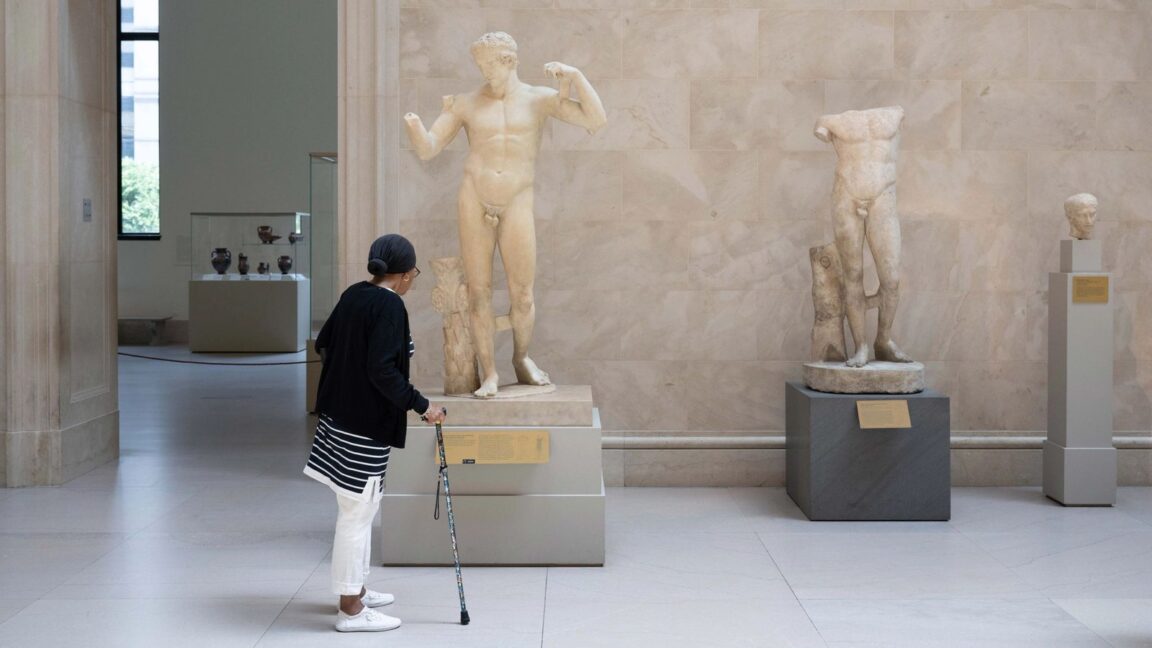
Skipping is a strategy, not a failure, in a museum of this size. Arms and Armor is magnificent, the parade of mounted knights anchored by the armour of Henry II of France from about 1555, but it is also self contained; give it twenty minutes, not an hour, unless armour is your passion. The musical instruments, the costume holdings beyond the current exhibition, and the deep benches of any single department will eat a first day if you let them. The Greek and Roman galleries, by contrast, deserve their place at the end of the route rather than the start: the marble athletes and painted vases read beautifully when you are tired, because the sculpture court asks for looking, not label reading. Build the day as three acts, Egypt and Europe, America and Asia, Greece and Rome, with real breaks between them. The museum’s cafes and the courtyard are part of the route; a first visit that never sits down ends in the familiar glazed shuffle past masterpieces nobody is seeing any more.
When do the Cloisters deserve their own half day?
Almost always, if medieval art, gardens or quiet hold any appeal, but never as a bolt-on to a full Fifth Avenue day. The Met Cloisters, the museum’s second site in Fort Tryon Park at the top of Manhattan, is built from the cloisters of European monasteries and devoted to the art, architecture and gardens of medieval Europe. It is smaller, calmer and more atmospheric than the main building, and the journey is part of the experience: the M4 bus runs directly between the Cloisters and 82nd Street and Fifth Avenue, or the A train and a park walk gets you there. The catch is the ticket: general admission covers both sites only on the same date, so the efficient play is a morning at the Cloisters, when its gardens are at their best, followed by the bus south and a Friday or Saturday evening at Fifth Avenue. That is a long day, but a coherent one. If you have two days, split them and pay twice; the Cloisters in a rush is a waste of the one museum in New York that runs on slowness.
What does it cost, and who pays what they wish?
General admission is $30 for adults, $22 for seniors aged 65 and over and for visitors with a disability, whose care partner enters free, and $17 for students, with children aged 12 and under free. New York State residents, and students from New York, New Jersey and Connecticut, pay what they wish, with a minimum of one cent per ticket and proof of residency or student status; online pay what you wish tickets require a New York State billing address, while New Jersey and Connecticut students buy in person with student ID. Members enter free. Special exhibitions are included in general admission, and advance tickets are not required for anyone, which removes the booking anxiety that surrounds other New York institutions: you can simply turn up, though buying on your phone on the way saves the desk queue.
Frequently Asked Questions
How long does a first visit to the Met take?
Plan three to four hours for a routed first visit covering Egypt, European Paintings, the American Wing and one or two more departments. A full day still will not exhaust the building, so choose a route and accept the skips.
Is the Met open on Wednesday?
No. Both the Fifth Avenue building and the Cloisters close every Wednesday, as well as on Thanksgiving, December 25, January 1 and the first Monday in May.
Does one ticket cover the Cloisters too?
Yes, on the same date. A general admission ticket is valid at both The Met Fifth Avenue and The Met Cloisters that day, which is why pairing a Cloisters morning with a late opening evening downtown works so well.
When is the Met least crowded?
Friday and Saturday evenings, when the museum is open until 9 pm, and the first hour after the 10 am opening on weekdays. Midday in the headline galleries is the peak to avoid.
Do I need to book tickets in advance?
No. The museum states that advance tickets are not required. Buy online on the way or at the Great Hall desks when you arrive.
Hours, admission prices, pay what you wish rules and Cloisters access checked against metmuseum.org, the museum’s official site, on November 24, 2026.
Photo: The Metropolitan Museum of Art, via metmuseum.org, the museum’s official website, used with credit. A visitor in the Greek and Roman galleries at The Met Fifth Avenue.