 River Callahan
The Alaska state ferry is not a cruise, and that is exactly its appeal. The Alaska Marine Highway System carries passengers, cars, kayaks and dogs along 3,500 miles of coastline to more than 30 communities, many of which have no road connection at all, from Bellingham, Washington, up the Inside Passage and out as far as Dutch Harbor in the Aleutian Chain. You ride alongside residents hauling groceries, trucks supplying villages and travellers sleeping in the solarium under a sleeping bag. In return you get port time in towns the big ships skip, the freedom to stop off and rejoin a later sailing, and a fare built from parts you choose yourself: a passenger ticket, a vehicle space if you bring one, and a cabin only if you want one. This guide explains how the system actually works, checked against the Alaska Department of Transportation’s own Marine Highway pages on November 24, 2026, so you can decide honestly between the ferry and a cruise ship before you book either.
Quick Facts
- The system: the Alaska Marine Highway covers 3,500 miles of coastline and serves over 30 communities, from Bellingham, Washington, to Dutch Harbor in the Aleutian Chain.
- How fares are built: a passenger fare, plus a vehicle fare based on overall length if you bring a vehicle, plus a cabin if you book one. Cabins are sold per trip, not per day or per person.
- Sleeping without a cabin: recliner lounges double as sleeping areas, covered solariums on the upper decks are popular sleeping spots, and small tents are allowed on the upper decks.
- Check-in: walk-on passengers check in 2 hours before departure in Bellingham and Juneau, and 1 hour before at all other ports. Passengers must clear security at least 30 minutes before boarding and be on board 15 minutes before departure.
- Baggage: walk-on passengers may hand-carry up to 100 pounds of baggage.
- Food: every vessel except the MV Lituya offers food and beverage service. The MV Columbia and MV Tustumena have full-service dining rooms, and passengers may bring their own coolers aboard.
- Reservations: book online through the state’s booking portal or call 1-800-642-0066, Monday to Friday, 8:00 am to 3:30 pm Alaska time.
- Money and tips: only US currency is accepted on board, and crew members are State of Alaska employees who are prohibited by state law from accepting tips.
How is the ferry different from a cruise ship?
A cruise ship is a resort that happens to move. The ferry is transport that happens to pass through some of the finest coastal scenery on earth. That single distinction explains every other difference. The ferry’s timetable serves communities first: it calls at small Inside Passage towns such as Wrangell, Petersburg, Hoonah, Gustavus, Angoon, Kake and Pelican alongside the headline ports of Ketchikan, Sitka, Juneau, Haines and Skagway, and it runs year round, in winter as a lifeline rather than a holiday product. There is no casino, no show lounge programme and no dress code. What there is, on the state’s own description, is a viewing experience of ice-blue glaciers, tranquil fjords, lush forests and heavy concentrations of seabirds and marine wildlife, watched from open decks and a heated solarium rather than from behind a balcony rail you paid extra for.
The second difference is freedom. A cruise passenger sees a port for the hours the ship allows. A ferry passenger can book port to port, get off in Petersburg for three days, and board a later sailing, because the ticket is transport, not a package. The state’s guidance is blunt about the flip side: if you want to stay in a port longer than a single sailing’s stop allows, you must book your sailing from port to port along the way, and the next ferry cannot continue your ride unless you have booked space on it first. Even during a single stop, the rule is to check with the purser on board before you go ashore, confirm there is enough time, and be back when told. Travellers who like building their own route, in the spirit of our Isle Royale ferry planning guide, will recognise the model immediately: the boat is the road, and the itinerary is yours to assemble.
What are your sleeping options, from deck passage to a cabin?
The ferry sells three broad ways to spend the night, and choosing between them is the main comfort decision of the trip. The cheapest is deck passage in the broadest sense: the recliner lounges also serve as sleeping areas, with space to roll out a sleeping bag, and the covered solariums on the upper decks of each vessel are, in the state’s own words, also popular sleeping areas. Travellers with small tents may pitch them on the upper decks. The official advice, delivered with unusual candour, is to bring duct tape, which campers use to secure a tent against the deck and the wind. There is no shame and no novelty in any of this. On a summer mainline sailing the solarium fills with sleeping bags in a way that regular riders treat as the normal social contract of the boat.
A cabin buys you a door, a bunk and quiet. Cabins provide basic amenities and vary in price according to size and location. They are equipped with single or double bunk-style berths, most include private bathroom facilities, and for those that do not, public restrooms and showers are available; public showers are fitted on all vessels except the MV Lituya. The pricing detail that matters most is that cabins are sold per trip, not per day or per person, so a cabin on a two-night Bellingham sailing is a single purchase covering the whole passage, and a couple sharing one cabin pays once, not twice. On the longest Inside Passage runs that structure makes a cabin better value than it first looks, while on a short daylight hop between Juneau and Haines it is usually money spent on a nap. Judge the cabin by the nights, not by the miles.
What does the ferry do with cars, kayaks, pets and baggage?
Vehicles are the ferry’s second trade. The system can transport any form of conveyance with wheels that has roll-on and roll-off capability, and vehicle space is the scarcest inventory on summer sailings, which is why the vehicle booking window matters more than the passenger one. The state’s warning deserves quoting in spirit: each vessel and port is unique, non-standard vehicles that are extra wide, tall or heavy can face restrictions from dock configurations and loading ramps, and accurate vehicle measurements are crucial to a smooth loading process. Measure honestly, book the vehicle space early, and treat a summer vehicle reservation as the first purchase of the trip, not the last.
Smaller cargo is simpler. Walk-on passengers may hand-carry up to 100 pounds of baggage, and baggage carts are driven from terminals and parked on the vessel car deck to help. Kayaks and canoes may be carried aboard, and small inflatable boats are allowed if they weigh less than 300 pounds and do not exceed 18 feet in length and 3 feet in width; anything larger travels on a trailer. Pets travel under firmer rules: animals are restricted to the car deck, must be properly contained in an approved carrier or transported in a vehicle, and must be accompanied by an adult passenger. There is no overnight or long-term parking at ferry terminals, so a car left behind needs a plan made with the departure terminal, not an assumption.
How far ahead should you book, and what can go wrong?
Book the pieces in scarcity order. Vehicle spaces go first, cabins second, and plain passenger seats last, because a walk-on traveller is the easiest booking in the system to accommodate. Summer mainline sailings between Bellingham and Southeast Alaska are the contested ones, and the sensible approach is to secure the vehicle and cabin as soon as your dates are firm, then build port stops around the confirmed sailings rather than the other way round. Changes and cancellations can be made through the reservations call centre, at any local ferry terminal, or by modifying the booking online.
Weather is the honest risk, and the system does not hide it. On the day this guide was checked, the state was advising that the MV Columbia’s departure from Bellingham had been delayed a day by a severe weather forecast for Queen Charlotte Strait, and that MV Tustumena sailings were cancelled for several days while crews repaired minor hull damage sustained while docking in Whittier. Neither notice is a scandal; both are the reality of a working ferry system on an exposed coast. Build a buffer day before anything in Alaska that cannot move, a flight home or a Denali bus booking further north, and keep the reservations number, 1-800-642-0066, in your phone. Identification is checked twice, at ticket acceptance and again before boarding, so carry government-issued photo identification in your hand luggage, not in the car.
Who should take the ferry, and who should take the cruise?
Take the ferry if you want Alaska itself rather than a performance of it: if the small towns are the point, if you are bringing a car, a kayak or a dog, if you would rather spend on days ashore than on board, or if you are travelling outside the summer cruise season altogether. Take the cruise if you want entertainment, dining variety and a crew whose job is your holiday, and if the ports are scenery between shipboard days. Neither answer is a compromise. The ferry’s own passengers include plenty of people who could afford the ship and chose the solarium anyway, sleeping bag, duct tape and all, because the Marine Highway is the last piece of the American highway system where the road itself is the destination.
Frequently Asked Questions
Can you sleep on deck on the Alaska ferry?
Yes. Recliner lounges serve as sleeping areas where you can roll out a sleeping bag, covered solariums on the upper decks are popular sleeping spots, and small tents are allowed on the upper decks. Bring duct tape to secure a tent, as the state itself advises.
How are ferry cabins priced?
Per trip, not per day or per person. Cabins vary in price by size and location, have single or double bunk-style berths, and most include a private bathroom. On a multi-night sailing, one cabin price covers the whole passage.
Can you get off at a port during a sailing?
Sometimes, if the stop is long enough. Check with the purser on board before arriving, follow the return time exactly, and remember that staying longer means booking port to port in separate segments, because the next ferry cannot carry you without a booking.
Is food available on board?
Yes, on every vessel except the MV Lituya. Self-service dining areas serve hot and cold items including Alaska seafood, salads and sandwiches, the MV Columbia and MV Tustumena add full-service dining rooms, vending machines cover the gaps, and you may bring your own cooler aboard.
Can you bring a pet on the Alaska ferry?
Yes, under car-deck rules. Animals stay on the car deck, contained in an approved carrier or travelling inside a vehicle, accompanied by an adult passenger, and all State of Alaska regulations for animals entering the state must be met.
Should you tip the ferry crew?
No. Crew members are State of Alaska employees and are prohibited by Alaska state law from accepting tips.
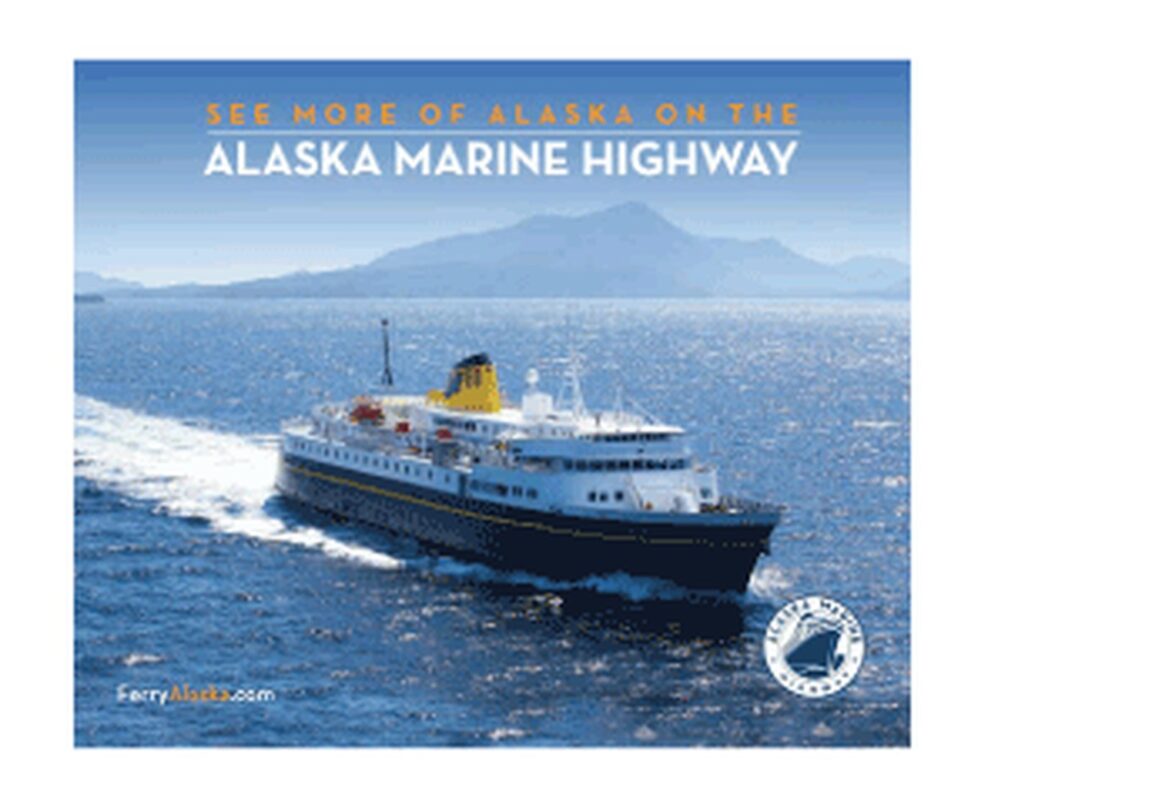
Image: An Alaska Marine Highway ferry underway on open water beneath coastal mountains, from the cover of the system’s official See More of Alaska handbook. Photo: Alaska Marine Highway System, via dot.alaska.gov/amhs, the system’s official website, used with credit.