 River Callahan
Denali runs on a single road, a single bus system and a single mountain that shows itself only about a third of the time, and three days is the visit length that finally respects all three facts. One day in Denali is a gamble on weather and wildlife. Three days gives you a frontcountry day to learn the park, a full transit bus day deep along the Park Road, and a spare day to spend on whichever promise the first two days made, a second bus ride, a ranger led hike, or a morning watching the mountain appear. This guide explains the one road system before you book anything, because in Denali the booking decisions, above all the transit bus reservation windows, decide what the trip can be. Season dates and prices below were checked against the National Park Service and the park’s reservation system on November 24, 2026.
Quick Facts
- One road: the Denali Park Road runs 92 miles into the park. Private vehicles may drive only the first 15 miles, to Savage River. Beyond that, buses are the way in.
- The current limit: the road is closed to all vehicles beyond Mile 43, at East Fork, because of the Pretty Rocks landslide at Mile 45.4. A bridge is under construction, and the Park Service expects full length bus services to resume in 2027.
- Bus season: transit and tour buses run from May 20 to September 17 in 2026. East Fork is the only transit destination.
- Transit price: the East Fork transit bus costs 33.50 dollars for adults 16 and over. Children 15 and under ride free but still need a reserved ticket.
- Entrance fee: park entry costs 15 dollars per person and is not included in a transit bus ticket. Narrated tour bus prices do include it.
- The mountain: Denali rises 20,310 feet, the highest summit in North America, and is visible on only about 30 percent of days, which is why local talk sorts visitors into the 30 percent club and everyone else.
- Scale: the park covers six million acres and receives roughly 600,000 visitors a year, almost all of them in the summer season from late May to early September.
The one road system, explained before you book
Everything in Denali planning descends from one piece of geography. There is exactly one road, it is mostly gravel, and for most of its length it is closed to private cars. You may drive your own vehicle as far as Mile 15, where the Savage River check station ends the public road. Past that point the road belongs to the park’s buses: green transit buses, which are transport first and commentary second, and tan narrated tour buses, which are the reverse. Transit buses are the flexible tool. You may get off at any safe point, walk the tundra or a river bar for an hour or three, and flag down a later bus, which is why hikers and photographers build their days around them. Tour buses keep you aboard and interpret as they go. Since the Pretty Rocks landslide cut the road in 2021, every bus turns around at Mile 43, East Fork, and the famous far country beyond, Polychrome, Eielson and Wonder Lake, waits for the bridge. The Park Service’s current plan has construction finishing in 2026 and full bus services resuming in 2027, so a 2026 visit is a visit to the eastern half of the road, planned well rather than apologised for. Our companion piece on the mistakes to avoid on Denali’s Park Road covers the booking traps in more detail.
Booking windows: the decision that decides the trip
Reservations for a summer’s transit buses open on December 1 of the previous year through the park concessioner, and the most popular dates and departure times go first. After the opening release, remaining seats are sold on a rolling basis, so a trip planned in spring is not hopeless, but a trip planned in December chooses its hours instead of accepting what is left. Book the transit bus before you book almost anything else, and book it for your second day, not your first, so that a travel delay cannot strand the reservation. Every rider needs a ticket in hand, including children, whose tickets are free but must still be reserved. Separately, hold the park entrance fee in the budget at 15 dollars per person: it rides on top of the 33.50 dollar transit fare, while the narrated tours, which run well over 100 dollars, fold entry into their price. Campers should know the same system governs the park’s campgrounds, and that the Riley Creek campground near the entrance is the practical base for a bus based visit without a car.
Day 1: the frontcountry, learned properly
Keep the first day inside Mile 15, where you are free to move at your own speed. Start at the Denali Visitor Center for the park film, the exhibits and the day’s ranger program board, then walk the gentle trails that loop through the spruce forest near the entrance. The park’s sled dog kennels, a short free shuttle ride away, run demonstrations in season and explain themselves as what they are, the only working sled dog kennel in the national park system, still patrolling the winter park by dog team. In the afternoon, drive or ride the free Savage River shuttle to Mile 15 and walk the Savage River Loop, an easy circuit of about two miles along a canyon the river cut through ancient rock, with Dall sheep sometimes on the ridges above. Day 1 has a second, quieter job: watch the sky. Note when the mountain shows, if it shows, and how the light moves, because that intelligence shapes how early you will want to be out on Days 2 and 3.
Day 2: the East Fork transit bus, ridden like a local
This is the expedition day, so take an early departure. The run to East Fork and back takes roughly four and a half to five hours with stops, and the road delivers the park in sequence: Savage River at Mile 15, the taiga thinning into tundra, and then the long wildlife miles where the bus slows for whatever the passengers spot, grizzly, caribou, moose, Dall sheep, and calls it out window by window. Drivers stop for animals, for photographs at the great viewpoints, and on request at any safe pullout for riders leaving to hike. Use that right once. The river bars and open tundra beyond Mile 30 are trackless hiking of a kind almost no other park allows, there are no trails to follow, and a two hour wander followed by a flagged down bus back is the quintessential Denali afternoon. Carry everything the day needs: no food is sold beyond the entrance, weather at road level can run from t-shirt sun to sleet in one ride, and binoculars double the value of every wildlife stop. Back at the depot by mid afternoon, the evening belongs to a ranger talk and an early night.
Day 3: spend it on the promise the park made you
The third day is why three days beats two. If the mountain hid on Day 2, ride again, a second transit ticket is the cheapest lottery ticket in Alaska, and mornings give the summit its best odds before the day’s clouds build on the peak. If wildlife was the story, book a ranger led discovery hike, where a ranger takes a small group off trail into the tundra to read it properly. If the weather broke gloriously, walk instead: the trails around Mountain Vista and the entrance area, or a return to Savage River with time to climb higher on the ridges. Travellers continuing deeper into the Alaska story can pair Denali with the inholding lodges described in our profile of Camp Denali, at the road’s far end in Kantishna, reachable by air while the road is cut. However Day 3 falls, it converts the trip from a single throw of the dice into a visit, and that conversion, in a park governed by one road and a one in three mountain, is the whole argument for the third day.
Mountain etiquette, and the 30 percent rule
A word on the mountain itself. Denali makes its own weather, standing so far above its range that cloud forms on the summit while the park below sits in sunshine, which is why a clear morning at the visitor center guarantees nothing and a grey one forbids nothing. The 30 percent figure is not a promise about your three days; it is a long run average, and three days roughly triples a single day’s chance without ever making the sighting likely enough to plan around. So plan around the certainties, the road, the tundra, the animals, the sled dogs, and let the mountain be what it has always been to everyone who travels here, a gift when it comes. When it does come, usually early, usually without warning, stop whatever the day was doing. Nothing else on the itinerary outranks it.
Frequently Asked Questions
How far can I drive my own car in Denali?
Fifteen miles, to Savage River. Beyond Mile 15 the Park Road is buses only, and in 2026 all vehicles, buses included, turn around at Mile 43 because of the Pretty Rocks landslide closure.
When do Denali transit bus reservations open?
Reservations for a summer season open on December 1 of the previous year through the park’s reservation system, with remaining seats then sold on a rolling basis. The East Fork transit fare is 33.50 dollars for adults, and children 15 and under are free but need a reserved ticket.
Is the park entrance fee included in the bus fare?
Not in the transit fare. Entry costs 15 dollars per person on top. Narrated tour bus prices include the entrance fee, which partly explains their higher prices.
What are the chances of seeing the mountain in three days?
The mountain is visible on about 30 percent of days. Three days gives you three separate draws, ideally including early mornings, but no honest guide can promise a sighting. Build the trip on wildlife and the road, and treat the mountain as a bonus.
When is Denali’s bus season?
Buses run in summer only, from May 20 to September 17 in 2026. Outside that window there are no transit or tour buses, and a visit is a frontcountry visit.
Can I get off a transit bus and hike?
Yes. That is the system’s purpose. Ask the driver to stop at any safe point, hike the trail free tundra, and flag down a later bus to return. Carry food, water and warm layers, as nothing is sold along the road.
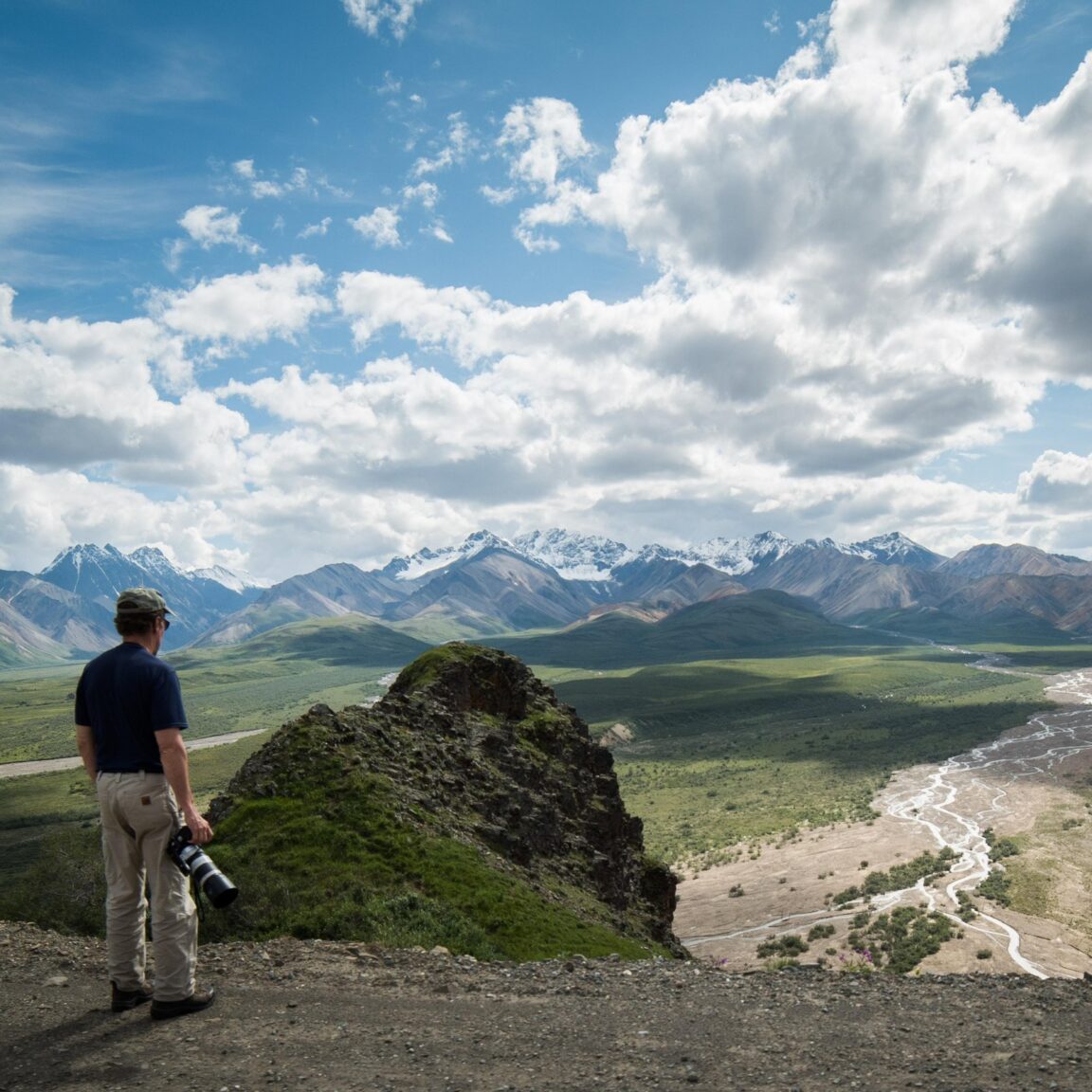
Image: A visitor with a camera at a scenic overlook above a braided river plain and the Alaska Range in Denali National Park. Photo: National Park Service, via nps.gov, the park’s official website, used with credit.