 Omar Haddad
Stay at least two nights in Essaouira. That is the whole argument of this guide, because the day trip version of this Atlantic port gives you the ramparts at the busiest hour and the medina at its most transactional, while the overnight version gives you the fishing port at dawn, Gnawa music after dark, and a wind calendar you can actually use to choose between a surf morning and a rampart afternoon. Essaouira’s medina was inscribed by UNESCO as a World Heritage Site in 2001 as an outstanding example of a late 18th century fortified port town, and the Gnaoua and World Music Festival has been held here every June since 1998. Both facts matter on the ground: this is a working, walled port that also happens to host one of Africa’s great music gatherings, and it rewards travellers who slow down enough to see both sides.
Quick Facts
Where: On Morocco’s Atlantic coast, west of Marrakech.
UNESCO status: Medina of Essaouira, formerly Mogador, inscribed on the World Heritage List in 2001.
Signature sights: The Skala de la Ville sea ramparts with their bronze cannons, the Skala du Port above the fishing harbour, and the working port itself.
Music: The Gnaoua and World Music Festival, held in Essaouira every June since 1998; Gnawa music is also heard in the medina year round.
Wind: Trade winds make the bay a long standing surf and windsurf shore, and the windiest afternoons are best given to the ramparts and the medina.
Stay: Two nights minimum to see the port at dawn and the town after the day buses leave.
What does an overnight stay give you that a day trip cannot?
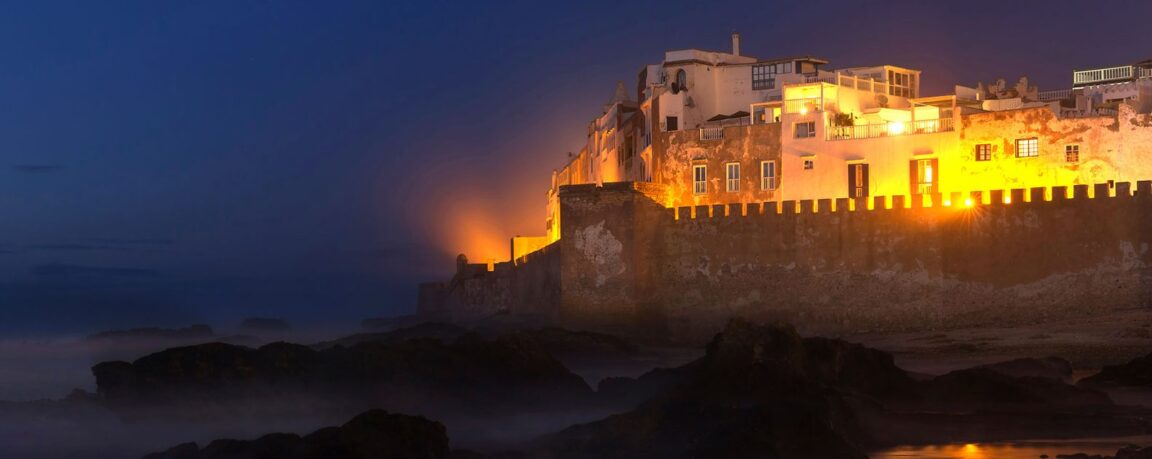
Time at the edges of the day. Early morning belongs to the port, where blue wooden boats land the catch, nets are repaired on the quay, and the grill stalls near the harbour gate are setting up rather than performing for a lunchtime crowd. Late afternoon belongs to the Skala de la Ville, the long sea rampart along the medina’s ocean edge, where a row of old bronze cannons still points at the Atlantic and the light turns the stone gold before the sun drops into the sea. Evening belongs to the medina itself, which is unusually legible for Morocco: Sultan Sidi Mohammed ben Abdallah had it laid out in the 1760s as a planned royal port, so its main streets run straighter than the labyrinth medinas of the imperial cities, and a first time visitor can learn its order in a single walk.
A day trip compresses all of that into the middle hours, when the wind is often strongest, the ramparts are fullest, and every cafe on Place Moulay Hassan is competing for the same visitors. Staying over also changes your relationship with the town’s sellers and musicians. You are no longer a three hour customer. You have time to return to a workshop, to hear a full set rather than a fragment, and to let the second day be unplanned, which is when Essaouira is at its best.
For a useful contrast with Morocco’s bigger medina, read our guide to mistakes to avoid in Marrakech’s medina before you combine the two cities in one trip. For another walled port that rewards an overnight stay over a cruise hour visit, see Kotor Bay beyond the old town.
How do the two Skalas differ, and which should you walk first?
Visitors confuse them constantly, so separate them now. The Skala de la Ville, also called the Skala de la Kasbah, is the medina’s own sea wall, reached by steps from the lane that runs along the inside of the ramparts. It is the sunset walk, the cannon line, and the view across the medina roofs and the offshore islands. Beneath and around it, vaulted spaces that once served the fortifications now hold workshops, many of them working thuya wood, the fragrant local timber that Essaouira’s carvers and marquetry makers are known for. The Skala du Port is the harbour bastion, out by the fishing port beyond the marine gate. Climb it for the view back across the boats to the walled town, the postcard angle that explains the whole geography in one frame: port in front, medina behind, islands offshore.
Walk the port Skala in the morning, when the harbour below it is working, and save the Ville ramparts for late afternoon. That order puts each bastion at its best hour and spreads your day the way residents use the town, outward to the water early and back into the medina as the light softens. Wear shoes with grip. Sea spray and worn stone make the rampart surfaces slick, and the wind that defines this coast does not politely die down just because you are standing on a historic wall with a camera.
Where does Gnawa music fit into an ordinary evening?
Gnawa culture is not a festival only phenomenon in Essaouira, even though the June festival, running since 1998, is when the town fills with stages in its squares and along the beach and musicians from across Morocco and far beyond it. The tradition itself, rooted in the descendants of West Africans brought to Morocco, centres on the guembri, a three stringed bass lute, metal qraqeb castanets, and all night ceremonial music in its ritual form. In an ordinary week you will hear its rhythms in medina lanes, in small venues and cafes, and from musicians playing in and around the main squares in the evening.
The respectful way to enjoy it is simple. Stay for whole pieces rather than filming thirty seconds and moving on, pay musicians whose performance you have enjoyed, and ask before close up photography of performers, just as you would anywhere. If your trip can be timed to the festival in June, book accommodation far ahead, because the town’s room stock is small against festival demand. If it cannot, do not treat that as a loss. An ordinary Gnawa evening in a half full room is a more intimate introduction than a festival main stage, and Essaouira outside festival week is calmer, cheaper to sleep in, and easier to know.
How does the wind decide a surf day from a rampart day?
Essaouira’s nickname, the Wind City of Africa, is a planning tool. The trade winds that cool the town through summer also build the conditions that made its long bay and the beaches to the south a surf and windsurf base, with schools working from the main beach. On a moderate wind morning, surf first: take a lesson or a board early, while the beach is quieter, then retreat into the medina when the afternoon wind peaks. On a strong wind day, reverse the logic entirely. Give the morning to the port and the medina, walk the ramparts when the light is good, and treat the beach as scenery rather than a swimming plan, because wind blown sand and a rough shore are poor ingredients for a relaxed swim.
This is also why Essaouira pairs so well with Marrakech in a single Morocco itinerary. The coast is the pressure release from the inland heat, and the roughly three hour road journey between them means you can leave the medina crowds after breakfast and be walking a sea wall by lunch. Give the pairing at least four nights split between the two, with the longer share wherever your interests sit, and resist any itinerary that tries to do Essaouira as a same day return. The road time alone eats the best hours this guide is built around.
Frequently asked questions
Is one night in Essaouira enough? One night is the minimum that unlocks the dawn port and an evening in the medina. Two nights is better, because it gives you a full unplanned day and a buffer against a strong wind day.
When is the Gnaoua and World Music Festival? In June, as it has been since 1998. Book rooms well in advance for festival dates, because Essaouira’s accommodation stock is limited.
What is the difference between the Skala de la Ville and the Skala du Port? The Ville is the medina’s sea rampart, best at sunset, lined with bronze cannons. The Port Skala stands above the fishing harbour and gives the classic view back across the blue boats to the walled town.
Why is the medina easier to navigate than others in Morocco? It was planned in the 1760s as a royal port under Sultan Sidi Mohammed ben Abdallah, with a more regular street layout than the organic medinas of older cities.
When should I surf and when should I sightsee? Surf in the morning on moderate wind days, and switch to the port, medina and ramparts when the afternoon trade wind peaks or the wind is strong all day.
Image credit: Essaouira’s medina sea walls at dusk, Visit Morocco, via visitmorocco.com.