 River Callahan
Australia’s working holiday is two visas with one nickname, and the 2026 settings are these: subclass 417 and subclass 462 each give 12 months from your first entry, the first visa costs 840 Australian dollars, you must be 18 to 30 on the day you apply unless your passport is one of the ten that now run to 35, and a second year is earned with three months, usually counted as 88 days, of specified work in regional Australia. A third year needs six months of specified work during the second. You apply online from outside Australia for the first visa, you should hold about 5,000 dollars plus a fare out, and since 1 July 2026 your age is judged on the day you lodge, so a birthday deadline is a hard wall, not a guideline.
Quick Facts
The two visas: Subclass 417 Working Holiday and subclass 462 Work and Holiday; your passport decides which
Age: 18 to 30 inclusive; 18 to 35 for the 417 passports of Canada, Cyprus, Denmark, Finland, France, Germany, Ireland, Italy, South Korea and the United Kingdom
Fee: 840 Australian dollars for a first visa; 1,000 dollars for a second or third, set by the Department of Home Affairs
Stay: 12 months from first entry, multiple entry, study up to 4 months, work for any employer usually up to 6 months per employer
Second year: 3 months, usually 88 days, of specified work in regional Australia during the first year
Funds: Usually about 5,000 Australian dollars, plus a return ticket or the money to buy one
Checked: 24 November 2026, against Department of Home Affairs visa pages
Which visa does your passport get?
You do not choose. Subclass 417 covers 19 passports, including the United Kingdom, Ireland, Canada, France, Germany, the Netherlands, Sweden, Denmark, Italy, Japan, South Korea, Taiwan, Belgium, Estonia, Hong Kong, Malta, Norway, Cyprus and Finland, with no cap, no ballot, no education requirement and no English test. Subclass 462 covers a different list of around 30 countries, including the United States, Spain, Portugal, Austria, Poland, Argentina, Chile, Indonesia, Israel, Thailand and Vietnam, and it asks for more: evidence of tertiary study for most passports, functional English for most, a government support letter for some, and, for China, India and Vietnam, a pre application ballot you must be selected in before you may apply at all. Annual caps apply to most 462 countries, with the United States the standing exception. Two applicants standing in the same hostel kitchen can therefore have faced completely different doors into the same year, and both doors are correct.
How does the age rule really work?
By the day you lodge, and by Australian eastern time. Home Affairs counts you as eligible if you apply before midnight on the day before your 31st birthday, or your 36th where the higher limit applies. The July 2026 change widened the 35 club on the 417: Cyprus, Finland, Germany and South Korea joined Canada, Denmark, France, Ireland, Italy and the United Kingdom at 18 to 35, taking the group to ten passports. Every 462 passport remains 18 to 30. The trap is administrative, not arithmetic: an application lodged a day late is not a nearly eligible application, it is an invalid one, and the fee conversation that follows is short. Anyone within a month of a cut off birthday should lodge first and plan the leaving party second. Your age on the day you fly, and on the day a decision is made, does not rescue or ruin a properly lodged application.
What does specified work actually mean?
It means named industries in named places, done for the required days while you hold the right visa. For the second year, the standard recipe is three months of specified work in regional Australia during your first year: plant and animal cultivation, fishing and pearling, tree farming and felling, mining, and construction are the classic 417 categories, with tourism and hospitality counting in northern and remote areas, and bushfire and flood recovery work counting where it is formally recognised. The 462 list overlaps but is not identical, and its geography has historically centred on northern Australia for hospitality. Days are counted by evidence, payslips, employer details and dates, not by memory, and work done while you held a different visa does not count. Keep every payslip from the first shift. The third year doubles the dose: six months of specified work carried out during the second visa. Travellers who treat the farm months as a rumour to be reconstructed at month eleven are the ones posting desperate questions in hostel groups. Those bound for the cities first can plan the landing with our first time Sydney four day itinerary.
How much does the year really cost to start?
The visa fee is the smallest honest number in the budget. A first visa is 840 dollars, a second or third is 1,000 dollars, and fees reset each 1 July, which is why older guides quoting 670 dollars are simply out of date. On top sit the funds expectation, usually about 5,000 dollars plus an onward fare, health cover you arrange yourself because working holiday makers are generally outside Medicare unless a reciprocal agreement covers their passport, a flight, and the first month of hostel beds and bond money before the first payslip lands. Card payments in ImmiAccount carry a surcharge. None of this is a reason not to go. It is a reason to arrive with the buffer Home Affairs describes rather than the buffer a social media caption describes, because the specified work that unlocks year two is much easier to choose well when you are not forced to take the first farm gate that opens. Shorter trips need a different door entirely, explained in our Australia ETA app guide.
What are the work and study conditions on the visa?
You may work for any employer, usually for up to six months with each one under condition 8547, with exemptions that have applied across sectors such as tourism and hospitality, agriculture, health and disaster recovery since the pandemic settings were broadened; check your own grant notice, because the grant is the document that governs you. You may study or train for up to four months, read by Home Affairs as 17 weeks. You may leave and re enter as often as you like inside the 12 months, which run from your first entry, not from the grant date, a distinction that rewards travellers who wait to enter until they are ready to use the year. Partners and children cannot be added as dependants to this visa; a couple applies as two individuals, twice the fees, twice the specified work if both want second years.
Frequently asked questions
How many days of work do I need for a second year? Three months of specified work, usually counted as 88 calendar days, completed in regional Australia while holding your first working holiday visa.
Can a 34 year old apply? Only on a passport with the 35 limit: Canada, Cyprus, Denmark, Finland, France, Germany, Ireland, Italy, South Korea or the United Kingdom, on subclass 417. All other passports stop at 30.
How much is the visa in 2026? A first subclass 417 or 462 visa costs 840 Australian dollars. A second or third costs 1,000 dollars. Fees are reviewed each 1 July.
Do I apply inside or outside Australia? A first working holiday visa is applied for online, from outside Australia, through ImmiAccount. Second and third visas can be lodged in or outside Australia, with bridging rules to check before you lodge onshore.
Can I work for one employer for the whole year? Usually not. Condition 8547 normally caps work with one employer at six months, although listed exemptions apply in several sectors. Your visa grant notice states your conditions.
Does the 12 months start when the visa is granted? No. It starts on the day you first enter Australia, and you generally have 12 months from grant to make that first entry.
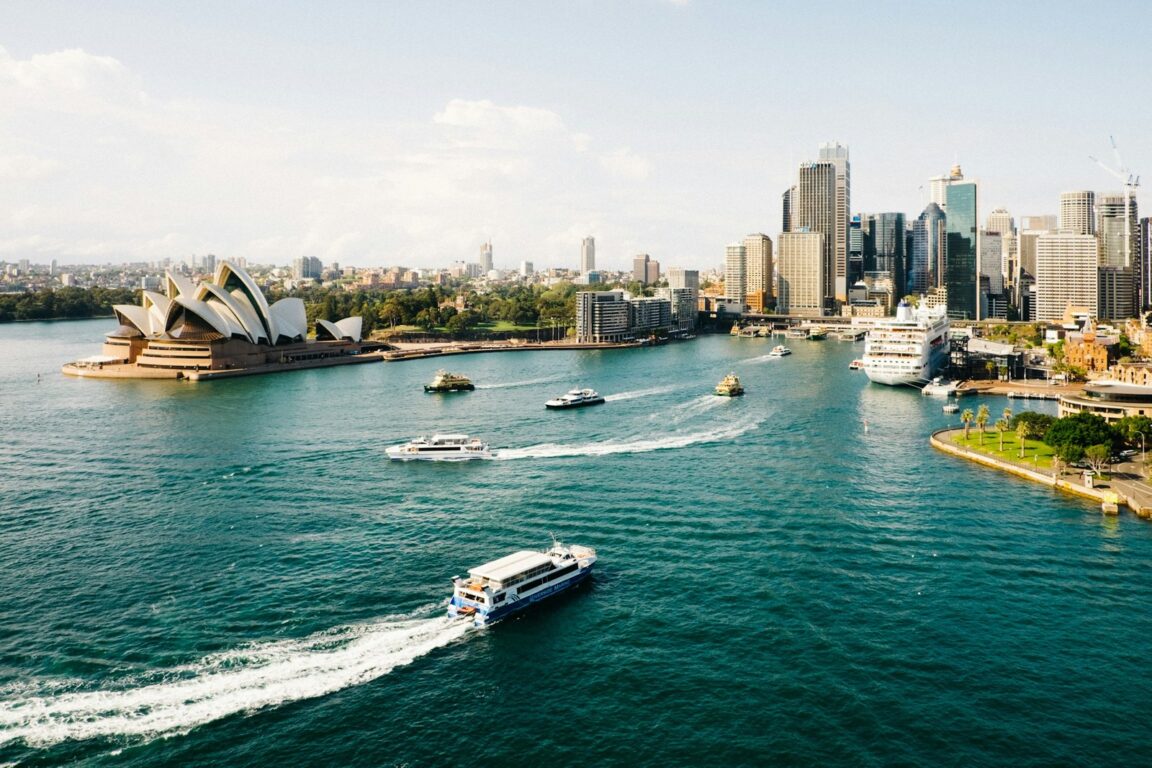
Image: Sydney Opera House and the harbour from Mrs Macquarie’s Point, the first view most working holiday arrivals walk to. Photo via Unsplash (photo 1506973035872-a4ec16b8e8d9), Unsplash License.