 LeVar Thomas
New York has not banned resort fees, and neither has Washington. What has changed, federally since 12 May 2025 and in New York City under its own hotel fee disclosure rule, is where the fee must appear: inside the first total price you are shown, not waiting for you at the final payment screen. The Federal Trade Commission’s Rule on Unfair or Deceptive Fees requires hotels and booking platforms to display the total price, including every mandatory fee, clearly and more prominently than other pricing information. Taxes and government charges may still be added later, optional extras stay optional, and the fee itself remains legal. So the quoted rate you compare today should already contain the destination fee, the facility fee and the urban fee, whatever a property calls it, and a rate that grows by a mystery nightly charge at checkout is a rate worth screenshotting and questioning.
Quick Facts
Federal rule: FTC Rule on Unfair or Deceptive Fees, 16 CFR Part 464, in effect for short term lodging since 12 May 2025
Core duty: Display the total price including all mandatory fees, more prominently than other price information
Still added later: Taxes and government charges, and genuinely optional extras, disclosed before you consent to pay
Not banned: Resort, destination, facility and urban fees themselves; the rule governs disclosure, not the amount
New York City: The Department of Consumer and Worker Protection has adopted its own hotel junk fee rule on the same total price model
New York taxes: City hotel room occupancy tax, state and city sales taxes, and a 1.50 dollar per unit per day hotel unit fee still apply on top of rent
Checked: 24 November 2026, against the FTC rule and New York City rulemaking notices
What must be inside the first price you see?
Everything the hotel knows is mandatory and can calculate. The FTC’s own worked example is a resort room advertised at 199 dollars with a mandatory 39 dollar daily resort fee: the fee belongs in the total, full stop. In New York the same logic catches the local vocabulary of fees, the destination fee in Midtown, the facility fee, the urban fee, the hospitality service fee, because the rule follows the substance, a charge you cannot decline, and not the label a revenue team chose in a meeting. The total must be shown clearly and conspicuously whenever a price is offered, displayed or advertised, and that duty binds the hotel and the third party platforms and travel agents who sell its rooms. A search results page, a hotel homepage and an app listing are all price displays. If the first number you see cannot be the number on your card for the room itself, before taxes, the display is the problem the rule was written to end.
What can still be added on top?
Taxes and government charges are the honest exception. New York City stays carry a stack of them: the city hotel room occupancy tax at 5.875 percent of the rent plus a flat per room per day amount that rises with the rent band, state and city sales taxes on occupancy, and the 1.50 dollar per unit per day hotel unit fee. Those may sit outside the advertised total, provided they are disclosed, with the final amount of payment shown, before you consent to pay. Optional charges sit outside too, provided they are genuinely optional: parking you decline, a minibar you ignore, a late checkout you choose. The line the rule polices is consent. A charge presented as optional but applied to every guest is a mandatory fee wearing a costume, and it belongs in the total. Deposits and card holds have their own disclosure moment: the amount and terms of a deposit or hold should be clear before payment, which matters in New York, where a nightly incidental hold can be larger than the fee that started the argument.
Why do people keep calling it a ban?
Because ban is a better headline than disclosure, and because a few American jurisdictions have gone further in tone if not in substance. The FTC is explicit that its rule does not prohibit any type or amount of fee or any pricing strategy; it prohibits hiding them. New York City’s rule, adopted by the Department of Consumer and Worker Protection after a 2025 proposal and hearing, follows the same model: it makes it a deceptive practice to advertise a hotel stay without the total, and its own title is about disclosure, Hotel Fee Disclosures, not prohibition. New York State legislation on the same theme has been introduced and debated, which adds to the noise. The traveller’s translation is simple. The fee may still be on your bill in 2026 and 2027. What you have gained is the right to see it in the first price, compare it honestly against the hotel across the street, and hold the seller to the number it advertised. For a sense of what the money buys at the calmer end of Manhattan, see our room by room look at Greenwich Village’s small hotels.
How do you screenshot a rate so it protects you?
Treat the booking like evidence, because under a disclosure regime, evidence is the point. Capture the search results page or listing with the total price, the dates and the property name in frame. Capture the room page showing what the total includes and what it excludes. Capture the final payment page with the full breakdown, the taxes itemised and the final amount of payment, before you press pay. Keep the confirmation email, which restates the bargain in the seller’s own words. If the folio at checkout later adds a mandatory nightly charge that was in none of those frames, you have a clean before and after: show the desk the advertised total first, ask for the added charge to be removed as undisclosed, and escalate to the platform that sold the room and, in the city, to the Department of Consumer and Worker Protection if it is not. Most desks fold quickly when the screenshot shows the total they themselves displayed. The same paper trail habit serves you at the airport end of the trip, as our JFK terminal and AirTrain guide keeps reminding late night arrivals.
Does the rule cover booking platforms and vacation rentals?
Yes, and that breadth is deliberate. The FTC rule covers businesses offering short term lodging, including hotels, vacation rentals and home shares, and it reaches the third party platforms, resellers and travel agents who display their prices. A platform cannot launder a hidden fee by blaming the property, and a property cannot hide behind the platform’s template. Whoever displays the price owes the total. That matters in New York, where the same room is sold through the hotel’s site, two global platforms, a members’ app and a map listing, sometimes at four different first numbers. Under the rule those first numbers should now converge on the same honest total, with taxes the remaining, disclosed, difference at the payment step.
Frequently asked questions
Are resort fees illegal in New York now? No. Resort, destination and facility fees remain legal. Federal and city rules require them to be included in the total price displayed from the start.
When did the federal rule start applying to hotels? The FTC Rule on Unfair or Deceptive Fees has applied to short term lodging since 12 May 2025.
Why is my final bill still higher than the advertised total? Usually taxes. New York adds occupancy and sales taxes and a 1.50 dollar per unit per day hotel unit fee, which may be excluded from the advertised total if disclosed before payment. Optional extras you chose also add on.
A site showed me a low rate and added a facility fee at checkout. What can I do? Screenshot both stages, raise it with the seller first, then the platform, and in New York City you can complain to the Department of Consumer and Worker Protection. A mandatory fee revealed only at payment is exactly what the rule targets.
Does the total have to be the biggest number on the page? The FTC requires the total price to be displayed more prominently than other pricing information, so a small honest total beside a huge partial rate is not compliance.
Are deposits and card holds part of the total price? A refundable deposit or incidental hold is not part of the price, but its amount and terms must be disclosed before you consent to pay, so there should be no surprise hold at the desk.
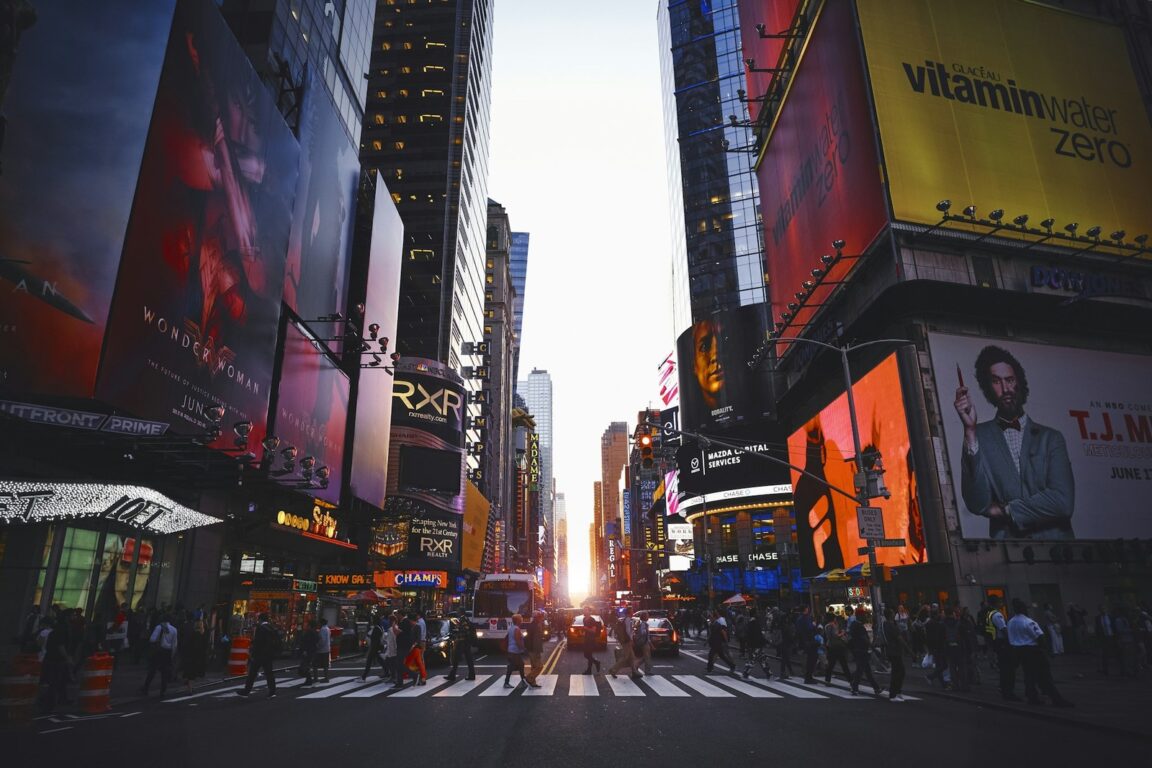
Image: Times Square at dusk, in the middle of Manhattan’s densest hotel district. Photo via Unsplash (photo 1496442226666-8d4d0e62e6e9), Unsplash License.