 Jonas Lindqvist
Seydisfjordur deserves to be judged as a destination in its own right, not as the dock where the Denmark ferry happens to land: this East Iceland village of roughly 700 people, at the head of a 17 kilometre fjord, holds the country’s most photographed small street, a working arts centre in a 1907 timber house, a sound sculpture on the hill, a waterfall walk that starts at the harbour, and a ring of Norwegian wooden houses that survived from the herring era. It is also genuinely at the end of the road. The only land route in is Route 93, 27 kilometres from Egilsstadir over the Fjardarheidi mountain pass, a road that closes the village off in winter storms. The other arrival is the sea: Smyril Line’s Norrona sails here from Hirtshals in Denmark via Torshavn in the Faroe Islands. Come either way, but stay at least a night. The village’s pleasures are slow ones, and they belong to the hours when neither a ferry nor a tour bus is in.
Quick Facts
- Where: Head of the Seydisfjordur fjord, East Iceland; about 700 residents
- By road: Route 93 from Egilsstadir, 27 km over the Fjardarheidi pass at about 600 metres; check conditions on umferdin.is
- By sea: Smyril Line’s Norrona from Hirtshals, Denmark, via Torshavn, Faroe Islands; sails April to mid November, check in at least 1 hour before departure
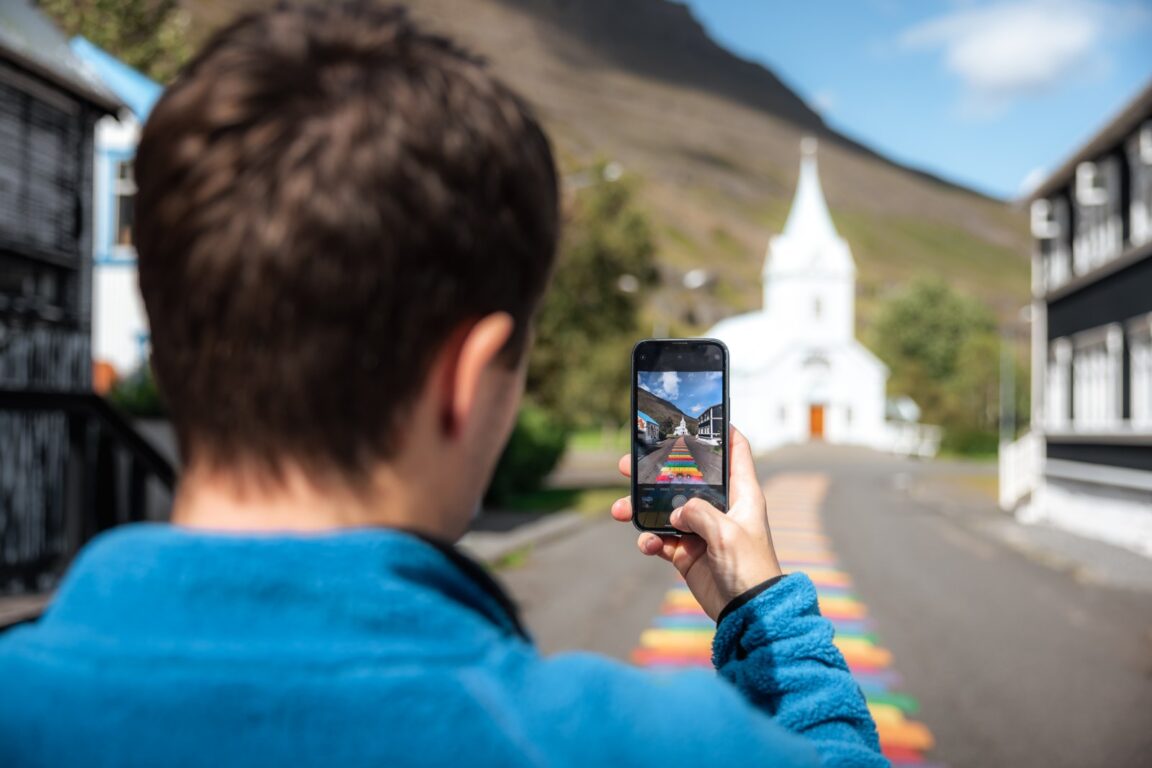
- Signature view: Rainbow Street, the painted pavement of Nordurgata, leading to the Blue Church
- Arts anchor: Skaftfell Center for Visual Art, in a timber building from 1907
- Waterfall: Gufufoss, on the Fjardara river on the road into town
- Facts checked: November 24, 2026, against Visit Austurland, Smyril Line and Icelandic road authority sources
Rainbow Street and the Blue Church
The village’s emblem takes five minutes to walk and repays an hour. Nordurgata, the street running up from the harbour, is painted in broad rainbow stripes that lead the eye straight to Seydisfjardarkirkja, the Blue Church, the pale blue timber church at the street’s end. Visit Austurland records that residents painted the street in the summer of 2016, and the repainting has become a start of summer ritual in the village. The church itself had a travelling life before this site: it was moved here in 1920 from Vestdalseyri, further out the fjord. In summer it is a concert hall as much as a church: the Blue Church Summer Concert Series, running since 1998, fills Wednesday evenings in July and early August with music in a room built of wood and light. Photographers should come early or late in the day, when the street is empty of the ferry hour crowd and the fjord light does the work.
The arts village: Skaftfell and Tvisongur
Seydisfjordur’s second identity is its art scene, improbable at this latitude and entirely real. Skaftfell Center for Visual Art, founded in 1998 and housed in one of the village’s grand old timber buildings from 1907, runs exhibitions, residencies and a bistro, and it anchors a calendar that has made the village a byword for creative life in the east. Above the town, a 15 to 20 minute walk up the hillside, stands Tvisongur, the sound sculpture by German artist Lukas Kuhne: five interconnected concrete domes, each tuned to a tone of Iceland’s traditional five tone harmony. Step inside, hum, and the chambers answer. The walk up also gives the orientation view, the fjord, the harbour, the church and the coloured roofs in one frame. The Technical Museum of East Iceland completes the triangle, telling the stranger story of how this fishing village became a technology beachhead: the first submarine telegraph cable to Iceland came ashore here in 1906, and the museum’s machinery and workshops preserve that industrial past near the harbour.
The waterfall walk order
Water organises the walking here. On the drive in, Route 93 passes Gufufoss, the Steam Falls, where the Fjardara river drops in a broad, spray wreathed cascade a short walk from the road; it is the natural first stop before you even reach the village. In town, the Fjardara runs through the village in a staircase of falls, and the marked walking routes follow the river up the valley, passing cascade after cascade toward the heath. The Vestdalur valley, a protected nature reserve just beyond the village, extends the same logic into a half day: the Vestdalsa river, its waterfalls, and the ruins of Vestdalseyri, the abandoned settlement from which the church was moved into town. Walk them in that order, road waterfall, town river, valley reserve, and the village’s geography explains itself: everything here runs downhill to the fjord, and the village lives at the bottom of the slope.
The pass road, the ferry, and the winter truth
Route 93 is both the village’s lifeline and its gatekeeper. From Egilsstadir the road climbs onto Fjardarheidi, a high, pond dotted heath at about 600 metres, then descends in switchbacks with the fjord opening below, a descent famous enough to have carried a celebrated film sequence of a longboard ride down it. In summer it is an easy half hour. In winter the pass can close at short notice in storms, and the village plans around that fact; check the Icelandic Road Administration’s conditions at umferdin.is before driving it between October and May, and take a closure as information, not insult. The ferry writes the other timetable. Norrona sails between April and mid November, linking Hirtshals and Torshavn with Seydisfjordur roughly weekly, with check in no later than an hour before departure. Ferry day reshapes the village for a few hours, cars rolling off, cabins emptying, the cafe queues lengthening, and then the quiet returns, which is precisely when Seydisfjordur is at its best.
How long, and where it fits
Half a day covers the street, the church and Skaftfell, and sells the place short. One full day and a night is the honest unit: arrive over the pass in the afternoon, walk the river and the sound sculpture in the long evening light, hear the village without the ferry in it, and spend the next morning on Vestdalur or the harbour before the road calls you on. Two nights turns it into a base for the northern Eastfjords. However long you give it, build the plan around the two facts that define the village: a single mountain road that weather can close, and a single weekly sea link to Europe. Seydisfjordur is not on the way to anywhere. That is the whole point of it, and the reason the rainbow street leads to a church at the end of a fjord, in a village that travellers remember out of all proportion to its size.
Frequently Asked Questions
How do you get to Seydisfjordur?
By road on Route 93 from Egilsstadir, 27 km over the Fjardarheidi pass, or by sea on Smyril Line’s Norrona ferry from Hirtshals in Denmark via Torshavn in the Faroe Islands, sailing April to mid November. Egilsstadir, with its airport and Ring Road junction, is the gateway either way.
When was Rainbow Street painted?
Visit Austurland dates the painting to the summer of 2016, when residents painted the pavement of Nordurgata in rainbow stripes running up to the Blue Church. It has been refreshed since and is now the village’s signature view.
Does the road to Seydisfjordur close in winter?
Yes, it can. Route 93 crosses the Fjardarheidi heath at about 600 metres and closes at short notice in winter storms. Check live conditions on umferdin.is, the Icelandic road authority’s site, before travelling between October and May.
What is Tvisongur?
A sound sculpture by Lukas Kuhne on the hillside above the village: five interconnected concrete domes tuned to the tones of Icelandic traditional harmony. It is a 15 to 20 minute walk from the centre, and visitors step inside and sing or hum to hear the chambers resonate.
Is Seydisfjordur worth more than a ferry stop?
Yes. The Rainbow Street and Blue Church, the Skaftfell arts centre, the Technical Museum, the Fjardara waterfall walks and the Vestdalur reserve fill a full day easily, and an overnight shows the village at its quietest, after the ferry has sailed.
Image: Seydisfjordur’s Rainbow Street on Nordurgata, photographed toward the church. Photo: Thrainn Kolbeinsson, via Visit Austurland (east.is).