 Wei Chen
Flushing’s food courts reward a system, because the neighbourhood packs more regional Chinese cooking into a few blocks than most cities manage in total. Start in the basement of New World Mall on Roosevelt Avenue, where the MTA’s own Chinatown guide counts three dozen stalls covering everything from Chongqing noodles to Uyghur laghman. Then walk two minutes to Prince Street for the soup dumplings at Nan Xiang Xiao Long Bao, the Flushing original that the Michelin Guide recommended nine years running, and finish with White Bear’s chilli oil wontons. Bring cash: the smallest and best counters in the courts still run cash first.
Quick Facts
- The anchor: New World Mall food court, basement level, 136-20 Roosevelt Avenue, with three dozen or more stalls under one roof
- The soup dumpling benchmark: Nan Xiang Xiao Long Bao, 39-16 Prince Street, the restaurant’s original Flushing home since 2006, Michelin Guide recommended for nine consecutive years by its own account
- The wonton stop: White Bear, famous for a dozen pork wontons in chilli oil, listed at $10 in the MTA’s Away guide to the city’s Chinatowns
- The second court: New York Food Court, smaller than New World Mall, with Taiwanese steak, Hunan fish noodles and Shanghainese crab roe among its stalls, per the MTA guide
- Getting there: The 7 train and the Long Island Rail Road both terminate at Flushing Main Street; the courts sit within a few minutes’ walk of the station
- Money: Carry cash in small bills. Card acceptance has spread, but the classic counters and several court stalls remain cash only or cash preferred
How should the New World Mall basement be worked?
The basement court beneath New World Mall is the correct first stop, and it should be walked before anything is ordered. Three dozen stalls ring the space, each specialising narrowly: hand pulled Lanzhou noodles stretched to order, Sichuan malatang where the ingredients are chosen by weight, pan fried pork buns, Taiwanese shaved ice, and the Uyghur laghman that the MTA’s food guide singles out by photograph. A full lap takes five minutes and prevents the rookie error of committing to the first fragrant counter by the escalator.
Ordering is a system of its own. Each stall takes its own order and payment, most give a number or a buzzer, and the communal tables in the middle are found by whoever in the group is not currently queuing, which is the practical reason the court works best with two or more people: one holds the table, the others fan out and return with a region each. Solo diners should come before noon or after the lunch peak, when a seat at the edge is easy and the stalls are still firing at full quality. Dishes arrive as they are ready, not together, and the meal is meant to be eaten that way, grazing across the table.
Where do the soup dumplings actually get rolled?
Two minutes from the mall, Nan Xiang Xiao Long Bao is Flushing’s standard setter for xiao long bao. The restaurant tells its own story plainly: opened in Flushing in 2006, it built its name on soup dumplings made by hand, and carried a Michelin Guide recommendation for nine consecutive years. Its own menu board gives the order of business: the soup dumplings first, in pork or pork and crab, six to a steamer; then the supporting dishes the house lists as its top plates, pan fried pork buns, braised beef noodle soup, fried rice, and shrimp and pork wontons in spicy peanut sauce.
The dumpling technique is worth the thirty seconds it takes to learn. Lift the dumpling by its pinched top onto the spoon, nick the skin, drink the soup, then eat the dumpling with the black vinegar and ginger. Biting straight through a fresh xiao long bao is the neighbourhood’s most reliable way to burn a mouth, and the queue of regulars at the Prince Street door, which builds at lunch and dinner, moves fast enough that arriving at 11:30 or after 14:00 is the whole of the strategy required.
What fills the gaps between the two anchors?
White Bear, a tiny counter a short walk away, makes the dish that Flushing regulars argue about most: wontons in chilli oil, ordered by number, a dozen for $10 in the MTA’s guide, under a slick of house chilli oil and pickled greens. It is cash only in spirit and often in fact, it sells through, and it is a ten minute stop, not a meal: order it as the bridge between the mall and Nan Xiang, or as the final savoury course before dessert.
The New York Food Court is the connoisseur’s second court, smaller than New World Mall and, per the MTA guide, no less diverse: Taiwanese steak, spicy Hunanese fish noodles, Shanghainese crab roe dishes and Taishan stewed chicken on one corridor. Around both courts, Main Street and Roosevelt Avenue carry the bakeries, roast meat shops and bubble tea counters that turn the trip into a shopping run: end at a bakery for pineapple buns and egg tarts to carry home, which is how the neighbourhood itself finishes these excursions.
When should the 7 train be timed?
Flushing is the end of the 7 line, and the trains that make the courts easy also set the day’s edges. The lunch rush inside the courts runs from about noon to 13:30 on weekends, when every stall has a queue and the tables turn slowly; the same stalls at 11:00 are empty enough to talk to. The dinner rush builds from 17:30. The sweet spots are therefore late morning and mid afternoon, and both pair with the express pattern of the 7, which cuts the ride from Midtown substantially outside the peaks.
Come hungry, come with cash, and come with a list of three dishes rather than a restaurant: a bowl of hand pulled noodles in the basement, soup dumplings on Prince Street, wontons in chilli oil to finish. That triangle, walked in that order, is the Flushing food courts in their best form, and it leaves the bakeries of Main Street as the walk back to the station.
What should a first timer avoid?
Three mistakes account for most disappointing Flushing trips. The first is arriving at 12:30 on a Saturday with no cash, joining the longest queue in the basement and eating whatever it sells: the courts reward the early, the funded and the deliberate. The second is treating the food courts as the whole neighbourhood, when the streets between them, Main Street’s bakeries and roast shops, the supermarkets with their live tanks and regional snack aisles, and the Prince Street dumpling houses are half the experience. The third is ordering like a restaurant meal, one dish per person at one stall, in a format designed for sharing: the courts are built for groups ordering across regions, and even a pair of diners should think in fours and fives of small plates rather than two large ones. None of this requires expertise, only sequence: lap first, cash ready, table held, dishes staggered, dumplings at the benchmark address, and something baked for the train home.
One more court belongs in the notebook for a second visit: the food court inside the Landmark Quest mall complex on Main Street and the smaller courts scattered through the arcades off Roosevelt Avenue extend the same formula, regional specialists in tight stalls around shared tables, and Flushing regulars rotate among them by dish rather than by loyalty. The neighbourhood rewards that dish first thinking at every scale.
Frequently Asked Questions
How much cash should a Flushing food court trip carry?
Enough for the whole meal. Individual dishes at the courts are mostly priced in the low teens or below, and a generous three stop graze for one person fits comfortably in $40 of small bills, with the understanding that the smallest counters may not take cards at all.
What is the one dish to order at New World Mall?
Hand pulled noodles, watched as they are stretched, are the court’s signature performance and its most reliable plate. After that, follow the regional logic: malatang for Sichuan heat, laghman for the Uyghur counter the MTA guide highlights, shaved ice to close.
Is Nan Xiang the original Flushing location?
Yes. The company states it opened its first restaurant in Flushing in 2006, and the Prince Street address remains its home store, now alongside branches across the New York area and beyond. It is the branch to visit for this itinerary.
How long does the trip from Manhattan take?
The 7 train runs from Midtown to its Flushing Main Street terminus, with express services cutting the journey outside local stopping patterns, and the Long Island Rail Road from Penn Station is faster still. Both stations are a few minutes’ walk from Roosevelt Avenue’s courts.
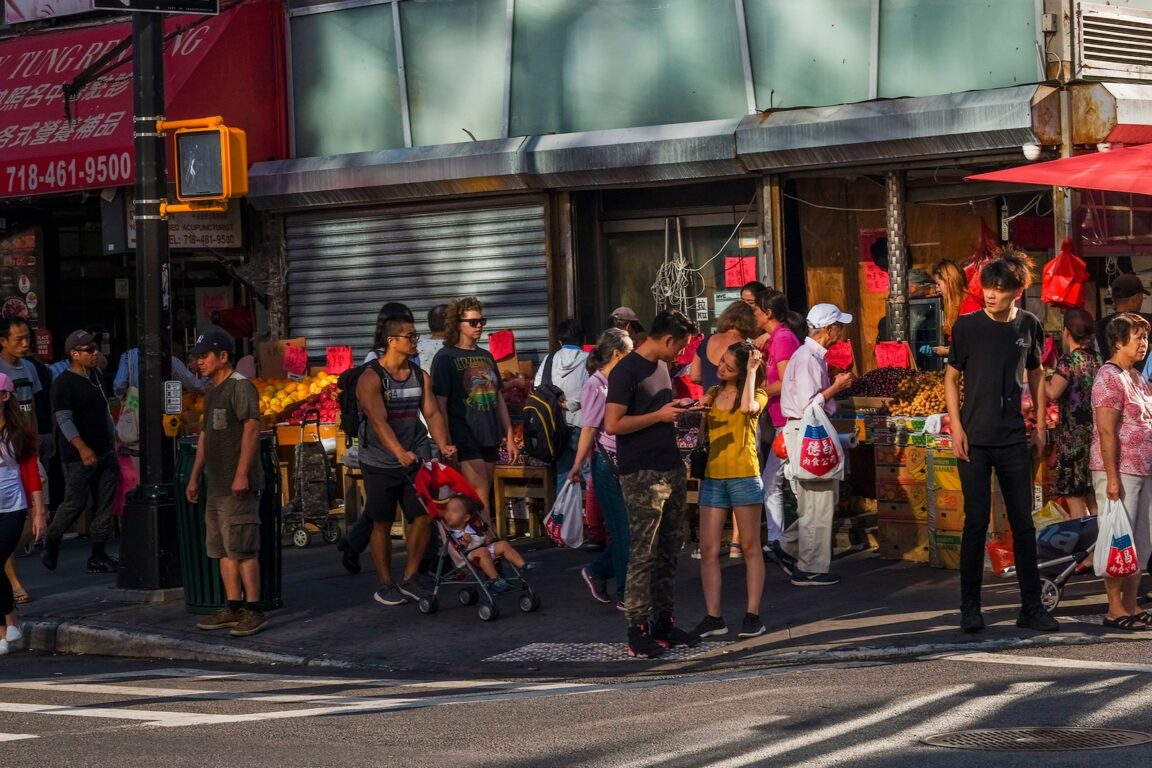
Photo: A Main Street market corner in downtown Flushing, photographed by Elizabeth Bick, via NYC Tourism (nyctourism.com), New York City’s official visitor authority, used with credit. Stall counts and recommendations checked against the MTA Away Chinatowns guide and Nan Xiang Xiao Long Bao’s official website on 24 November 2026.