 Sofia Rossi
The best version of Kotor starts by leaving the old town before the cruise crowds arrive in it. Base yourself in Kotor, climb the Ladder of Kotor at dawn while the stone is still cool, spend the quiet middle of the day on the waterfront at Prcanj, and finish in Perast, where small boats run out to the island church of Our Lady of the Rocks. That order, mountain first, calm shore second, baroque village last, is the back door into the Bay of Kotor, and it works precisely because it runs against the flow of the day boats and the old town queues.
Quick Facts
- Base: Kotor old town or the Dobrota waterfront, Montenegro
- Heritage status: The Natural and Culturo-Historical Region of Kotor has been a UNESCO World Heritage Site since 1979
- The Ladder: Waymarked trail 759, the old caravan road toward Njegusi, with more than 70 switchbacks
- Fortress climb for comparison: About 1,350 steps to St John’s Fortress, roughly 260 metres above the bay
- Prcanj: A quiet captains’ village on the bay’s western shore, anchored by the Church of the Birth of the Virgin Mary
- Perast: About 12 to 14 kilometres from Kotor by the shore road; local buses run about hourly
- Island boats: Small boats from the Perast waterfront cross to Our Lady of the Rocks in 5 to 10 minutes
- Currency: Euro
Why does the bay reward travellers who skip the old town first?
Kotor’s walled town is a few hectares of lanes inside fortifications that run about 4.5 kilometres, up the mountain as well as around the streets. It is magnificent, and between roughly 10am and the middle of the afternoon in season it is also full, because the Port of Kotor receives hundreds of cruise calls between spring and autumn and the passengers all walk through the same Sea Gate. The bay outside the walls tells a different story. The water bends inland for about 28 kilometres between the Orjen and Lovcen massifs, pinching at the Verige strait, where the shores close to about 300 metres, before opening into the inner bays of Risan and Kotor. Along that shore sit Dobrota, Prcanj, Stoliv and Perast, villages built by sea captains whose houses face the water their ships worked. A traveller who treats the bay, rather than the old town, as the main event gets the same UNESCO landscape with a fraction of the company.
For the wider Montenegro picture, including the old royal capital inland, see our guide to Cetinje, Montenegro’s old royal capital. This article stays on the water and the mountain directly behind Kotor, because that is the ground a short stay can actually cover well.
How do you climb the Ladder of Kotor, and when should you start?
The Ladder of Kotor is the historic mule and caravan road that linked Kotor with the Montenegrin interior long before the modern road existed. Waymarked as trail 759, it leaves from behind the town, near the river gate side of the walls, and climbs in more than 70 switchbacks toward the abandoned hamlet of Spiljari, with its roofless stone houses and the small chapel of St George, before continuing up toward Njegusi and the Lovcen plateau. Most day walkers do not go that far. The rewarding section is the lower and middle climb: an hour or so of steady zigzags that lifts you above the fortress line, with the bay opening wider at every turn and the red roofs of the old town shrinking into their triangle of walls.
Start at dawn for three practical reasons. The track is open rock with little shade, and in summer the heat on the slope builds fast. The light in the early morning comes across the bay rather than down into it, which is when the water and the far shore read most clearly. And the descent returns you to town before the cruise peak, leaving the rest of the day free. Carry water, because there is no reliable supply on the route, and wear shoes with real grip: the stone is worn smooth in places and treacherous after rain. Walkers have long used the Ladder as the free alternative to the ticketed fortress staircase, and the two routes are neighbours on the same mountain, but they are different experiences. The fortress climb, about 1,350 steps to St John’s Fortress at roughly 260 metres, is a staircase inside the fortifications. The Ladder is a road, older than the resort era, built for pack animals and trade, and it feels like one.
What makes Prcanj the bay’s quiet shore?
Prcanj, on the western shore a short bus or taxi ride from Kotor, is where the bay exhales. This was a village of ship captains, and its waterfront is a line of stone houses and small jetties facing across the water toward Dobrota and Kotor. The building that stops every walker is the Church of the Birth of the Virgin Mary, a large baroque church raised by the captains’ families on a terrace above the shore, reached by a broad sweep of steps and fronted by marble busts. Its scale is out of all proportion to the village, which is exactly the point: Prcanj’s money came from the sea, and the church is the receipt.
There is no checklist here beyond the church, the shore and lunch. Swimming is from the stone and concrete platforms along the waterfront, as it is all around the inner bay, and the water in the inner bay is calm and sheltered. Cafes and family restaurants line the road at a local pace. Prcanj works best as the middle of the day, after the morning climb, when the old town is at its most crowded and the shore here is at its emptiest. It is also a genuinely pleasant base for travellers who want Kotor’s bay without Kotor’s evenings: the bus ride into town is short, and the nights in Prcanj belong to the village.
How do the boats to Perast and Our Lady of the Rocks work?
Perast, further along the same shore, is the bay’s baroque miniature: one waterfront street, a run of palaces built by captains and merchants, and two islands sitting just offshore. The town lies within the same UNESCO listed region as Kotor, inscribed in 1979, and its St Nicholas bell tower, finished in 1691 and about 55 metres tall, is the tallest on the bay and can be climbed for the view back down the water. The Perast Museum, housed in the Bujovic Palace on the waterfront, gives the maritime story its evidence: portraits, weapons, ship models and the records of a town that trained sailors for empires. Published museum hours run Tuesday to Sunday, longer in the summer season and shorter in winter, with Mondays and January closed, so check the day before you build an afternoon around it.
The boats are the simplest arrangement on the bay. Small boats work from the Perast waterfront to Our Lady of the Rocks, the artificial island crowned by its church, crossing in 5 to 10 minutes and typically allowing half an hour or so on the island before the return. Agree the fare and the return time before you board, and carry small cash. The island exists because, according to the tradition Perast still keeps, sailors found an icon of the Virgin on the reef in 1452 and began laying stones around it; every 22 July the Fasinada procession still rows out at sunset to add more. The neighbouring island, St George, with its cypresses and monastery, is a view rather than a landing: boats pass it, and that is close enough. If you are weighing Perast as a destination in its own right, our earlier piece on Perast and its island churches makes that case in full.
How do you fit the Ladder, Prcanj and Perast into one day?
The sequence matters more than the speed. Climb the Ladder from first light and be down by mid morning. Take the local bus along the shore toward Prcanj, or walk the Dobrota waterfront if your legs allow, and give Prcanj the late morning and lunch: church steps, a swim from the platforms, a slow meal facing the water. Continue by bus to Perast for the afternoon, when the excursion boats from Kotor have thinned and the light on the palaces turns warm. Do the museum first if it is open, then the bell tower, then the island boat in the late afternoon, when the church island sits in the best light of the day. Buses on the shore road run about hourly and cost a couple of euros; pay the driver in cash and keep coins handy. Drivers should note the Kamenari to Lepetane car ferry across the Verige strait, a crossing of about 10 minutes that cuts the long drive around the head of the bay when you are heading to or from Herceg Novi and the airport side of the water.
Frequently Asked Questions
Is the Ladder of Kotor free to climb?
Yes. The Ladder is a public waymarked trail, trail 759, on the old caravan road. There is no ticket gate. The separate fortress staircase inside the walls is the ticketed climb.
How long does the Ladder take?
Allow one to two hours for the rewarding lower and middle section up to and beyond Spiljari, plus the descent. The full road continues toward Njegusi and is a much longer mountain day.
How do you get from Kotor to Perast without a car?
Local buses run along the shore road about hourly, take roughly half an hour and cost a couple of euros, paid to the driver. Shared boat trips from Kotor also call at Perast and the island.
Can you land on both of Perast’s islands?
No. Boats land visitors on Our Lady of the Rocks, where the church and small museum can be visited with shoulders and knees covered. St George island is viewed from the water.
When is the bay quietest?
Early mornings year round, and the shoulder months of spring and autumn, when cruise calls are fewer. On any summer day, the shore villages are calmest while the old town is busiest, from late morning to mid afternoon.
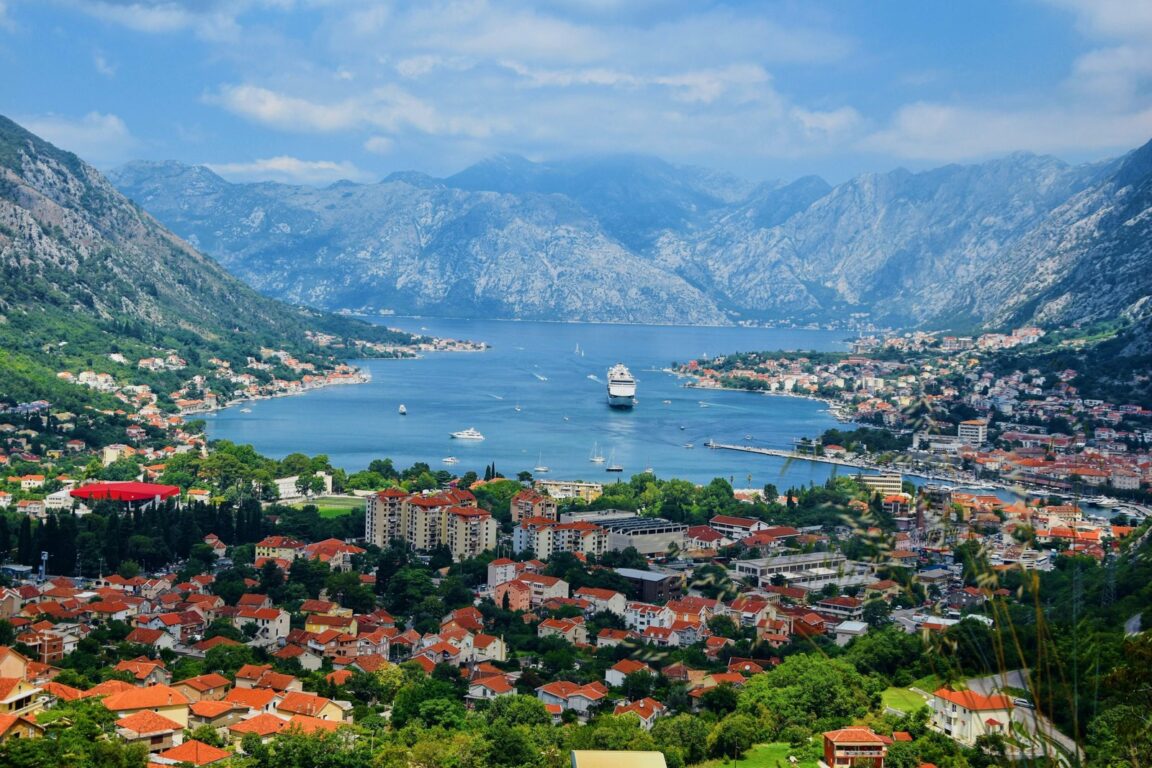
Featured image: The Bay of Kotor from above, Montenegro. Photo by Olga Brajnovic via Unsplash, Unsplash License.