 Thandiwe Nkosi
Azura Benguerra is a twenty villa eco boutique resort on Benguerra Island, the second largest island in Mozambique’s Bazaruto Archipelago, inside the Bazaruto Marine National Park. Guests reach it by an eight minute scenic helicopter transfer from Vilanculos International Airport on the mainland, and that short hop is what makes the resort such a natural beach finish to a Kruger safari: flights from Kruger Mpumalanga Airport to Vilanculos let travellers move from game drives to a private beach villa, often on the same day. Every villa is air conditioned, beachfront and built by hand by the local community, with a private pool, a beach sala, a sunbathing deck and a dedicated Mozambican butler host. Part of what a stay supports is visible on the island itself, because Azura’s Rainbow Fund built the island school and its first clinic, and the protected waters in front of the resort hold dugongs, seahorses, turtles and the reefs of Two Mile Reef.
Quick Facts
- Where it is: Benguerra Island, the second largest of the five islands in the Bazaruto Archipelago, inside the Bazaruto Marine National Park, about 14 kilometres north east of Vilanculos.
- The villas: twenty beachfront villas, hand built by the local community, each with a private pool, beach sala, sunbathing deck, outdoor sofa and dining table, and a private butler host.
- Getting there: fly to Vilanculos International Airport (VNX), then an eight minute scenic helicopter transfer to Benguerra Island.
- Safari pairing: flights from Kruger Mpumalanga Airport (MQP) serve Vilanculos, direct from July to January and routing via Johannesburg in the rest of the year, according to Azura.
- Helicopter luggage: 20 kilograms per person including hand luggage, in soft sided bags. Hard suitcases are not recommended, and the maximum size for one is 60 x 40 x 15 centimetres.
- Island size: Benguerra is approximately 9 kilometres by 5 kilometres and has about 2,000 inhabitants, according to Azura.
- Community fund: the Rainbow Fund built the island school in 2008, where 490 children now have primary education, and built the first clinic on the island, Azura says on its island drive description.
- Connectivity: wifi is available throughout Azura Benguerra Island via Starlink, and cell phone signal is usually available.
How does the Kruger to Benguerra pairing actually work?
The logic is a single change of scene with no long surface transfer in between. Safari time in the Greater Kruger area ends at Kruger Mpumalanga Airport, and Azura notes that flights from that airport to Vilanculos allow an excellent bush and beach combination with many lodges in the Greater Kruger area. From July to January those flights are direct. During the rest of the year they route via Johannesburg, which adds a connection but keeps the same one day shape to the journey. Johannesburg also has daily flights to Vilanculos, at approximately 80 minutes of flight time, and there are scheduled return flights between Maputo and Vilanculos as well.
Once a flight lands at Vilanculos, the resort leg is measured in minutes rather than hours. The helicopter transfer to Benguerra Island takes eight minutes and is described by Azura as scenic, crossing the channel between the mainland and the archipelago. That brevity matters after a safari, when early starts and game drive hours have already filled the trip. Instead of a boat schedule, a tidal window or a long road transfer, the beach part begins almost as soon as the mainland flight touches down. Travellers planning the reverse order, beach first and safari second, can use the same links in the opposite direction. For the safari half of the pairing, our guide to Londolozi Game Reserve covers one of the best known private reserves in the Greater Kruger system.
What are the twenty villas like, and who looks after you?
Azura describes its accommodation as an array of air conditioned villas, all carefully positioned to optimise turquoise views, beachfront access and a sense of seclusion. The design mixes modern amenities with beach chic Mozambican flair, and the villas were hand built by the local community, a point the resort returns to often because the building project is part of its founding story. Each villa has free flowing indoor and outdoor spaces, a private pool, a beach sala, a sunbathing deck, a comfortable outdoor sofa and a dining table.
Service is personal rather than departmental. Every villa has a private butler host, and guests meet that dedicated host on arrival. Azura says its hospitality team are Mozambican locals who share their island with guests, and the host is the person who cares for a villa throughout the stay, from serving a private beach dinner in front of the villa to setting up sunset cocktails on the deck. The pattern suits the safari pairing well: after days of being looked after by a ranger and tracker team at a lodge, the beach days keep the same small team, one host model rather than switching to an anonymous large hotel.
What is there to do on the water, from dhows to dugongs?
The sunset dhow cruise is the signature slow excursion. Guests board a traditional East African sailboat for a private sunset sailing, with a cocktail in hand as the wind catches the sails and the sun sinks into the sea. It is the direct descendant of the dhows that have worked these waters for centuries, and it needs no engine noise and no itinerary beyond the light. Azura also runs island hopping by boat, combining the climb up Bazaruto Dune for views across the archipelago, tidal Pansy Island with its shells, snorkelling at Two Mile Reef and a picnic lunch at North Point.
Two Mile Reef is the main snorkelling and diving site, set in the protected marine reserve and described by Azura as teeming with sea life in sunlit warm water, with bright fish, turtles and smaller rays. Scuba sites across the archipelago add moray eels, several ray species and colourful coral, and a qualified dive certificate is required, although PADI courses can be done at the resort. Closer to shore, the seahorse marine safari explores the seagrass meadows directly in front of the resort, a locally managed marine protected area home to two resident seahorse species, the giraffe seahorse and the kuda seahorse, alongside pipefish, shrimps, nudibranchs and moray eels, guided by the in house marine biologist.
The dugong excursion is handled with deliberate restraint. Azura describes the local dugongs as the last remaining population of these marine mammals in the West Indian Ocean, grazing on seagrass and present year round. Guests drift by in a boat to observe them, and the resort is explicit that diving or snorkelling with dugongs is not permitted. That rule is the point: the sighting is valuable precisely because the animals are left undisturbed. Whale watching runs in season, when humpback whales pass through the channels between July and October on their migration from Antarctic waters. Fishing, beach picnics at North Point, Wild Side and Paradise Island, horse riding along the shoreline, stargazing with a local expert and spa treatments using traditional African oils and balms fill out the rest of the programme.
How does the Rainbow Fund connect a stay to the island?
Benguerra is not an empty resort island. About 2,000 people live there, and Azura was built by hand in partnership with that community and is staffed by Mozambican hosts, guides and teams. The Rainbow Fund is the resort’s community and conservation vehicle, and the clearest way to see what it does is to take the island drive. Azura says the drive visits local communities and stops at the school built by the Rainbow Fund in 2008, where 490 children now have the opportunity of primary education, while 34 children on the mainland attend high school. The drive also passes the first clinic ever built on the island, offering health screening and medications that were previously unavailable, also built by the Rainbow Fund. Island stays also reward a close look at how per night charges stack up in island destinations, which our explainer on the Maldives green tax rise works through for a different archipelago.
What should you sort out before you travel?
Visas need early attention. Azura’s current guidance is that guests travelling on an international passport who are not South African or SADC nationals must complete an online entry application 48 hours or more before arrival, and the resort advises applying at least four to seven days before the arrival date through the Mozambique e visa system. Payment is taken on arrival at Vilanculos International Airport, in cash, and Azura lists the cost per visa as US 160 dollars for non exempted countries and US 11 dollars for the exempted countries it names. Those figures are the resort’s current understanding of regulations that it notes may change without notice, so check them again close to departure rather than treating this page as the final word.
On arrival, Azura lists a passport valid for at least six months after departure from Mozambique, a minimum of three empty passport pages, a copy of the electronic travel authorisation printed or digital, and the confirmation of accommodation letter the resort prepares when guests send passport details in advance. Cash in new notes and small denominations is advised for the visa payment, and the resort suggests travelling with 100 dollars or more in small denominations for contingencies. On money generally, Azura prices extras in US dollars but takes payment in meticais under Mozambican law, accepts major credit cards except American Express and Diners, and also accepts South African rand, euros and US dollars, but not traveller’s cheques.
Frequently Asked Questions
How do you get to Azura Benguerra from Vilanculos?
By helicopter. Azura states that the transfer from Vilanculos International Airport to Benguerra Island is an eight minute scenic helicopter flight. The luggage allowance is 20 kilograms per person including hand luggage, in soft sided bags.
Can you combine Azura Benguerra with a Kruger safari?
Yes, and Azura promotes exactly that pairing. Flights from Kruger Mpumalanga Airport to Vilanculos are direct from July to January and route via Johannesburg in the rest of the year, connecting Greater Kruger lodges with the helicopter hop to Benguerra.
What does each villa at Azura Benguerra include?
Each of the twenty villas is air conditioned and beachfront, with a private pool, a beach sala, a sunbathing deck, an outdoor sofa and dining table, free flowing indoor and outdoor spaces, and a dedicated Mozambican butler host for the stay.
Can you swim or dive with the dugongs at Benguerra?
No. Dugong spotting is done by drifting past in a boat to observe the animals as they graze on seagrass. Azura states clearly that diving or snorkelling with dugongs is not permitted.
What is the Rainbow Fund at Azura Benguerra?
It is Azura’s community fund for the island. On its island drive, Azura credits the Rainbow Fund with building the island school in 2008, where 490 children now receive primary education, and with building the first clinic on Benguerra Island.
When is whale watching season at Benguerra Island?
Between July and October, when humpback whales pass through the channels around the island during their annual migration from Antarctic waters to warmer equatorial waters to give birth, according to Azura.
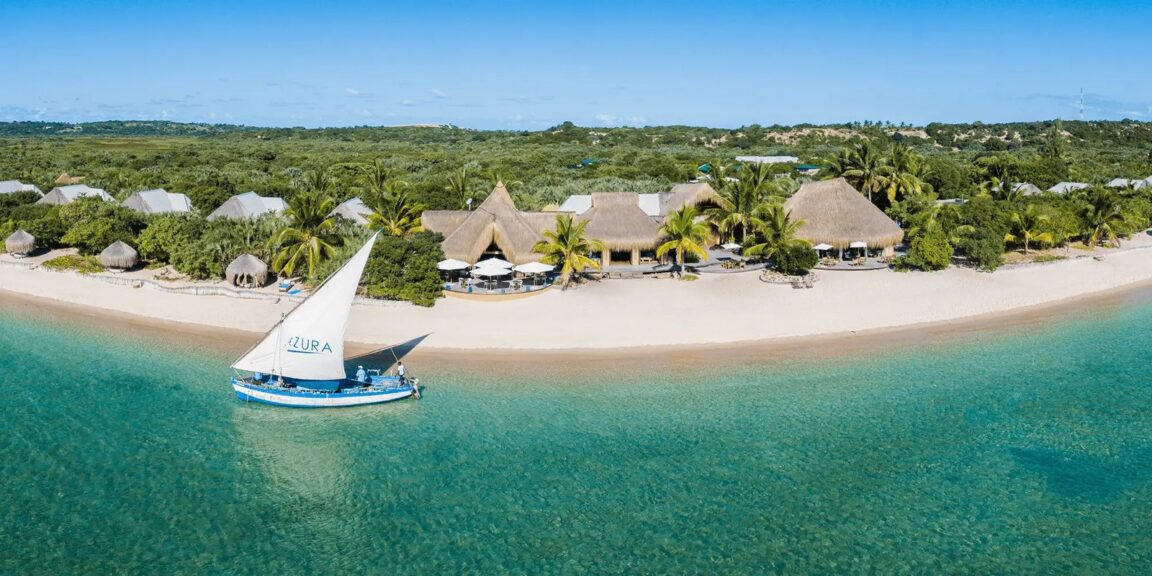
Featured image: aerial view of the Azura Benguerra main area on Benguerra Island, its thatched beachfront buildings and palms above a white sand beach, with the resort’s own dhow, its sail marked Azura, on turquoise water in front of the resort. Source: Azura Retreats, the property’s own official website (azura-retreats.com). Creator: Azura Retreats (azura-retreats.com).