 Jordan Ellis
Bisbee earns an overnight, not a drive through, because its two defining experiences pull in opposite directions: the Queen Mine Tour takes you 1,500 feet into the mountain that made the town, and the Bisbee 1000 stair route climbs through the neighbourhoods that copper money built above it. This is a former copper boomtown in the Mule Mountains of southeastern Arizona, close to the Mexican border, which reinvented itself as an art colony after the mines closed. Judge it on that double identity. Book the mine tour first, because its fixed departure times anchor the day, climb stairs in the cool of the morning, and stay for the evening, when the galleries close, Brewery Gulch lights up and the day trip crowds have gone.
Quick Facts
- Setting: Old Bisbee, a canyon town in the Mule Mountains, Cochise County, Arizona, at roughly 5,300 feet
- Anchor booking: Queen Mine Tour, 478 N Dart Road, just south of Old Bisbee off the Highway 80 interchange
- Tour times: Five departures daily at 9 am, 10:30 am, noon, 2 pm and 3:30 pm, about one hour, reservations required
- Tour price: $18 adults, $9 children aged 6 to 12, taxes included; children under 6 are not permitted underground
- Underground: About 1,500 feet into the mountain by mine train; a constant 47 degrees Fahrenheit; hard hat, lamp and yellow slicker provided
- The stairs: The Bisbee 1000 links nine public staircases totalling 1,034 steps through the hillside neighbourhoods
- Getting there: About 90 miles southeast of Tucson by road; driving is the practical option
What happens on the Queen Mine Tour?
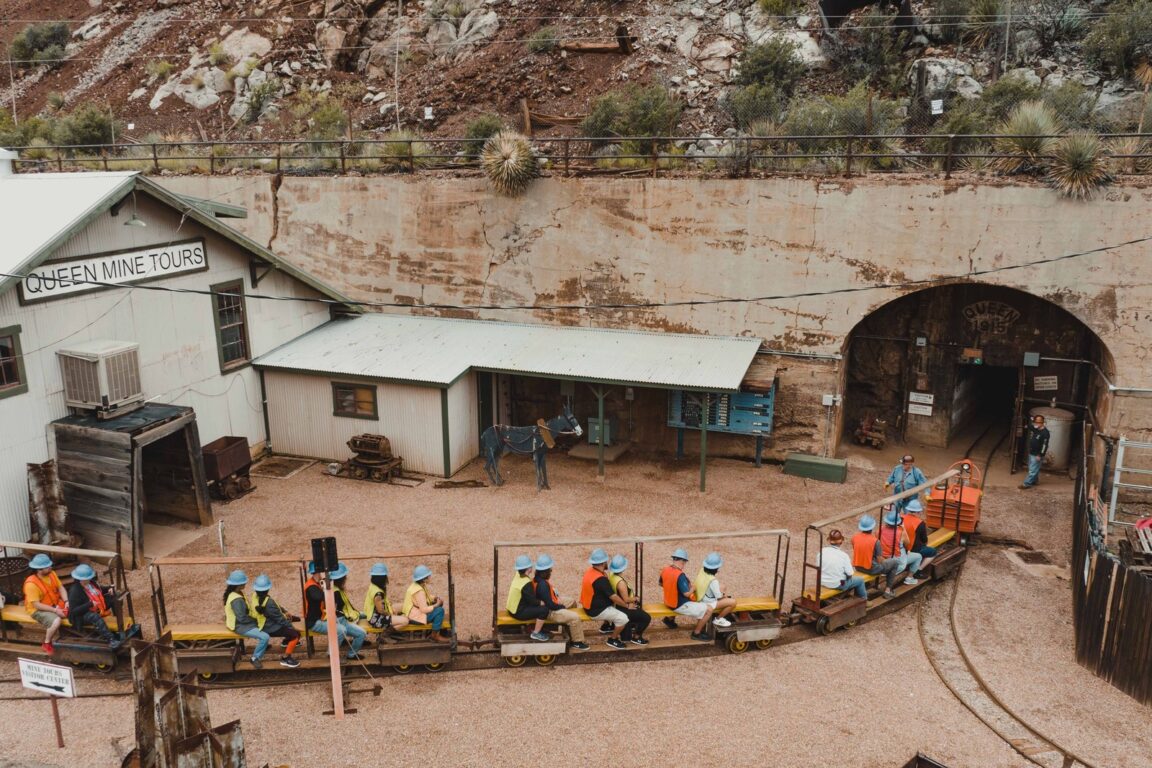
The tour is run from the Queen Mine Tour building at 478 N Dart Road, and it is a working mine experience rather than a museum reconstruction. Visitors are fitted with a hard hat, a miner’s lamp and a yellow slicker, loaded onto the mine train and carried about 1,500 feet into the Queen Mine. Underground, guides, many of them retired miners, explain how copper was drilled, blasted and hauled out of this mountain, and the route includes a walk of about 300 feet through a tunnel and one stop with 36 steps, which can be skipped by staying on the train. The official tour site lists five departures a day, seven days a week, with reservations required and check in well before departure. Two practical notes decide whether people enjoy it: the underground temperature sits at 47 degrees Fahrenheit all year, so bring a layer even in summer, and closed shoes are the sensible choice for wet tunnel floors. For the wider Arizona context before you go, our Sedona hiking and wellness guide covers desert altitude and sun discipline, and our Tucson food guide plans the natural stop on the drive down.
How should you walk the Bisbee 1000 and the neighbourhood stairs?
Bisbee was built vertically because it had no choice. Miners’ houses climb the gulches above the commercial canyon floor, and the town connected them with public staircases that now form the Bisbee 1000, a signed route of nine staircases and 1,034 steps threading the hillside neighbourhoods. Walk it as a morning hike, not a stroll: start early for cool air and low sun on the rooftops, carry water even in winter, and expect iron railings, landings with shrines and gardens, and long views back over town to the Mule Mountains. The route is also the course of the Bisbee 1000 Great Stair Climb, the town’s signature October endurance event, which tells you how to pace it. These are residential stairs passing people’s front doors, so keep voices down, stay on the public path and do not treat porches as viewpoints. If 1,034 steps at altitude is more than the day allows, climb two or three staircases off Brewery Gulch instead and save your legs for the mine.
What fills the rest of a Bisbee day?
Old Bisbee’s Main Street bends through Tombstone Canyon under the hillsides, lined with mining era commercial buildings now holding galleries, studios, vintage shops and cafes. The Copper Queen Hotel, operating since 1902, anchors the historic district and gives the town centre its landmark. The Bisbee Mining and Historical Museum, in the former Phelps Dodge general office building, is the place to understand what the Queen Mine produced and what the town was when copper ruled it, and it pairs naturally with a morning mine tour. South of town, the Lavender Pit, the vast open pit left by later mining, has a roadside overlook that explains the scale of the industry better than any panel. Erie Street in the Lowell district, a preserved strip of vintage storefronts and classic cars that survived while the pit expanded around it, is worth the short drive for anyone interested in how close the mine came to the town.
Why does Bisbee reward staying past sunset?
Because the town’s second identity only fully switches on in the evening. Bisbee’s art colony life runs through its gallery openings, small bars and live music rooms, and Brewery Gulch, once famous for its saloons, is again the centre of the night scene. Day visitors from Tucson and Tombstone leave by late afternoon, the canyon cools quickly at this altitude, and the streets empty to residents and overnight guests. That is also when the hillside houses light up across the gulches and the town looks most like the improbable place it is: a Victorian mining camp, an artists’ retreat and a borderlands town sharing the same steep streets. Book dinner, because kitchens in a small town close earlier than city travellers expect, and book lodging in Old Bisbee itself if you can, so the stairs, not a car park, end your night.
How did a copper town become an art colony?
Bisbee’s arc is written into its buildings. The Queen Mine opened in the late 1870s and the camp grew into one of the great copper producers of the American West, with Phelps Dodge as the dominant operator and a population that made Bisbee, briefly, one of the largest towns between St. Louis and San Francisco. When the mines wound down and the Queen Mine closed in 1975, property became cheap at exactly the moment artists and independent spirits were looking for exactly that: a beautiful, intact, inexpensive old town. Galleries, studios and small cafes moved into the mining era storefronts rather than replacing them, which is why Bisbee does not feel like a themed reconstruction. The art colony lives inside the copper town’s shell, and the friction between the two, retired miners guiding tours a street away from studio openings, is the town’s character.
When is the best time of year to go?
Bisbee’s altitude does the work that air conditioning does in Phoenix. At roughly 5,300 feet in the Mule Mountains, summer days are warm rather than punishing and nights cool down, while winter brings cold mornings, bright sun and the emptiest staircases of the year. Spring and autumn are the comfortable middle, and autumn carries the Bisbee 1000 Great Stair Climb, when the stair route becomes a organised endurance event and the town fills. Whenever you go, plan outdoor climbing for the morning, the underground tour for any hour, because its temperature never changes, and indoor museum time for the windiest or wettest part of the day. Desert weather at altitude turns quickly, so a layer and sun protection belong in the same small bag.
What should you know before driving in?
Bisbee sits about 90 miles southeast of Tucson, with the last stretch on Highway 80 through Tombstone and the Mule Mountains. Parking in Old Bisbee is limited and the streets are narrow, steep and occasionally confusing, because the town grew along a canyon rather than on a grid. The practical approach is to park once, near your lodging or in the public lots below Main Street, and walk everything from there: the mine tour building, the museum, the galleries and Brewery Gulch are all within the same compact canyon. Drivers continuing south should remember how close the border is; Bisbee is a few miles north of Mexico, and Border Patrol checkpoints operate on the highways out of the area, which is routine but worth knowing before you set your timing for a flight out of Tucson.
Frequently Asked Questions
Do I need to reserve the Queen Mine Tour?
Yes. The official Queen Mine Tour site requires reservations, lists five daily departures, and advises arriving well before your tour time. Popular departures sell out in spring and on event weekends.
Can young children go underground?
No. Children under 6 are not permitted on the underground tour. Children aged 6 to 12 pay the child price, listed at $9 with taxes included.
How hard is the Bisbee 1000?
Treat it as a hike. The full route climbs 1,034 steps across nine staircases at about 5,300 feet. Strong walkers finish comfortably in a morning; anyone can sample shorter staircases instead.
How cold is the Queen Mine?
The official tour information puts the underground temperature at a constant 47 degrees Fahrenheit. Bring a warm layer whatever the surface weather is doing.
Is Bisbee a day trip or an overnight?
It works as a long day trip from Tucson, but an overnight is the better call: it allows a morning stair climb, a midday mine tour and the evening scene in Brewery Gulch without driving mountain roads after dark.
Tour times and prices checked against the official Queen Mine Tour site on November 24, 2026.
Photo: Queen Mine Tour, via copperqueenmine.com, the tour’s official website, used with credit. The Queen Mine Tour entrance and mine train, Bisbee, Arizona.