 Kwame Mensah
Cetinje is Montenegro’s Old Royal Capital, a town of about 14,500 people in a karst field at 670 metres under Mount Lovcen, and it rewards a traveller in a way the coast cannot: five national museum houses on one collective ticket, a monastery holding the right hand of St John the Baptist, a street of former embassies built for a kingdom of a few thousand people, and the mausoleum road climbing behind the town to Njegos’s tomb. It was the country’s capital from 1482 to 1946, it still holds the constitutional title of Old Royal Capital and the president’s official residence, and it sits about 40 minutes by road from Kotor and Budva and about 49 minutes from Podgorica airport. Go for the history, in the morning, with an umbrella in the bag: Cetinje is famous in Montenegro for rain.
Quick Facts
- Status: Old Royal Capital (Prijestonica) of Montenegro. Capital from 1482 to 1946; Podgorica is the modern seat of government, while the president’s official residence, the Blue Palace, is in Cetinje.
- Altitude and size: 670 metres above sea level in the Cetinje field below Lovcen; 14,494 residents at the 2023 census.
- The monastery: Cetinje Monastery, seat of the Montenegrin church since the fifteenth century and rebuilt in 1701, holding the right hand of St John the Baptist, a fragment of the True Cross and the relics of St Peter of Cetinje. Entry is free; it is open daily.
- The museums: the National Museum of Montenegro runs five houses in Cetinje, plus the Lovcen mausoleum and Njegos’s birth house at Njegusi. One collective ticket costs EUR 20 for adults and EUR 10 for pupils and students, with children under 12 free.
- Museum hours: daily 09:00 to 17:00 from mid April to mid November; weekdays 09:00 to 15:00 in winter.
- The mountain: Lovcen National Park charges EUR 3 per person per day, and the Njegos Mausoleum charges EUR 8, on the park’s published tariffs.
- Rain: around 3,300 mm a year, more than double the rainfall of Kotor on the other side of the mountain. Pack for it in every season.
Why does a town this small have embassies?
The embassy quarter is Cetinje’s strangest and best sight, and it only makes sense with the dates in hand. The Congress of Berlin recognised Montenegrin independence in 1878, and the great powers of Europe did what protocol required: they built legations in the capital. The capital happened to be a mountain town of a few thousand people, reachable by carriage road, so the result is a miniature diplomatic Europe set down in limestone country: the former French, Russian, Austro Hungarian, Italian, British and Ottoman legations, built between 1878 and 1910, standing along quiet streets a short walk from the palace square.
None of them is an embassy now. The buildings have been absorbed into the town’s second life as a cultural capital: faculties of the University of Montenegro’s arts academies, the national library’s departments, archives, a music school and museum space. That reuse is the point of a Cetinje walk. In most capitals, diplomatic architecture is fenced and guarded; here it is the ordinary fabric of a small town, read from the pavement, one villa at a time. Allow the legation streets a slow half hour rather than a photograph each, and read them alongside the palaces: King Nikola’s red palace, now the King Nikola Museum, and the Blue Palace of 1895, built for Crown Prince Danilo and now the official residence of the President of Montenegro, viewable from its gardens rather than inside.
What is inside the monastery, and how do you visit it properly?
Cetinje Monastery is the spiritual centre of Montenegro, and it has been rebuilt on or near this site since Ivan Crnojevic founded it in the 1480s, when Cetinje itself was founded as a refuge capital squeezed between the Ottoman Empire and Venice. The present monastery dates from 1701, after the earlier complex was destroyed, and it remains the seat of the Metropolitanate of Montenegro and the Littoral. Its treasury holds relics of the first rank in the Orthodox world: the right hand of St John the Baptist, a fragment of the True Cross, and the relics of St Peter of Cetinje, the prince bishop who is Montenegro’s patron saint. The hand of John the Baptist alone draws pilgrims from across the Balkans.
Practicalities are simple and should be respected exactly. Entry is free and the monastery is open every day, with long hours through the day. Dress modestly, with shoulders and knees covered, keep voices down, and do not photograph inside the church or the relic chapel: photography in the complex is restricted, and the relics are shown in a devotional setting, not a museum one. A small monastery museum of icons and church objects sits within the complex. Visitors who arrive outside service times will find the visit short, perhaps 30 minutes, but dense; those who coincide with a service should observe from the back or return later rather than tour through it. Pair the monastery with its near neighbour, the Church of the Nativity of the Virgin on Cipur, built on the foundations of the original Crnojevic monastery, where the town’s founding story is literally underfoot.
How should you spend the museum ticket?
The National Museum of Montenegro, founded in 1896, is not one building but a complex, and the collective ticket is the intelligent way to buy it: EUR 20 for adults, EUR 10 for pupils and students, free for children under 12, covering the Cetinje houses and Njegos’s mausoleum on Lovcen. In season, mid April to mid November, the houses open daily from 09:00 to 17:00; in winter they keep weekday hours, 09:00 to 15:00, and one unit, the Historical Museum in Government House, has been closed to visitors while a new permanent exhibition is prepared, so expect the art collections in that building to carry the visit there.
Sequence matters more than completeness. Start at the King Nikola Museum, the royal palace where Montenegro’s only king lived for over 50 years: the state rooms, weapons, flags, court dress and diplomatic gifts give you the kingdom whole, in one floor plan. Cross to the Biljarda, the residence Petar II Petrovic Njegos built in 1838 and named for the billiard table hauled over the mountains for it: his library, his manuscripts and the great relief map of Montenegro, modelled by officers in the First World War era, explain the poet prince bishop who still defines the national imagination. Then take the Ethnographic Museum for the material culture behind the costumes and weapons you have just seen in royal form, and the Art Museum for the icon of Our Lady of Philermos in its Blue Chapel, a treasure with a itinerary of its own across Rhodes, Russia and revolution before it reached Cetinje. Two to three unhurried hours covers the town houses well. The same museum instinct, applied on the coast, is what our first timer’s guide to Kotor’s walled old town recommends for the maritime museum there: one strong collection, read properly, beats a checklist.
Is the Lovcen mausoleum road worth the climb?
Yes, and it is the half of the day that turns a museum town into a mountain one. Behind Cetinje the road climbs into Lovcen National Park, through the village of Njegusi, where Njegos was born and where the smoked ham and cheese of the same name are made, and up to Jezerski Vrh, the peak where the Mausoleum of Petar II Petrovic Njegos stands. The park charges EUR 3 per person per day and the mausoleum EUR 8 on published tariffs; the mausoleum is a National Museum site on the same collective ticket family, and it closes for the winter, roughly mid November to mid April, when the mountain road and the weather make their own argument.
The building itself is a statement: a stone chapel tomb designed by the Croatian sculptor Ivan Mestrovic, guarded by two granite caryatids in Montenegrin dress, reached by a long stair climb from the car park and tunnel. From the terrace behind it, on a clear day, the view runs across most of Montenegro, from Lake Skadar to the Bay of Kotor and the Durmitor mountains. That panorama is also the geography lesson that makes Cetinje intelligible: you can see why a capital was planted in this defensible, rain soaked hollow, and why its kings spent centuries looking outward from it. Drivers should know the road is a genuine mountain road, with hairpins on the Kotor side famous enough to have their own reputation; the Cetinje approach is the gentler one. If the coastal comparison helps, our guide to Ronda’s Puente Nuevo gorge makes the same case for a small inland town that a coast bound itinerary nearly skips.
How do you fit Cetinje into a Montenegro trip?
Logistics are forgiving. Cetinje is about 38 km and 49 minutes by road from Podgorica airport, and about 47 km and just over an hour from Tivat airport, with buses linking it to Podgorica, Budva and Kotor through the day. As a day trip, it pairs naturally with Lovcen and Njegusi in one loop from the coast: up from Budva in the morning, museums before lunch, the mausoleum in the afternoon light. As a base, it suits travellers who prefer a quiet, lived in town to a resort strip, at the price of a drive to swim. Two habits improve any visit. Come early, because the museum houses are at their best before the day trip groups reach them, and carry the umbrella the town’s rainfall statistics insist on: Cetinje’s roughly 3,300 mm a year is the highest urban rainfall in the region, and a bright coastal morning guarantees nothing at 670 metres. Finally, remember what the town is. Cetinje produced the first printing house in southeastern Europe, the Crnojevic press of 1493 to 1496, whose Oktoih of 1494 was printed here decades before many larger capitals had a press at all. A town that printed books while defending a mountain pass is not a detour. It is the country, in concentrated form.
Frequently Asked Questions
Is Cetinje still the capital of Montenegro?
Cetinje holds the constitutional title of Old Royal Capital and was the capital from 1482 to 1946. Podgorica is the modern capital and seat of government, but the president’s official residence is in Cetinje, and the town remains the country’s historical and cultural capital.
What relics does Cetinje Monastery hold?
The monastery treasury holds the right hand of St John the Baptist, a fragment of the True Cross and the relics of St Peter of Cetinje. Entry to the monastery is free, it is open daily, and photography inside is restricted.
How much is the Cetinje museum ticket?
The National Museum of Montenegro’s collective ticket costs EUR 20 for adults and EUR 10 for pupils and students, with children under 12 free. It covers the museum’s Cetinje houses and Njegos’s mausoleum on Lovcen. In season the houses open daily 09:00 to 17:00; in winter, weekdays 09:00 to 15:00.
How do I get to Cetinje from the coast?
By road it is about 40 minutes from Budva and around 40 minutes from Kotor over the Lovcen serpentines, with buses from both, and about 49 minutes from Podgorica airport. Many visitors combine Cetinje, Njegusi and the Lovcen mausoleum in a single day loop.
Why are there so many embassy buildings in Cetinje?
After the Congress of Berlin recognised Montenegro’s independence in 1878, the European great powers built legations in the capital. The former French, Russian, Austro Hungarian, Italian, British and Ottoman legations survive as faculties, libraries, archives and museum buildings.
When is the best time to visit Cetinje?
From mid April to mid November the museums open daily and the Lovcen mausoleum is open. The town sits at 670 metres and receives around 3,300 mm of rain a year, so pack an umbrella in every season.
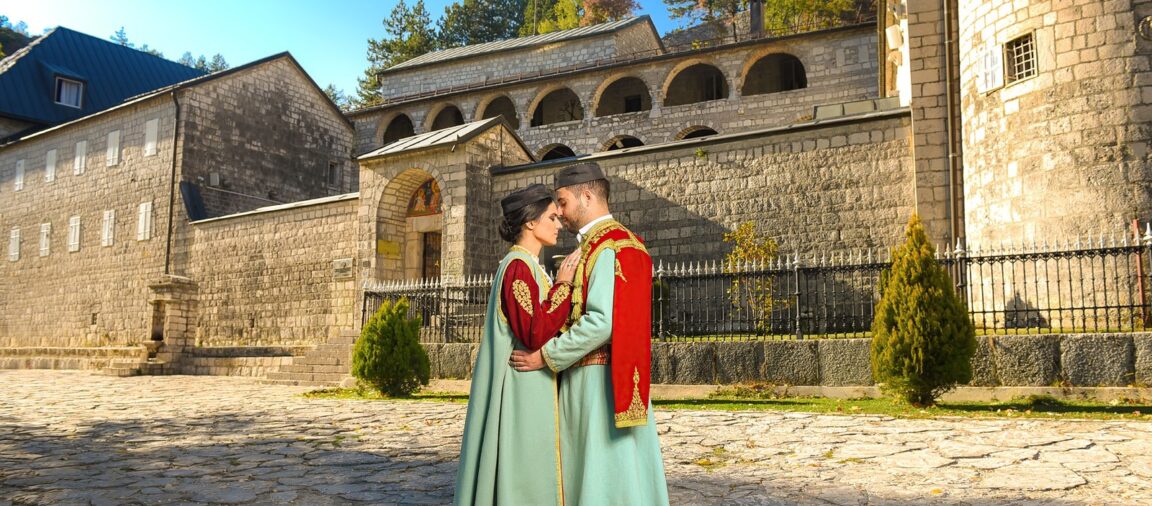
Photo: A couple in Montenegrin national dress in the courtyard of Cetinje Monastery, its stone walls and arcades behind them, via the Tourism Organisation of Old Royal Capital Cetinje (cetinje.travel), the town’s official tourism website, used with credit.