 Elena Vasquez
Ronda is two towns wearing one name: stand on the Puente Nuevo for the postcard, then walk down into the El Tajo gorge until the bridge fills the sky, and only then cross into La Ciudad for the bullring museum and the Arab baths. Done in that order, gorge first and old town second, Ronda stops being a day-trip photo stop and becomes the layered Moorish and Romantic-era town that writers crossed Spain to see.
Quick Facts
- The bridge: The Puente Nuevo was completed in 1793 and stands 98 metres above the Guadalevin River at the floor of the El Tajo gorge.
- The two halves: The bridge links La Ciudad, the old Moorish town, with El Mercadillo, the newer district across the gorge.
- The bullring: Ronda’s Plaza de Toros opened in 1785 and is among the oldest bullrings in Spain, with a museum run by the Real Maestranza de Caballeria.
- The baths: The Arab baths, dating from the 13th century, are among the best preserved in Spain.
- The writers: Ernest Hemingway set a famous scene of For Whom the Bell Tolls in Ronda, and Orson Welles had his ashes buried in the countryside nearby.
- Time needed: One full day covers the gorge path, the bridge, the bullring museum and the baths; an overnight adds the town after the day buses leave.
First register: the gorge, and the bridge seen from below
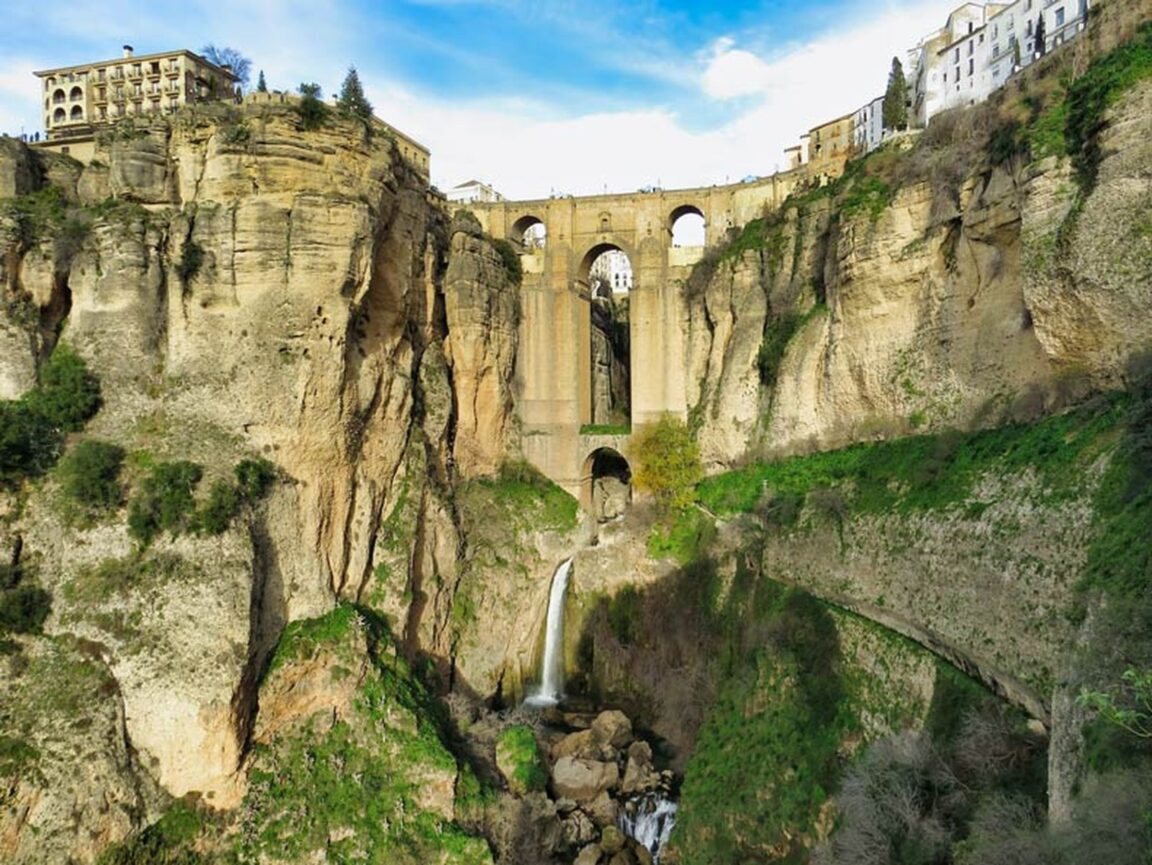
Every visitor photographs the Puente Nuevo from its own parapet or from the viewpoints beside it. Fewer do the thing that gives the structure its true scale, which is to descend. The bridge is 98 metres of masonry standing on the floor of the gorge, a single great arch with a chamber above it, completed in 1793 after an earlier bridge on the site collapsed during construction in the previous attempt of the 1730s and 1740s. From the parapet that height is an abstraction, a number on a plaque. From the path below, looking up at stone that rises cliff to cliff, it becomes the engineering argument the town spent decades making: that the two halves of Ronda could be joined at the top of the gorge rather than by the long descent to the older, lower bridges.
Walking the Camino de los Molinos and the gorge paths
The classic descent is the Camino de los Molinos, the millers path, which drops from the old town side toward the gorge floor and the viewpoint the postcards use, facing the bridge and the waterfall that spills beneath it. A newer gorge walkway, the Camino del Desfiladero, has formalised part of this descent in recent seasons, with controlled access on the steepest section. Either way, the rules are the same: go early or late for the light and the quiet, wear shoes that grip on stone and dust, and budget the climb back up as part of the visit rather than an afterthought. The gorge rewards the effort twice, once for the bridge from below and once for the river itself, green and loud at the bottom of a chasm that the town above barely hints at.
Reading the bridge itself
Back at the top, cross slowly. The chamber above the central arch, visible in the bridge’s face, has served as a store and, in darker chapters, a prison, and now holds a small interpretation centre on the bridge’s construction and the gorge’s geology. The two smaller bridges downstream explain why this one had to exist: the Puente Viejo of 1616 and the older Puente Arabe near the baths carried traffic at river level, which meant every cart and animal climbed the gorge to reach the town. The Puente Nuevo solved the problem at parapet height, and in doing so gave Ronda its defining image, the white town split by a canyon and stitched together by one enormous arch.
Second register: the bullring town
The Plaza de Toros and its museum
Ronda’s bullring, opened in 1785 and still owned by the Real Maestranza de Caballeria, the royal order of horsemanship, is one of the oldest in Spain and one of the widest in the ring’s diameter. Modern bullfighting on foot was largely codified here in the 18th century by the Romero dynasty, and the museum under the stands covers that history with costumes, posters and the firearms and horsemanship collections of the Maestranza. Whatever a visitor’s view of bullfighting itself, the building is essential Ronda evidence: a neoclassical stone arena that predates the famous bridge by eight years and explains the town’s wealth and self-image in the century that built both. Visit at opening time, before the day-trip groups arrive, and the empty arena has a stillness no afternoon visit matches.
Hemingway, Welles and the Romantic travellers
Ronda was a pilgrimage site for Romantic-era travellers long before the railway made it easy, drawn by bandit legends, the gorge and a Moorish old town that seemed to hang in the air. Hemingway knew the town well, wrote bullfighting here into his work, and set the bridge at the centre of a grim and famous episode of For Whom the Bell Tolls. Orson Welles, who began his working life in Spain, asked for his ashes to be buried in the countryside outside Ronda. Neither fact needs embellishment. Together they explain why this small town carries an outsized literary shadow, and why the old town in the evening, when the swifts are working the gorge and the day visitors have gone, still feels like a place writers would cross a country to reach.
The old town below the parapet: baths, palaces and the water mine
La Ciudad, the old town south of the gorge, holds the quieter half of the visit. The Arab baths, built in the 13th century in the old San Miguel quarter near the Puente Arabe, survive with their barrel vaults, brick columns and star-shaped skylights intact, the cold, warm and hot rooms still legible in sequence. They are routinely described as the best preserved Arab baths in Spain, and for once the superlative is structural rather than promotional: the roof that protected other baths was lost elsewhere, and here it never went.
Nearby, the Casa del Rey Moro pairs an 18th century house and hanging gardens with something far older beneath it, a water mine cut down through the rock to the river in the Moorish period, reached by a long stair of more than 200 steps. The descent is the gorge experienced from inside the cliff, and it pairs naturally with the baths on a walking loop that returns over the Puente Viejo. The Palacio de Mondragon, residence of Ronda’s Moorish rulers and later reworked for their successors, now holds the municipal museum, strongest on the prehistory and Roman archaeology of the surrounding Serrania, and its clifftop gardens give one of the old town’s best gorge views without a crowd.
Travellers looping Andalusia can continue the white-village thread with our guide to Setenil de las Bodegas, the village built under a rock overhang, under an hour away, or weigh a very different Andalusian splurge in our assessment of Finca Cortesin near Casares.
How to sequence a Ronda day
Start with the gorge path in the first cool hour, while the light is on the bridge’s western face and the descent is empty. Cross the Puente Nuevo mid morning, visit the interpretation centre inside the bridge, and take the bullring and its museum before lunch, when the arena is at its quietest. Eat in El Mercadillo, then cross back for the old town in the afternoon: Mondragon Palace, the water mine stair, and the Arab baths last, paired with the Puente Viejo on the walk back up. Stay the night if the itinerary allows it at all. Ronda’s day-trip crowds are heavy precisely because the town is beautiful, and the Ronda of dawn and dusk, the gorge empty and the parapets clear, belongs to the people who slept there.
Frequently asked questions
How tall is the Puente Nuevo?
The bridge stands 98 metres above the Guadalevin River at the floor of the El Tajo gorge. It was completed in 1793 and links the old town of La Ciudad with the El Mercadillo district.
Can you walk down into the El Tajo gorge?
Yes. The Camino de los Molinos descends toward the gorge floor and the classic viewpoint facing the bridge and its waterfall, and a formalised gorge walkway covers the steepest section. Wear grippy shoes and allow time and energy for the climb back up.
Why is Ronda’s bullring important?
Opened in 1785 and owned by the Real Maestranza de Caballeria, it is among the oldest bullrings in Spain, and modern bullfighting on foot was largely codified here by the Romero family in the 18th century. Its museum covers the ring, the stables and the Maestranza collections.
Are the Arab baths worth the walk down?
Yes. Dating from the 13th century, they are among the best preserved in Spain, with vaults, columns and star-shaped skylights intact and the sequence of cold, warm and hot rooms still readable.
Is Ronda a day trip or an overnight?
It works as a long day trip from Malaga or Seville, but an overnight is better. The gorge path at dawn and the old town after the day buses leave are the two experiences day visitors consistently miss.
Featured image: The Puente Nuevo from the El Tajo gorge floor, with the waterfall beneath its central arch, Ronda. Photo by William Fernandes, via Unsplash (Unsplash License), used with credit.