 Omar Haddad
Ait Benhaddou rewards the traveller who stays past the tour-bus hour: cross the Ounila River from the new village, climb the stepped lanes to the ruined granary at the summit, and the famous film-set ksar becomes a working lesson in how a fortified earthen village fed, defended and governed itself. The day visitors see a backdrop. The overnight visitor sees a settlement, and that difference is the whole reason to sequence this stop properly.
Quick Facts
- Where: In the Ounila Valley, in the foothills on the southern slopes of the High Atlas in Ouarzazate Province, Morocco, roughly 30 kilometres from Ouarzazate.
- Status: Inscribed on the UNESCO World Heritage List in 1987 as the most famous ksar in the Ounila Valley.
- Oldest surviving buildings: None appears earlier than the 17th century, although the site was fortified from the Almoravid era and its building techniques are far older.
- The summit: A fortified loft, or granary, stands at the top of the village, listed by UNESCO among the ksar community buildings.
- Getting across: A pedestrian footbridge, completed in 2011, links the new village to the ksar across the Ounila.
- Time needed: Two to three hours covers the climb, the lanes and the river viewpoints; an overnight stay adds dawn and dusk, when the day tours are absent.
What a ksar actually is, and why this one matters
UNESCO describes the Ksar of Ait Benhaddou as a mainly collective grouping of dwellings inside defensive walls, reinforced by angle towers and pierced with a baffle gate. That dry sentence contains the entire visit. A ksar is not a single castle. It is a fortified village built as one earthen organism, in which modest houses crowd together with dwellings that resemble small urban castles, their high angle towers decorated with motifs in clay brick. The community areas matter as much as the houses: UNESCO lists a mosque, a public square, grain threshing areas outside the ramparts, a caravanserai, two cemeteries, one Muslim and one Jewish, and the Sanctuary of the Saint Sidi Ali or Amer.
The site was also one of the many trading posts on the commercial route linking ancient Sudan to Marrakesh by the Dra Valley and the Tizi-n-Telouet Pass. Read that way, the village stops being a photo and becomes infrastructure: a secure warehouse town on a caravan corridor, where goods, animals and people needed walls, water and a granary more than they needed grandeur. Travellers planning the wider Moroccan south can pair this reading with our guide to Essaouira on the Atlantic coast for the other end of the old trade world, where goods that crossed the Atlas met the sea.
The climb to the granary, step by step
Start on the new-village bank
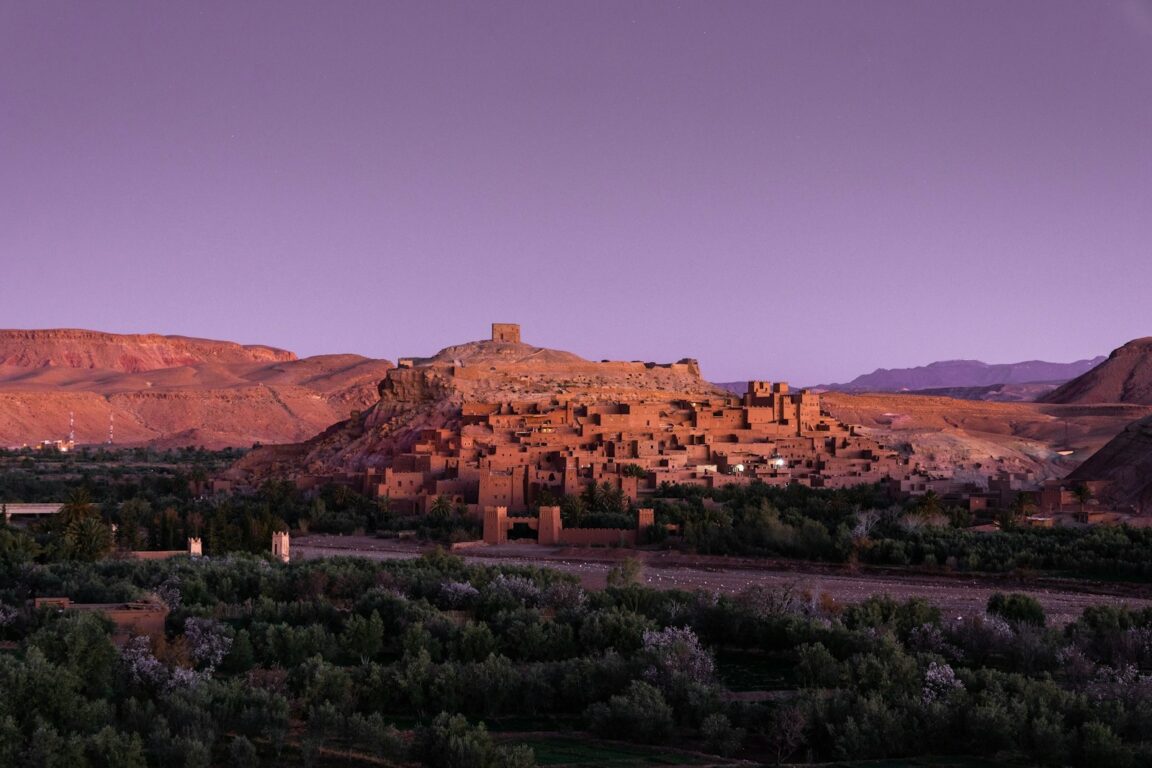
Begin in the newer village across the river, where most residents now live and where the guesthouses, cafes and parking sit. From the riverbank the whole ksar stacks up the hillside in one view: walls, towers and rooftops rising to the summit loft. This is the angle the films made famous, and it is worth taking in before you cross, because once inside the lanes the village deliberately hides its own shape from you. Baffle gates and tight turns were designed to confuse an attacker, and they still work on a visitor holding a phone map.
Cross the Ounila and enter the lanes
The footbridge makes the crossing simple in normal conditions. After heavy rain the riverbed deserves respect, and no view is worth wading a swollen channel. Inside the walls, the lanes climb in steps and ramps of packed earth and stone. Some families open their houses to visitors, and small shops and painters line the main ascent. Go slowly here. The decorative brick motifs sit high on the tower walls, the wooden lintels and doors are original fabric rather than set dressing, and conservation monitoring has kept cement and metal replacements largely out of the old village, which is precisely why it still photographs as a single earthen mass.
Finish at the summit granary
The fortified loft at the top of the village is the point of the climb. A communal granary was a village bank: grain stored high, dry and defensible, above the houses it fed. From the summit the geography resolves. The Ounila bends below, the palm and field plots line its banks, the new village faces you across the water, and the foothills run away toward the High Atlas passes. Come up late in the day and the earthen walls take on the deep red and gold tones that no midday visit delivers, while the tour groups who climbed at noon are already on buses back to Marrakesh.
Beyond the film sets
The filmography is real and long. Lawrence of Arabia, Gladiator and Game of Thrones are among the productions that used the ksar, and the nearby studios at Ouarzazate built an industry on this landscape. But the film framing flattens the place if you let it. The productions came because the ksar is an authentic, complete example of pre-Saharan earthen construction, not the other way round. UNESCO gives it two criteria: it is an eminent example of a southern Moroccan ksar illustrating the earthen building types of the Dra, Todgha, Dades and Souss valleys, and it illustrates a traditional earthen habitat that has become vulnerable as social and economic change empties it.
That vulnerability is the honest shadow over a visit. UNESCO notes that the earthen buildings suffer from lack of maintenance as inhabitants leave, and that the conservation body CERKAS monitors the site. Every house visit paid for, every night booked in a local guesthouse and every piece bought from a painter in the lanes is a small counterweight, because an earthen village survives only while people have reasons to repair it. Rain erodes unmaintained rammed earth quickly, and a ksar that becomes a pure set will not stay standing for the next production.
Staying after the day buses leave
The strongest argument for an overnight is arithmetic. Most visitors arrive on day tours from Marrakesh, a drive of roughly 180 kilometres over the Tizi n-Tichka pass, or on shorter excursions from Ouarzazate. They cluster between late morning and mid afternoon. A traveller sleeping in the new village, in one of the kasbah-style guesthouses facing the ksar, gets the two hours the day tours never see: the evening light on the towers from the riverbank, and a dawn climb in near silence before the heat builds. The summit at sunrise, with the valley mist still on the river plots, is a different place from the summit at noon, and it costs nothing but a night on the road south.
Overnighting also changes the Ounila side of the visit. The new village is not a dormitory for the monument; it is where the community actually lives, farms the riverside plots and runs the cafes. Eat there in the evening, walk the riverbank at dusk, and the ksar across the water reads as a neighbour rather than an exhibit. Travellers building a longer Moroccan itinerary can use our Chefchaouen and Akchour waterfalls guide for the northern counterpoint, a blue medina town in the Rif that rewards the same slow approach.
Practical notes for the visit
Wear shoes with grip. The lanes are stepped, uneven and dusty, and the summit climb is short but steep, with unprotected edges that demand attention, especially with children. Carry water and sun protection in every season; shade inside the ksar is scarce at midday and summer heat in the valley is serious. Spring and autumn give the most comfortable walking conditions, with green fields along the river in spring. Winter days can be bright and quiet, but nights at this altitude are cold, and the pass road from Marrakesh deserves a conditions check after bad weather.
There is no single gatehouse experience here, because the ksar is a living village rather than a ticketed monument. Individual families may ask a small contribution to enter a house or private museum, which is fair and worth paying. Ask before photographing residents, keep off walls and roofs, which are fragile earthen structures rather than viewpoints, and dress with the modesty a conservative village expects. These are small courtesies that keep visitors welcome in a place that never asked to be a film set.
Frequently asked questions
How long does Ait Benhaddou take to visit?
Two to three hours covers the river crossing, the lanes and the climb to the summit granary at an unhurried pace. Add an overnight stay if you want the ksar at dawn or dusk without the day-tour crowds.
Does anyone still live inside the ksar?
Only a handful of families remain inside the walls. Most residents moved to the newer village across the Ounila, where the guesthouses and cafes now sit, and many work in farming and tourism.
How old is Ait Benhaddou?
The site has been fortified since the Almoravid era, but UNESCO advises that the oldest surviving constructions do not appear to be earlier than the 17th century, built with techniques propagated in southern Morocco from a much earlier period.
What films were made at Ait Benhaddou?
Productions filmed here include Lawrence of Arabia, Gladiator and Game of Thrones, drawn by a complete and authentic earthen ksar rather than a purpose-built set.
How do you reach Ait Benhaddou?
The ksar sits about 30 kilometres from Ouarzazate and about 180 kilometres from Marrakesh over the High Atlas by the Tizi n-Tichka pass. Many travellers visit on the way to or from the desert routes east.
Featured image: Ait Benhaddou at dusk, the earthen ksar stacked above the Ounila Valley with the summit granary on the skyline. Photo by Ansgar Scheffold, via Unsplash (Unsplash License), used with credit.