 Thandiwe Nkosi
Grootbos Private Nature Reserve works as a land based safari, provided the quarry is understood correctly: across 3,500 hectares of fynbos above Walker Bay, the game drive is a guided 4×4 flower safari through a reserve recording 1,031 plant species, the forest walk goes through milkwood forests more than 1,000 years old, and in season the headline wildlife is watched from land, as southern right whales move along the coast on a coastal drive that Grootbos runs especially from June to December. The accommodation matches the safari format too, with full board rates, all meals and most land based activities included, split between Forest Lodge with 16 suites, Garden Lodge with 11 suites and two private villas. It is not a substitute for a big game reserve, and it does not claim to be. Judged on plants, coast and guiding, it is one of the most complete nature stays in the Western Cape.
Quick Facts
- Where it is: On the R43 above Walker Bay in the Western Cape, 13 kilometres past Stanford and reached by driving through Hermanus, 160 kilometres and about a two hour drive from Cape Town, according to Grootbos’s own directions and helpful information.
- The reserve: 3,500 hectares holding 1,031 recorded plant species, seven of them newly discovered here, 100 endangered plant species and three milkwood forests over 1,000 years old.
- The lodges: Forest Lodge has 16 freestanding suites and accepts children from age 12. Garden Lodge has 11 freestanding suites and accepts children of all ages. Two private villas, of four and six bedrooms, come with a private chef, butler and guide.
- What the rate covers: Full board, meaning breakfast, a light or three course lunch and an a la carte dinner, plus the 4×4 flower safari, guided fynbos and milkwood walks, horse riding, beach picnics, the Klipgat Cave excursion and a coastal drive with seasonal land based whale watching.
- Published rates: On the official Grootbos rates page, a luxury suite for two adults is R33,000 per night in high season from 16 July to 15 December 2026 and R26,400 per night in low season from 1 May to 15 July 2027, before a conservation contribution of R400 per adult per night. Private villas are listed from R84,500 per night.
- Whale season: Land based whale watching is at its best from June to December, and boat trips to Dyer Island combined with seasonal whale watching run in the same June to December window as a paid extra.
- Minimum stay: Grootbos strongly recommends at least two nights, with check in at 14:00 and check out at 11:00.
Does a flower safari really work like a game drive?
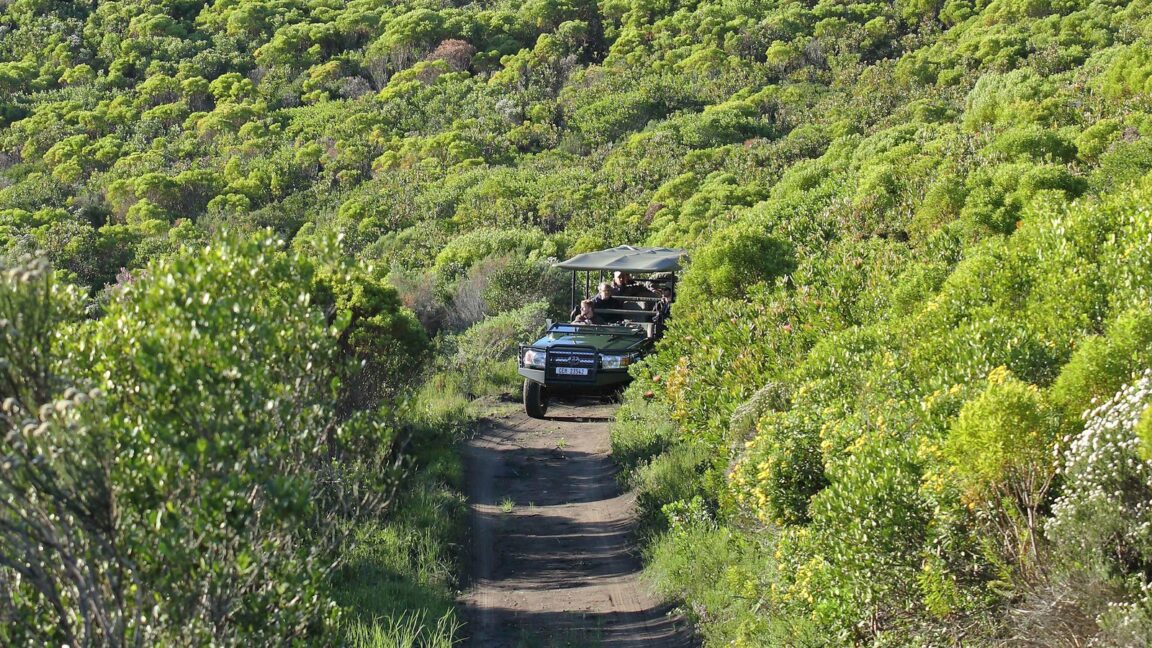
Structurally, yes. The botanical 4×4 experience at Grootbos puts guests in an open safari vehicle with a specialist nature guide, exactly as a game drive does, except that the sightings are plants and the stories attached to them. The reserve sits in the Cape Floral Kingdom, which Grootbos describes as the smallest yet most biodiverse plant kingdom on earth, and the guiding task is to make small things legible: why a protea flower is built the way it is, which birds and insects pollinate which species, and how fynbos uses fire to regenerate. With 1,031 species recorded on the reserve and seven discovered here that were new to science, there is no shortage of material, and the guide has a genuine checklist to work through rather than a script to repeat.
The honest limit is pace and spectacle. A flower safari does not deliver the adrenaline of tracking a predator, and travellers whose safari dream is centred on large mammals should not book Grootbos expecting that dream in a different costume. What it delivers instead is density. In a single drive the subject changes constantly, from hillside colour to a single rare bloom, and the botanical art gallery holding the Grootbos Florilegium, described by the reserve as the birthplace of South Africa’s first Florilegium, lets the same species be looked at again as detailed botanical artworks. The safari logic of expert guide, open vehicle, morning and afternoon outings and a tally of finds all survives the translation. Only the size of the quarry changes.
What is inside the ancient milkwood forest?
The milkwood forest is the second half of the land safari, and it is experienced on foot rather than from a vehicle. Grootbos counts three milkwood forests over 1,000 years old on the reserve, and its guided nature walks and the dedicated Milkwood Forest Walk are both included in the rate. The name Grootbos itself is Afrikaans for big forest, a reference to these ancient trees, whose gnarled branches and shaded understorey give the walks a completely different register from the open, sunlit fynbos slopes outside. Forest Lodge is set with an ancient milkwood forest on one side and fynbos on the other, so for guests staying there the forest is not an excursion so much as the setting of the lodge itself, and the lodge’s spa and its boma dining area both use the forest as their backdrop when weather permits.
Walking is where the reserve’s birdlife also comes into its own. Bird watching is listed among the included activities, and guided hikes range from the botanical fynbos hike to coastal walks, with maps supplied for self guided walks as well. For travellers building a longer Western Cape trip, the contrast is worth planning around: the farm gardens and mountain fynbos of Babylonstoren in Franschhoek make a natural inland pairing with Grootbos’s coastal fynbos, and the two stays together cover the Cape Floral Kingdom from valley floor to shoreline.
How does whale season work from land?
Walker Bay is the marine half of the Grootbos proposition, and the reserve is careful to separate what is included from what costs extra. Included in every rate is a coastal drive with seasonal land based whale watching, which Grootbos notes is especially good during June to December, together with beach picnics and the excursion to the ancient Klipgat Cave and the Walker Bay Nature Reserve beach. The cave is presented by Grootbos as an example of early human dwelling dating back to the Middle and Late Stone Age, so the coastal outing carries archaeology as well as whale watching. The reserve’s whale watching package describes land based viewing of southern right whales close to the coast, watched with sundowners from its Whale House, as the opening act of a stay.
The Hermanus side of the season is part of the same coastline and the same drive in. Grootbos is reached by driving through Hermanus and then Stanford on the R43, so the famous Hermanus cliff path whale watching belongs to the journey as much as to the destination, and a stay can be sequenced to spend time on the Hermanus cliffs before or after the reserve’s own coastal drive. What Grootbos adds over a Hermanus town stay is elevation, privacy and guiding: the reserve looks down over Walker Bay from its own fynbos hills, and its coastal outings are led rather than self directed. Boat based whale watching, trips to Dyer Island, shark cage diving, scenic flights and the Lady Stanford River Cruise are all available but are explicitly excluded from the rate and charged separately, and the boat whale trips run seasonally from June to December. The full Marine Big Five framing used by Grootbos covers whales, sharks, penguins, dolphins and seals, but only the whale element is reliably part of the included land programme.
Which lodge should you choose, Forest or Garden?
Forest Lodge is the contemporary, quieter choice. Its 16 spacious suites sit between ancient milkwood forest and fynbos with panoramic views over the reserve to Walker Bay, its luxury suites are listed at 85 to 90 square metres and sea facing, and it accepts children only from age 12, which keeps its atmosphere adult. Garden Lodge is the family lodge. The Garden Lodge page lists 11 freestanding suites set in indigenous gardens, it accepts children of all ages, it holds the family suites, and its rebuilt main lodge has floor to ceiling windows, a lounge with what Grootbos calls one of the best views in Africa and a wine cellar for dining among South African wines. Children’s activities at Garden Lodge include treasure hunts through the forest and fynbos, pony rides and a dedicated playroom.
Above both lodges sit the two private villas, of four and six bedrooms, each with its own private chef, butler and private guide, listed from R84,500 per night. The villas suit multigenerational groups who want the safari programme run privately and on their own timetable. Whichever base is chosen, every suite is freestanding with a private deck and fireplace, and the rate structure is the same full board model, so the choice is about atmosphere and travelling party rather than about what is included.
What does a Grootbos stay actually cost, and what is extra?
Grootbos publishes its rates, so there is no need to guess. For a luxury suite shared by two adults, the official page lists R33,000 per night across the high season running from 16 July to 15 December 2026, R35,000 per night in peak season from 16 December 2026 to 10 January 2027, and R26,400 per night in the low season from 1 May to 15 July 2027. A family suite at Garden Lodge for two adults and three children sharing starts from R57,750 per night in high season. Rates include VAT at 15 percent and exclude the conservation contribution of R400 per adult per night. A South African residents’ special has been listed from R8,450 per person per night sharing, but that offer is restricted to residents and to its stated validity dates, so international travellers should budget from the standard table and check the rates page for their exact dates.
The inclusions are unusually broad for a hotel stay and are the core of the value argument. All meals are included, as are water, soft drinks, tea, coffee and the minibar, plus transfers to and from activities, horse riding through the reserve for riders up to 90 kilograms, the flower safari, the walks, the cave excursion, beach picnics and a Progressive Tourism Tour covering the work of the Grootbos Foundation, which has worked on conserving critically endangered species and developing skills in surrounding communities for over 20 years. The extras to budget for are alcoholic drinks, laundry, spa treatments and the marine and aerial add ons listed above. Bookings require a 25 percent deposit within seven days of confirmation, with final payment 30 days before arrival.
When is the best time to go, and how does Grootbos fit a Cape Town trip?
The calendar has two peaks that overlap helpfully. Whale season runs from June to December for both land based viewing and boat trips, while the reserve’s Secret Season framing covers the cooler months when winter fynbos colour and returning southern right whales coincide. Spring brings the fynbos into its most obvious flower, and summer brings long days for beach picnics and coastal walks. There is no closed season and no wrong month for the forest and flower programme, which runs all year; the decision is really about whether whales are a priority, in which case June to December is the window to aim for, with the middle of that window offering the best chance of combining whales with spring flowers.
Logistically Grootbos is an easy add on rather than an expedition. At 160 kilometres and about two hours by road from Cape Town, it can close or open a Cape Town stay, and travellers planning the city end of the trip can use a two day Cape Town itinerary to structure those days before heading east along the coast through Hermanus. Grootbos recommends a minimum of two nights, and that recommendation should be taken seriously: one night allows either the flower safari or the coast to be done properly, but not both with the forest walks in between. Three nights is the comfortable length for the full land programme, with a boat trip added in whale season if the sea allows.
Frequently Asked Questions
Is Grootbos a safari lodge?
It is a land based nature safari rather than a big game safari. The guided programme is built around 4×4 flower safaris, fynbos and milkwood forest walks, horse riding, bird watching and seasonal land based whale watching on a 3,500 hectare private reserve, with no large game viewing promised.
When can whales be seen at Grootbos?
Grootbos lists coastal drives with seasonal land based whale watching as especially good from June to December, and its paid boat trips to Dyer Island combined with whale watching also run from June to December. Southern right whales are the headline species in Walker Bay.
How many suites do the Grootbos lodges have?
Forest Lodge has 16 freestanding suites and accepts children from age 12. Garden Lodge has 11 freestanding suites, including family suites, and accepts children of all ages. There are also two private villas, of four and six bedrooms, with a private chef, butler and guide.
What is included in the Grootbos rate?
Full board meals, soft drinks, tea, coffee and minibar items, plus the 4×4 flower safari, guided fynbos hikes, the milkwood forest walk, horse riding, beach picnics, the Klipgat Cave and Walker Bay beach excursion, bird watching and transfers to activities. Alcohol, spa treatments, boat whale trips, shark cage diving and scenic flights are extra.
How far is Grootbos from Cape Town and Hermanus?
Grootbos gives its distance from Cape Town as 160 kilometres, about a two hour drive. The route drives through Hermanus and Stanford on the R43, and the reserve is 13 kilometres past Stanford, above Walker Bay.
How much does Grootbos cost per night?
Published luxury suite rates for two adults are R33,000 per night in high season from 16 July to 15 December 2026, R35,000 in peak season from 16 December 2026 to 10 January 2027 and R26,400 in low season from 1 May to 15 July 2027, plus a conservation contribution of R400 per adult per night. Check the official rates page for exact dates, as rates change by season and year.
Photo: A Grootbos safari vehicle on a botanical drive through dense green fynbos on the reserve above Walker Bay. Credit: Grootbos Private Nature Reserve, via grootbos.com.