 Thandiwe Nkosi
Most visitors cross to Robben Island for one small cell, but the island the ferry reaches is far bigger than that single room. On the standard museum tour, the bus circuit before the prison walk passes the lime quarry where political prisoners broke stone under a damaging white glare, the leper graveyard and church left from the decades when the island was a place of medical exile, and a shoreline where African penguins, absent for roughly a century, returned on their own in the 1980s and now breed. Ferries leave the Nelson Mandela Gateway at the V and A Waterfront, the general tour takes about 3.5 hours including both crossings, and tickets cost ZAR 400 for South African adults and ZAR 600 for other adults, so the wider island is not an extra. It is the tour, read in the right order.
Quick Facts
- Departure point: Ferries leave the Nelson Mandela Gateway at the V and A Waterfront in Cape Town, per the Robben Island Museum tour types page.
- Departure times: Peak season, 1 September to 30 April: 09:00, 11:00, 13:00 and 15:00, Monday to Sunday, weather and demand permitting. Off peak, 1 May to 30 August: 09:00, 11:00 and 13:00.
- Ticket prices: General tour tickets cost ZAR 400 per South African adult and ZAR 210 per child under 18, and ZAR 600 per non South African adult and ZAR 310 per child under 18.
- Tour duration: About 3.5 hours including the ferry trip to and from the island, depending on the boat used.
- Beyond the cell: The bus circuit passes the lime quarry, the leper graveyard, Robert Sobukwe’s house and wartime bunkers before the prison walk ends at Nelson Mandela’s cell.
- Status: Robben Island was inscribed as a UNESCO World Heritage Site in 1999, and the Robben Island Museum, established in 1997, manages it.
Why does the quarry matter as much as the cell?
The lime quarry is a shallow, bright pit near the centre of the island, and it is where the prison years were physically spent. Political prisoners, Mandela among them, were marched there to dig and crush lime for 13 years, work that the V and A Waterfront guide to the tour describes plainly: the white glare damaged prisoners’ eyesight, and the labour was punishment as much as production. The cell shows confinement. The quarry shows what confinement was for, day after day, in the open.
The quarry also carries the prisoners’ answer to that design. Prisoners taught one another history, politics, languages and law there, an informal curriculum so central to island life that it earned its own name, the Robben Island University. Men who arrived as activists used the quarry floor as a classroom and left prepared, in many cases, to govern. A small cairn of stones at the quarry, stacked by former prisoners on a return visit, marks the spot. Read alongside a longer stay in the city, using a plan like 2 days in Cape Town, the quarry turns the island from a memorial to one man into a record of how hundreds resisted together.
What happened on the island before the political prison?
Long before the apartheid prison, Robben Island was already a place South Africa sent people it wanted out of sight. Banishment began in the Dutch colonial period, and the island’s name comes from the Dutch word for seals, robben, after the animals that once crowded its shores. South African History Online records that in the 17th and 18th centuries the Dutch sent political prisoners from the Dutch East Indies here, and a kramat, or holy shrine, still honours an exiled prince of Madura who died here in 1754. Exile is not a chapter of the island’s story. It is the island’s story, repeated under different authorities for three centuries.
That continuity is what makes the prison legible. The apartheid government did not invent Robben Island as a place of removal in 1961. It inherited a working system, an island close enough to Cape Town that the city lights are visible, yet cut off by cold, rough water, and applied it to more than 3,000 political prisoners between 1961 and 1991. The museum frames the island as a symbol of the triumph of the human spirit over adversity, suffering and injustice, with a history it describes as 500 years deep and multi layered. The layers are the point, and the bus tour shows them in sequence rather than as background to the cell.
What do the leper church and graveyard add to the visit?
From 1846 to 1931, the island served as a leper colony, alongside an infirmary for the chronically ill and people classified at the time as insane. At first, patients came voluntarily, but after the Leprosy Repression Act of May 1882 they were forced to live on the island with no option of return, a history set out by South African History Online. The leper graveyard, which the bus tour passes, holds the dead of that era, and the small church built for the leper congregation still stands. They are the physical remains of a policy that treated illness as a reason for permanent exile.
Pausing at the graveyard changes the register of the tour before the prison walk begins. The political prisoners, for all the injustice of their sentences, were held by a state that expected many of them eventually to be released, and some lived to guide tours of their own prison. The leper patients of the 19th century had no such horizon. Their graves belong to people whose names rarely made it into the island’s famous story, and the church beside them served a congregation the mainland had decided not to see. A visitor who takes the graveyard seriously arrives at Mandela’s cell understanding that the island’s cruelty was never only political, and that its community of the exiled was always larger than any one era.
How did the penguins come back?
The island’s newest residents arrived without permission or planning. African penguins had disappeared from Robben Island in the 1800s, then returned in the 1980s and re-established a breeding colony along its shoreline, as the V and A Waterfront guide records. They now form part of a bird life of roughly 132 recorded species, alongside crowned cormorants and black crowned night herons, according to South African History Online. Around the harbour and along the bus route, penguins appear in the scrub and at the water’s edge, indifferent to the weight of the history a few hundred metres inland.
The colony matters for more than charm. The island’s story is usually told as a sequence of human decisions, almost all of them harsh, but the penguins are a reminder that it is also an ecosystem that kept its own timetable. Seals gave it its name, the sea decided who could leave, and a seabird colony reclaimed a shore that prison authorities had treated as a perimeter. Robben Island is a heritage site and a working piece of Table Bay nature at once, and the museum’s mandate covers conserving its natural resources as well as its cultural ones. Travellers building a wider South African trip around wildlife as well as history can pair the island with the very different scale of a Londolozi game reserve safari, where conservation, not confinement, is the organising idea.
How should you sequence the island on the day?
The tour’s own order does most of the work if you let it. The ferry crossing sets the isolation first: Table Mountain recedes, the island stays low and flat, and the distance that made it useful as a place of exile becomes physical. The bus circuit then moves through the layers in turn, the kramat, the leper graveyard, Sobukwe’s house, the quarry and the bunkers, before the prison walk ends at the cell. Visitors who know that sequence in advance can listen for it, rather than treating the bus ride as transport between the ferry and the famous room. The cell lands differently as the last stop in a 500 year sequence instead of the only stop.
Practically, book through the museum’s own channels and treat the schedule as weather dependent, because every sailing is listed as weather and demand permitting. The museum also offers a longer walking tour, at ZAR 1,000 per South African adult and ZAR 1,400 per non South African adult, Friday to Sunday. The standard general tour remains the right choice for most first time visitors: it covers the quarry, the graveyard and the prison in one circuit, and leaves the rest of the day for the Waterfront. What it asks in return is attention to the stops that are not the cell.
Frequently Asked Questions
How long does a Robben Island tour take?
About 3.5 hours including both ferry crossings, according to the Robben Island Museum. The exact time depends on the boat used.
How much do Robben Island tickets cost?
ZAR 400 per South African adult and ZAR 210 per child under 18, and ZAR 600 per non South African adult and ZAR 310 per child, per the museum’s tour types page.
Where do the ferries to Robben Island depart?
From the Nelson Mandela Gateway at the V and A Waterfront in Cape Town, for all tours.
What will I see besides Nelson Mandela’s cell?
The bus tour passes the lime quarry where prisoners worked for 13 years, the leper graveyard from the island’s years as a leper colony between 1846 and 1931, Robert Sobukwe’s house, the kramat and wartime bunkers, and the shoreline where African penguins breed.
When did the penguins return to Robben Island?
African penguins disappeared in the 1800s and returned in the 1980s, re-establishing a breeding colony among the roughly 132 bird species recorded on the island.
What are the ferry departure times?
In peak season, 1 September to 30 April, at 09:00, 11:00, 13:00 and 15:00. Off peak, from 1 May to 30 August, at 09:00, 11:00 and 13:00. All sailings are weather and demand permitting.
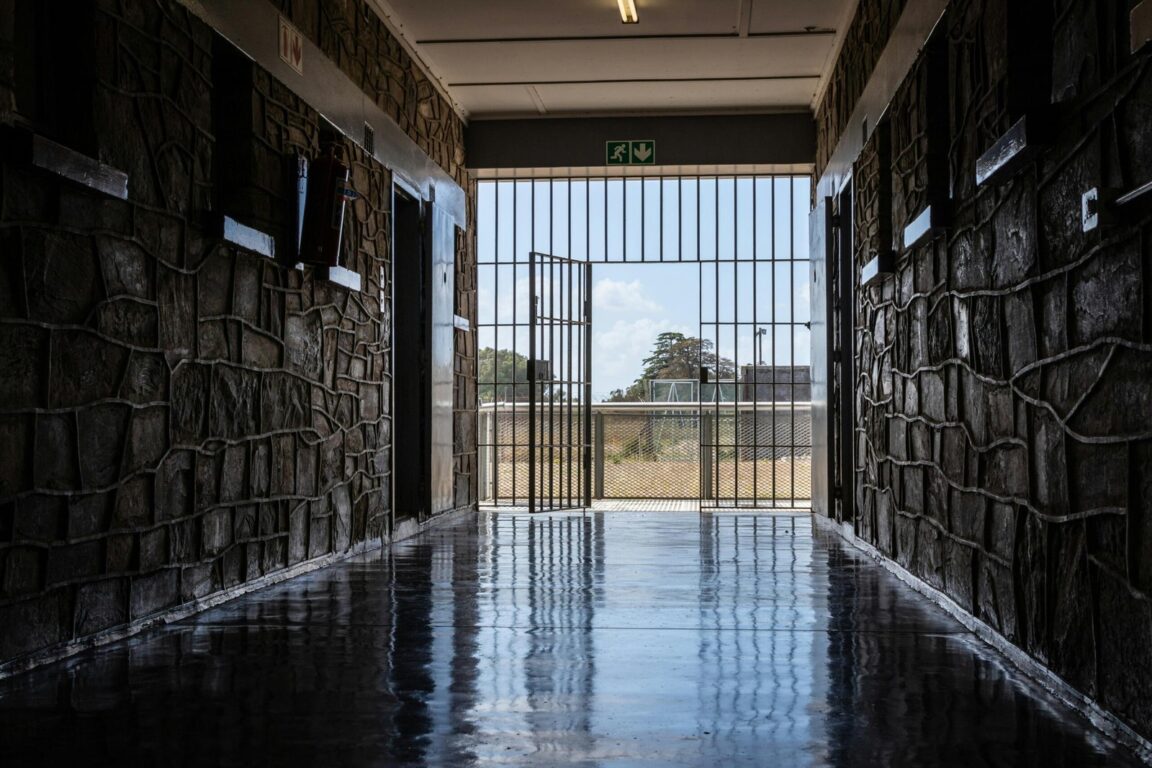
Photo: A stone walled corridor inside Robben Island’s Maximum Security Prison, its barred gate standing open to the yard beyond. Credit: Grant Durr, via Unsplash.