 Thandiwe Nkosi
Wolwedans is worth the long desert drive for one reason above all others: space rationed on purpose. Its Dune Camp sits on top of a 250 metre dune inside the 220,000 hectare NamibRand Nature Reserve in southern Namibia, sleeps a maximum of 16 guests in eight rooms, and runs on solar power in a reserve recognised as an International Dark Sky Reserve. The model is the attraction. Every stay funds conservation of the reserve through the Wolwedans approach of balancing people, planet and profit, and the camp pairs naturally with Sossusvlei because it offers the opposite experience: where Sossusvlei is a famous dune field you visit, the NamibRand is a private wilderness you stay inside, at a density of roughly one guest per thousand hectares of desert.
Quick Facts
- Where: The Wolwedans Collection, in the heart of the NamibRand Nature Reserve, southern Namibia, around 60 kilometres south of Sesriem and the Sossusvlei gate.
- The reserve: 220,000 hectares of private conservation land, one of the largest private nature reserves in Africa, and an International Dark Sky Reserve.
- Dune Camp capacity: A maximum of 16 guests in eight rooms: six tented rooms plus a two room tented Family Suite, per the camp’s own page at wolwedans.com.
- Power reality: The camp operates on solar, so there is no air conditioning and no hair drying facilities. Rooms are designed to maximise airflow instead.
- Published 2026 rates: NAD 14,900 to NAD 20,950 per person per night across the collection’s camps, as published in the Wolwedans Collection listing.
- Founded: Wolwedans began in 1995, from a dream shared by Albi Bruckner and his son Stephan, starting with four igloo tents.
- Best pairing: Two or three nights here after Sossusvlei, so the trip holds both the iconic public dunes and a private reserve stay.
What is the conservation model, in plain terms?
Start with the land, because Wolwedans only makes sense once the reserve does. The NamibRand was assembled from former farmland in the pro Namib, the gravel plains and dune belts east of the great Namib dune sea, and it is now run as a single private reserve of 220,000 hectares. Wolwedans states its long term goal plainly: to ensure the conservation of the pro Namib for future generations, guided by an approach in which people, planet and profit are all equally important. Tourism is the funding engine. A small number of beds, spread across five properties (Dune Camp, Desert Lodge, Plains Camp, Mountain View Suite and Boulders Camp), pays for the protection of an enormous area, which is why the arithmetic of the place feels so unusual. The collection’s own partners put it at roughly 1,000 hectares of desert per guest.
That low density is a deliberate cap, not a marketing accident. More rooms would earn more per night and protect less per hectare of attention, road and water. The reserve instead limits beds, keeps vehicles on set tracks and lets the landscape stay the headline. Travellers who have done the maths on other low impact safari models, such as the green season camps covered in packing for a Botswana green season safari, will recognise the same trade: fewer guests, higher rates, and a conservation levy built into the night rather than added as an afterthought.
What are the Dune Camp rooms actually like?
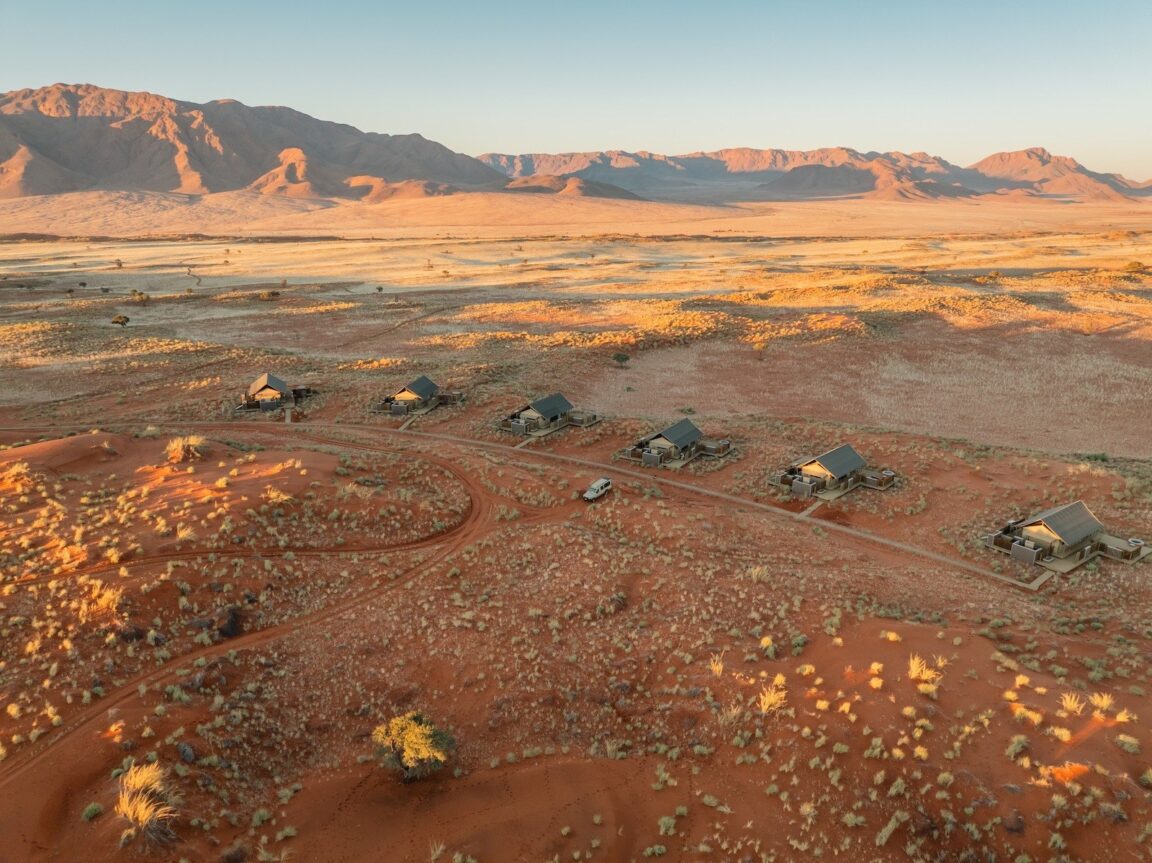
Dune Camp is the original Wolwedans camp, and its own description is specific. It sleeps a maximum of 16 guests in eight rooms: six tented rooms and one two room tented Family Suite. The tented rooms stand on wooden platforms raised off the ground, with king size beds that can convert to twins, and full indoor and outdoor bathrooms, with no bathtubs. New wooden walkways connect each room to the main area, which matters after dark in a camp where the walk back crosses open dune.
Two details define the rooms. The first is the private deck, which now carries a daybed that converts into a Starbed for sleeping outside under the desert sky, an easy promise to keep in an International Dark Sky Reserve with this little light pollution. The second is the Wolwedans Chiller, a small water filled silo on the deck for cooling off in the heat of the day. It is a plunge pool reduced to its honest essentials, and in a solar powered camp it makes more sense than a filtered pool. The Family Suite sleeps up to four adults and two children across two rooms, adds a sala with two single beds for children, and has its own small kitchen, bar and private dining area for groups who want separation from the main camp. Every room has a minibar, hot beverages are on hand, and hot water arrives in a thermos, a small ritual that underlines the camp’s off grid footing. Wi-Fi now runs throughout the rooms, which slightly softens the disconnect message, but the solar system still sets the terms: no air conditioning, no hairdryers, and airflow designed in from the start.
How do the days run, and what about the balloon mornings?
Desert days at Wolwedans are built around the light. The collection’s activities include scenic drives across the plains and dune belts, guided nature walks, horse riding, and drifting over the reserve at dawn. The balloon flight is the signature morning: balloons rise early, when the air is still, and the view takes in the full Wolwedans geography at once, red dunes, blonde grass plains, the mountain ranges that rim the reserve and the strange pale rings known as fairy circles scattered across the plains. Ballooning is weather dependent and is typically booked as an extra, so confirm its current price and availability when you reserve rather than assuming it is included.
On the ground, guiding is interpretative rather than trophy driven. The NamibRand’s wildlife is desert adapted: oryx, springbok, ostrich and zebra on the plains, with the smaller life of the dunes revealed on walks. Nobody should come here expecting the predator density of a savanna reserve. The point is the ecosystem itself, read slowly, in the company of guides who treat a fossil valley or a sociable weaver nest as a headline. Sundowners close the day, and dinners at Dune Camp are shared, which suits a camp of 16 guests and gives the place its house party feel. Readers comparing remote lodge formats may also enjoy Nayara Bocas del Toro in Panama, another small property where the setting, not the facility list, does the work.
How does Wolwedans pair with Sossusvlei?
The standard Namibia circuit runs Windhoek, Sossusvlei, the coast and the north, and Wolwedans slots into it as the second desert base. Sesriem, the gateway to Sossusvlei and Deadvlei, lies around 60 kilometres north of the Wolwedans area, close enough to combine and far enough to feel like a different desert. The sensible sequence is to do the famous dunes first, with their early gate queues and midday heat, then drop south into the NamibRand and slow down. At Sossusvlei you climb Big Daddy and photograph the dead camelthorn trees. At Wolwedans you watch the same desert system from a deck, with nobody else in the frame.
Getting there is part of the commitment. The collection is reached by a long scenic drive from Windhoek of around five and a half to six hours, or by light aircraft to a reserve airstrip followed by a road transfer. Self drivers should treat fuel, water and daylight seriously, as with any remote desert leg. Two nights is the minimum for the pairing to work; three lets the balloon morning survive one weather cancellation and still happen.
Who should book Dune Camp, and who should choose another Wolwedans property?
Choose Dune Camp if you want the original, most intimate version of Wolwedans: eight rooms, shared dinners, canvas and timber, and a dune top position with panoramic views across the reserve. Choose Desert Lodge for a slightly larger tented format among rolling dunes, Plains Camp for an exclusive use villa with a private guide and chef for a family or group, Mountain View Suite for the collection’s most private and romantic setup, and Boulders Camp for a rocky outcrop setting above gravel plains in the south of the reserve. Across all of them, the honest caveats are the same: this is a high rate, low density product, the desert is the entertainment, and travellers who need air conditioning, a gym and a full bar programme should look elsewhere. Travellers who measure a stay in hectares per guest will understand it immediately.
Frequently Asked Questions
How big is the NamibRand Nature Reserve?
220,000 hectares, making it one of Africa’s largest private nature reserves. Wolwedans’ camps sit in the heart of it, and the reserve is recognised as an International Dark Sky Reserve.
How many guests does Dune Camp take?
A maximum of 16 guests in eight rooms: six tented rooms plus a two room tented Family Suite that sleeps up to four adults and two children, according to the camp’s official page.
Is there air conditioning at Wolwedans?
No. Dune Camp operates on solar power, rooms are designed to maximise airflow, and air conditioning and hair drying facilities are not available. Each deck has a Wolwedans Chiller, a small water filled silo, for cooling off.
Can you take a balloon flight at Wolwedans?
Yes, dawn ballooning over the reserve is a signature Wolwedans activity, subject to weather. It is typically an extra, so confirm the current price and book it when you reserve your stay.
How far is Wolwedans from Sossusvlei?
The Wolwedans camps sit roughly 60 kilometres south of Sesriem, the Sossusvlei gateway, which makes the two an easy pairing: the famous public dunes first, then the private reserve.
Photo: An aerial view of Wolwedans Dune Camp, its tented rooms strung along a red dune above the NamibRand plains with the reserve’s mountain ranges behind. Credit: Wolwedans, via wolwedans.com, the camp’s own official website.