 James Wolfe
One day at the British Museum works if you stop trying to see it and start sequencing it. Entry to the permanent collection is free, the museum on Great Russell Street opens daily from 10.00 to 17.00 and until 20.30 on Fridays, with last entry at 16.45, or 20.15 on Fridays, and the winning order is this: book a free timed ticket in advance, enter at opening, go straight to the Rosetta Stone in Room 4 on the ground floor before the crowd seals around its case, walk the Egyptian sculpture gallery and the Assyrian rooms westward, take the Parthenon sculptures in Room 18 as your late morning anchor, break, then spend the afternoon upstairs with Sutton Hoo and the Egyptian mummies, and finish in the long Enlightenment Gallery, Room 1, where a replica of the Rosetta Stone you are actually allowed to touch closes the loop you started at the original.
Quick Facts
- Cost: Free. Admission to the museum and the permanent collection is free; special exhibitions and some events are charged separately, per britishmuseum.org.
- Hours: Daily 10.00 to 17.00, Fridays until 20.30. Last entry 16.45, or 20.15 on Fridays. Closed 24 to 26 December.
- Booking: The museum advises booking a free ticket in advance for a chosen timeslot. Entry without one depends on capacity, and queues for non ticket holders are expected at busy times.
- Security: All visitors pass a security check and bag search. Wheeled suitcases and larger bags are not permitted inside.
- Rosetta Stone: Room 4, Egyptian sculpture, ground floor. A priestly decree of 196 BC written in hieroglyphs, Demotic and Ancient Greek.
- Parthenon sculptures: Room 18, ground floor, the Duveen Gallery.
- Enlightenment Gallery: Room 1, the former King’s Library, with a touchable replica of the Rosetta Stone.
- Scale: More than 50 galleries across two million years of human history. One day is a selection, never a survey.
Why does the order matter so much here?
Because the British Museum’s crowd has a geography, and it moves predictably. Almost every visitor enters through the Great Court, drifts left into Room 4 for the Rosetta Stone by mid morning, and stays on the ground floor’s greatest hits circuit until lunch. By 11.00 the Rosetta case is several people deep and the Egyptian sculpture gallery is a slow shuffle. At 10.05 it is neither. The single highest value decision of the day is to be in Room 4 in the first fifteen minutes, read the stone properly, and then walk against the flow for the rest of the morning while the building fills behind you.
The second decision is to accept the museum’s shape. It is arranged as a great square around the Great Court, with the heavy stone sculpture on the ground floor and the smaller, stranger, often better objects upstairs. A one day visitor who only does the ground floor sees Egypt, Assyria and Greece very well and misses the Sutton Hoo ship burial, the Lewis Chessmen and the mummies entirely. The sequence below is built as a ground floor morning and an upper floor afternoon, with the Enlightenment Gallery held back as the finish because it explains the museum itself. Museum lovers planning a wider trip can compare this approach with Museo Larco in Lima, another collection where the storage galleries reward the visitors who reach them.
What should you see first in Room 4?
Room 4, the Egyptian sculpture gallery, runs along the west side of the Great Court, and the Rosetta Stone stands near its start. Give it your freshest ten minutes. The stone is a fragment of a decree issued in 196 BC, carved three times in hieroglyphs, in the everyday Egyptian script called Demotic, and in Ancient Greek. Because scholars could read the Greek, the stone became the key that unlocked hieroglyphs in the nineteenth century. Look for the cartouches, the ringed royal names, in the hieroglyphic section; matching them to the Greek is literally how the code was cracked.
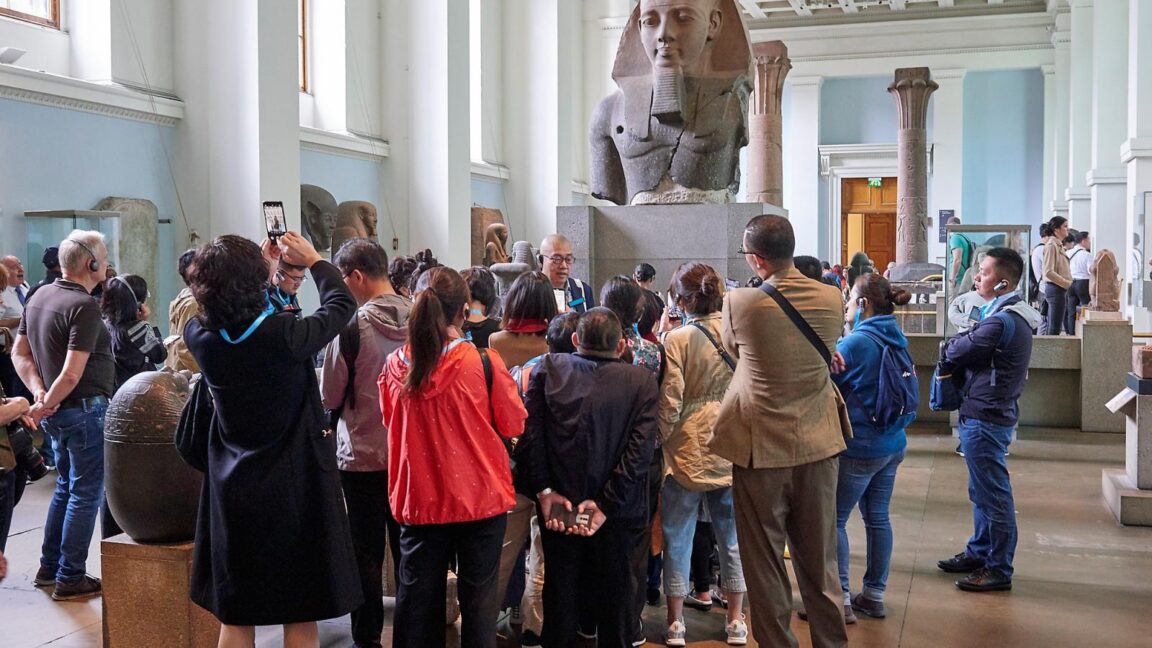
Then walk the gallery slowly rather than leaving. The colossal bust of Ramesses II, cut from a single block of two toned stone, stands further along, and the room’s procession of pharaohs, sphinxes and temple sculpture gives the stone its context: this was a civilisation that wrote on everything. The museum’s own tour photograph of this gallery, used as this article’s featured image, shows exactly the crowd that forms around these objects by late morning, which is why you are here at ten.
Where do the Assyrian rooms and the Parthenon fit?
From Room 4, continue west and north through the Assyrian palace reliefs in Rooms 6 to 10, where carved panels of lion hunts and sieges line the walls at reading height. These rooms are the connoisseur’s favourite part of the ground floor and they are comparatively calm, because the tour groups are still photographing Egypt. Do not rush them; the reliefs reward close looking, and the human headed winged bulls that guarded Assyrian palace gates are among the largest things the museum owns.
Then commit to Room 18, the Parthenon sculptures, before lunch. The long Duveen Gallery holds the marble frieze, the metopes and the pediment figures from the Parthenon in Athens, carved in the fifth century BC. Walk the frieze as it was meant to be read, as one long procession of riders, musicians and animals moving along the wall, and end at the pediments, where the reclining figures and the tired horse of Selene, the moon goddess, show Greek carving at its absolute peak. The museum’s position on the sculptures’ presence in London, and Greece’s long standing call for their reunification in Athens, are both part of the modern story of this room, and the gallery interpretation does not hide the argument. Read it and form your own view; the room is more interesting, not less, for the dispute.
What should the afternoon hold upstairs?
After a break in the Great Court, go up. The upper floors are where one day visitors gain the most, because half the building’s audience never leaves the ground floor. Prioritise three things. First, Room 41 and the Sutton Hoo ship burial, the Anglo Saxon treasure from Suffolk whose helmet has become the face of early medieval England. Second, the Egyptian mummies and funerary galleries on the upper floor, where the collection moves from the monumental sculpture of the morning to painted coffins, preserved bodies and the intimate objects of the afterlife. Third, one gallery chosen by appetite rather than fame: the Lewis Chessmen, the Americas in Room 24 and 27 with the great Easter Island figure Hoa Hakananai’a, or the clocks and watches, are all within a short walk of each other on the upper circuits.
Pace is the skill. Give each upstairs room a hard twenty minutes and keep moving; the fatigue in this building is real, and the visitor who sits down at 15.00 having seen four rooms properly beats the one who has blurred through twelve. If you are travelling on a Friday, the late opening until 20.30 changes the maths completely: arrive mid afternoon, do the ground floor as the day crowds leave, and take the upper galleries in the evening calm. The same timed ticket logic that governs a Lisbon museum day, explored in the Lisboa Card’s museum value in 2026, applies here in free form: the ticket costs nothing, but the slot is still worth booking.
Why finish in the Enlightenment Gallery?
Room 1, the Enlightenment Gallery, fills the old King’s Library along the museum’s east side, and it is the room most one day visitors never reach, which makes it a peaceful finish as well as a meaningful one. It displays how the collectors and scholars of the 1700s and early 1800s tried to order the whole world: natural history beside antiquities, coins beside manuscripts, the beginnings of the classification systems that museums still use. After a day of individual masterpieces, this room explains why they are all in this building at all, since the museum was founded in 1753 and opened to the public in 1759 as a collection of collections, free to all, an idea this gallery embodies.
It also holds the day’s neatest bookend. A replica of the Rosetta Stone stands here, and unlike the original in Room 4, it can be touched. Run a hand over the carved scripts at the end of the day and you will understand the morning’s object differently, as a working document rather than an icon behind glass. Leave by the Great Court, look up once at the glass roof, and walk out onto Great Russell Street with the particular satisfaction of a plan that held. Edinburgh’s Royal Mile rewards the same bottom up sequencing, as walking the Royal Mile from Holyrood upward shows.
Frequently Asked Questions
Is the British Museum really free?
Yes. Admission to the museum and access to the permanent collection and displays is free. Special exhibitions and some events are charged, and the museum advises booking a free timed ticket in advance to guarantee entry at busy times.
What are the British Museum’s opening hours?
Daily from 10.00 to 17.00, and until 20.30 on Fridays. Last entry is 16.45, or 20.15 on Fridays. The museum is closed from 24 to 26 December.
Where is the Rosetta Stone?
In Room 4, the Egyptian sculpture gallery on the ground floor, just west of the Great Court. Go in the first half hour after opening for the clearest view. A touchable replica is in Room 1, the Enlightenment Gallery.
Where are the Parthenon sculptures?
In Room 18, the Duveen Gallery, on the ground floor. The frieze, metopes and pediment sculptures from the fifth century BC Parthenon in Athens are displayed along one long gallery.
Can I see the British Museum in one day?
You can see its greatest objects in one day, not all of it. The museum holds more than 50 galleries spanning two million years. The sequence in this guide, Rosetta and Egypt first, Parthenon before lunch, Sutton Hoo and the mummies in the afternoon, Enlightenment Gallery last, is the realistic one day version.
Photo: A tour group in the British Museum’s Egyptian sculpture gallery, Room 4, gathered before the colossal bust of Ramesses II. Credit: The British Museum, via britishmuseum.org, the museum’s own official website.