 Aiko Tanaka
Acadia’s carriage roads are the rare family attraction that needs no selling to children, because the product is a bike ride on 45 miles of car free, crushed stone roads through a national park, built between 1913 and 1940 as a gift from John D. Rockefeller Jr., crossing 17 historic stone faced bridges, with a famous lunch in the middle: popovers at Jordan Pond House, overlooking the pond and the two rounded peaks called the Bubbles. The National Park Service rules are simple and family shaped. Cyclists share the roads with horses and pedestrians, everyone yields to horses, bicyclists yield to everyone, Class 1 e-bikes are allowed and Classes 2 and 3 are not, and no bicycle may exceed 20 mph. Rent hybrid or gravel friendly bikes in Bar Harbor, not skinny tyred road bikes, start at Eagle Lake or Jordan Pond, choose a loop shorter than you think, and time Jordan Pond House for an early or late lunch. That is the whole trip, made family proof.
Quick Facts
- The network: 45 miles of rustic carriage roads in Acadia National Park, weaving around mountains and valleys and over 17 historic carriage road bridges, per the National Park Service.
- Built: 1913 to 1940, financed and overseen by philanthropist John D. Rockefeller Jr. and family. Rockefeller financed 16 of the 17 stone faced bridges, each unique in design.
- Surface: Crushed rock, about 16 feet wide. Suited to hybrid, gravel and mountain bikes and sturdy hybrids for children, not to narrow road tyres or scooters.
- Yield rules: Everyone yields to horses. Bicyclists yield to everyone. Maximum bicycle speed 20 mph.
- E-bikes: Class 1 e-bikes are permitted on the carriage roads. Class 2 and 3 e-bikes are not allowed.
- Closures: In spring the carriage roads often close to all traffic during mud season, typically March and April. Check current alerts before a spring trip.
- Dogs: Allowed on a leash of six feet or less, though the Park Service notes that bicycling with your dog is not recommended for safety reasons.
- Rentals: Visitors can bring their own bicycles or rent from local outfitters in Bar Harbor, as the Park Service notes. Book ahead in summer.
Which bikes actually fit the carriage roads?
The surface decides the rental, and the surface is broken stone: a firm, well kept gravel, engineered a century ago with layered rock and a crowned profile to shed Maine’s wet weather. On that surface, a hybrid with tyres of moderate width is the family workhorse, a gravel bike is the keen adult’s choice, and a mountain bike is more than enough. A road bike on narrow tyres will survive and resent every mile. For children, the questions are wheel size and gearing rather than fashion: a child on a single speed with small wheels will walk the first long grade, while a geared bike with a low climbing gear turns the same hill into a story they tell at dinner.
Trailers and tagalongs work on the carriage roads’ generous width, and they are the honest answer for children too young to ride the distance, with the caveat that the adult doing the towing should test the combination on the flat before committing to a loop with climbing. Rental shops in Bar Harbor supply hybrids, children’s bikes and trailers through the season, and the Park Service’s own advice is simply that visitors may bring their own bicycles or rent from local outfitters. Reserve in July and August, size children in the shop rather than guessing, and ask for the carriage road map at the counter, because the numbered intersection signposts in the park only make sense with it in your pocket. Families extending a Maine trip will find the same rent early logic on Isle au Haut, Acadia’s quiet half, where the ferry, not the bike shop, is the capacity limit.
Which loop avoids the steepest grades?
Every carriage road loop is a compromise between water, bridges and climbing, because Rockefeller built roads that follow the landscape rather than flattening it. The family strategy is to ride the pond circuits, where the grades are kindest, and to treat the mountain circuits as a second day ambition. The Eagle Lake loop is the classic first ride: a well connected circuit on the northern side of the system with long water views and several intersections that let you shorten the day if small legs fade. The Jordan Pond circuit is the scenic headline, rolling rather than flat, with the pond, the Bubbles and the lunch stop built in, and it crosses historic bridges on the way.
The Around the Mountain loop is the one to admire on the map and save for teenagers and strong riders: it is the system’s big day, crossing the most bridges and climbing the most, and it has ended more family holidays’ goodwill than any other line on the map. Whichever loop you choose, ride it in the direction that does the climbing early, stop at the numbered signposts to check the map rather than guessing at junctions, and remember the etiquette that keeps the system pleasant: call out before passing, slow right down near horses, and stop completely if a horse looks unsettled, because everyone yields to horses and a startled horse is the one genuine hazard on these roads. Walkers planning a non cycling day can pair this guide with Monhegan Island, Maine’s artists’ island, another car light Maine day built around moving slowly.
How does the Jordan Pond House popover timing work?
Jordan Pond House, the restaurant by the pond on the Park Loop Road side of the system, is famous for one thing above all: popovers, the crisp, hollow, steaming rolls served with butter and jam, traditionally taken on the lawn with the pond and the Bubbles in front of you. It is the natural mid ride lunch for a carriage road day, since the carriage roads pass Jordan Pond and one of the system’s two gate lodges, the Jordan Pond Gate Lodge, stands here as the network’s ceremonial entrance.
The timing problem is that everyone has the same idea at 12.30. The family proof solutions are to arrive early, making Jordan Pond a late morning stop at the end of a shorter first loop, to arrive late, after the lunch peak has cleared, or to build the day backwards from a reservation where the restaurant offers one, and treat the ride as the morning and afternoon brackets around it. Do not promise children popovers at a fixed hour and then arrive at the back of a long wait with empty legs; promise popovers as the day’s destination and keep the riding before them gentle. Snacks in a jersey pocket are the insurance policy either way.
How do you turn the bridges into the game?
Seventeen bridges is a lot of architecture for a child to absorb as history, so absorb it as a hunt instead. Rockefeller financed 16 of the 17 stone faced bridges, each unique in design, spanning streams, waterfalls, roads and cliff sides, built of steel reinforced concrete faced with native stone so skilfully that he sometimes asked the cutters not to finish the stone too well, for fear of losing the rustic look. Give each rider a simple list: the bridge over a waterfall, the bridge with the most arches, the oldest bridge. Cobblestone Bridge, the system’s first, dates to 1917 and is recognisable by its rounded stones. Deer Brook, Waterfall and the Jordan Pond area bridges each have their own character, and the coping stones, the big granite blocks lining the roads as guardrails, have been known for a century as Rockefeller’s teeth.
The game does real work. It slows the ride at exactly the points where the views open, it gives the Jordan Pond lunch a before and after, and it turns the return leg, when children tire, into a count of bridges still to find. The same trick, scenery organised as a sequence of named stops, is what makes a first timer’s day at Pictured Rocks hold together for families on Lake Superior.
What else should a Bar Harbor parent know before riding?
Four practicalities close the guide. First, the roads are shared and the rules are enforced by courtesy as much as by rangers: bicycles yield to everyone, everyone yields to horses, and the 20 mph limit is generous on a family ride and still worth stating to a teenager on a descent. Second, bicycles are not permitted on hiking trails or on the privately owned carriage roads that interleave with the park system, so follow the signposts and the map at boundary points. Third, spring is not riding season by default: the roads often close to all traffic in mud season, typically March and April, and winter brings its own rules, including groomed ski sections where bicycles are not permitted. Fourth, the Island Explorer bus system exists precisely for this park’s car free logic, and its seasonal bike carrying services can rescue a one way ride or a tired rider; check the current season’s arrangements in Bar Harbor before relying on them. Pack water for everyone, because a pond view is not a tap, and a light rain layer, because Acadia’s weather turns on a maritime schedule, not a forecast’s feelings.
Frequently Asked Questions
How many miles of carriage roads does Acadia have?
45 miles inside Acadia National Park, built from 1913 to 1940 and crossing 17 historic carriage road bridges. The wider historic network on Mount Desert Island, including roads in the neighbouring Land and Garden Preserve, is longer still.
Can children ride the carriage roads?
Yes, and families are the system’s natural users, because the roads are car free, wide and surfaced in crushed stone. Choose geared bikes that fit, keep the loop short, use a trailer for the youngest riders, and favour the pond circuits over the mountain loop.
Are e-bikes allowed on Acadia’s carriage roads?
Class 1 e-bikes are permitted. Class 2 and Class 3 e-bikes are not allowed. All bicycles, electric or not, are limited to 20 mph and must yield to all other users.
Where do you rent bikes for the carriage roads?
In Bar Harbor, where local outfitters rent hybrids, children’s bikes and trailers for the carriage roads, as the National Park Service notes. Reserve ahead in peak summer and collect a carriage road map, since in park navigation works by numbered intersection signposts.
When are the carriage roads closed?
They often close to all traffic during spring mud season, typically March and April, and individual sections can close at other times. Check the park’s current alerts before a trip, especially outside the main summer season.
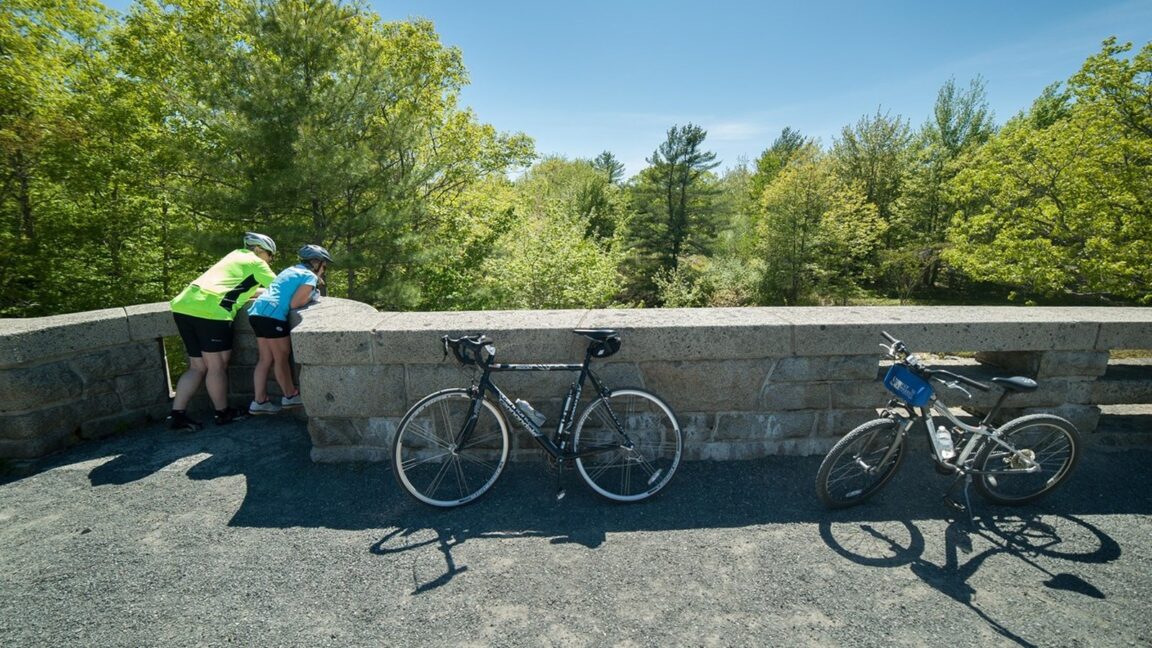
Photo: Two cyclists paused on a stone faced carriage road bridge in Acadia National Park, their bicycles resting against the granite parapet above the trees. Credit: Kent Miller, National Park Service (NPS Photo), via nps.gov.