 Maya Chen
Every Aman resort since 1988 is a variation on Amanpuri, and the original still makes the strongest case for the formula: 40 Thai roofed pavilions stepped through a coconut plantation above Pansea Beach, a black tiled main pool as the resort’s calm centrepiece, and service built on space, quiet and privacy rather than spectacle. A traveller weighing Phuket’s luxury old guard against the island’s newer branded resorts should understand Amanpuri as the template itself, not an ageing copy of it. What has dated is little; what the newer resorts borrowed is nearly everything. The honest cautions are different: many pavilions look over gardens rather than open sea by design, and the resort’s seclusion means the island’s nightlife might as well be in another country.
Quick Facts
- Opened: 1988, the inaugural Aman property, on a coconut plantation peninsula on Phuket’s west coast
- Beach: A stretch of Pansea Beach, a white sand crescent overlooking the Andaman Sea, shared with one neighbouring resort
- Accommodation: 40 guest Pavilions, each 50 square metres indoors with an outdoor sala, plus multi bedroom Villas of three to nine bedrooms, per Aman’s official factsheet
- Centrepiece: The black tiled main swimming pool, flanked by pavilions and palms above the beach
- Wellness: The Holistic Wellness Centre, in pavilions cascading down the hillside, with 12 treatment rooms
- Getting there: About 30 minutes by road from Phuket International Airport, per Aman
- Facts checked: November 23, 2026, against aman.com, the property’s official website
What did Amanpuri invent, exactly?
Before Amanpuri, a luxury beach resort competed on facilities: more restaurants, bigger pools, longer activity lists. Adrian Zecha’s first property, designed by architect Ed Tuttle on the site of a coconut plantation above Pansea Beach, competed instead on absence: few keys, generous space per guest, buildings that disappear into planting, and staff who anticipate rather than announce. The pavilions’ distinctive pointed roofs borrow from the temple architecture of Ayutthaya, Thailand’s former capital, drawn with a minimalist line that still looks contemporary. The layout became the house style for a global collection: accommodation dispersed through landscape rather than stacked in a block, a dramatic central pool as the social heart, and a beach treated as scenery for privacy rather than a stage for entertainment. Travellers who have stayed at later Amans will recognise every move here, because this is where the moves were made. Our coverage of the formula’s later variations includes Amandari above the Ayung Gorge in Bali and the five lodge circuit of Amankora in Bhutan.
How does the pavilion layout actually work?
Aman’s official factsheet counts 40 guest Pavilions, each with 50 square metres of interior and an outdoor sala, a shaded open sided terrace for lounging and private dining, arranged in stepped rows through the coconut grove and connected by raised walkways. All have king size beds, large bathrooms and dressing areas. The categories climb by view and water: Garden Pavilions face the plantation greenery, Partial Ocean and Ocean Pavilions open toward the Andaman, and the Pool Pavilions add private plunge pools, the Ocean Pool Pavilions pairing a 50 square metre interior with 95 square metres outdoors. A two bedroom Pool Pavilion suits families who want the pavilion experience with a second room. Above the pavilions in both size and price stand the Villas, residences of three to nine bedrooms, individually decorated with art and antiques, each functioning as a private estate within the resort.
The design consequence to understand before booking is the canopy. Amanpuri hides its buildings beneath the palms deliberately, so a standard pavilion’s outlook is green and private rather than a postcard sea view. Travellers for whom open water from the bed is the point should book an Ocean category pavilion or above and say so plainly when reserving; travellers who value shade, birdsong and seclusion will find the garden outlook is the resort working as intended.
What happens at the pool and the beach?
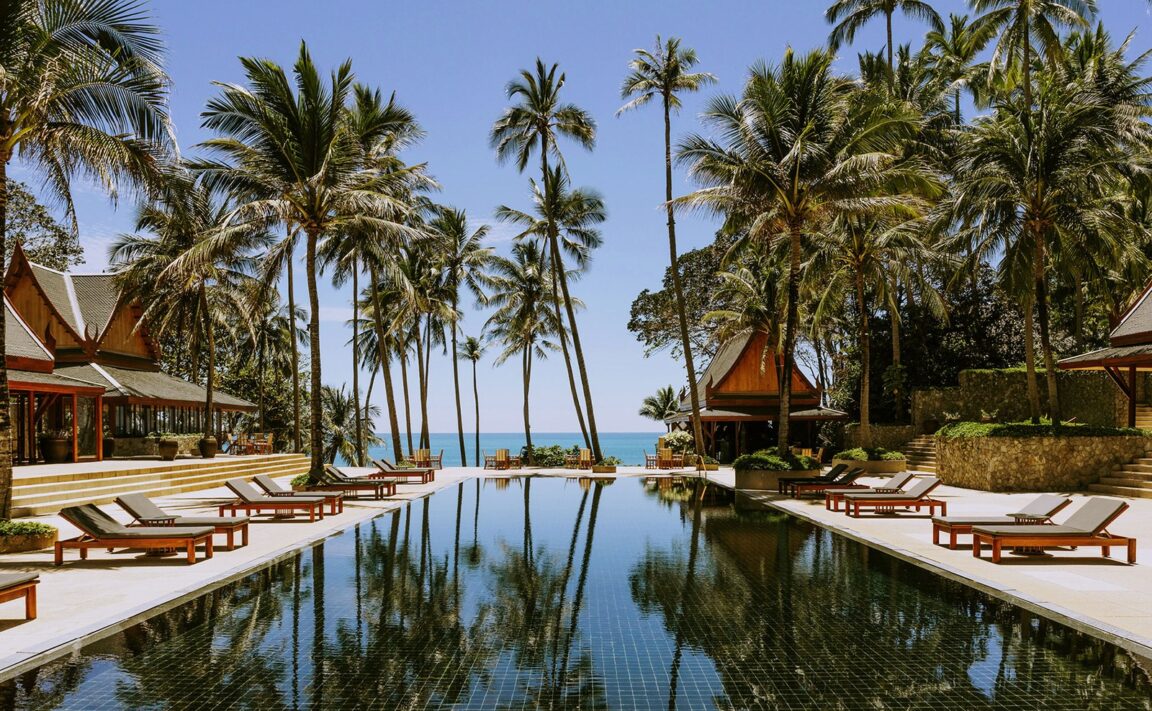
The main pool is the photograph everyone knows: a long, black tiled rectangle reflecting the coconut palms, set on a terrace between Thai roofed pavilions with the Andaman Sea framed at its far end. It functions as the resort’s living room, quiet by policy and temperament, with loungers spaced for privacy rather than packed for capacity. Steps descend through the plantation to Pansea Beach, a crescent of white sand on the peninsula’s shore. The beach is public in law, as all Thai beaches are, but its position between headlands and its access through the resorts that front it keep it effectively secluded; Amanpuri shares it with one neighbour, The Surin. Aman’s factsheet lists a fleet of cruisers for island hopping, fishing and scuba diving, and the west coast position gives the resort the sunset as a daily event, the sky performing over the Andaman while the pool terrace takes the light.
What about food and wellness?
Dining centres on Buabok, the main restaurant, serving Thai and international menus across breakfast, lunch and dinner, with the pavilion salas available for private dining in the Aman manner, meals arriving where you are rather than summoning you to a room. The Holistic Wellness Centre occupies its own series of pavilions cascading down the hillside, with 12 treatment rooms, each with its own shower and dressing space, and a programme that runs from individual treatments to multi day Immersion experiences addressing movement, mindfulness and nutrition. The wellness offer is a useful marker of how the resort has evolved: the 1988 bones now carry the structured wellbeing programming that modern luxury travellers expect, added in the same architectural language rather than bolted on. Buddhist temples lie within easy reach for travellers who want Phuket beyond the headland, and the resort can arrange the island’s excursions, but Amanpuri is honest about its gravity: most guests, most days, go nowhere, and the resort is designed to make that feel like the correct decision.
How does it compare with Phuket’s newer branded resorts?
The newer competition wins on novelty and loses on calm. Phuket’s recent luxury openings bring bigger water parks, beach clubs with DJs, branded spas and family programming at a scale Amanpuri deliberately refuses. For travellers travelling with children who need entertaining, or who want a resort as a social scene, the newer properties are the rational choice. Amanpuri’s counter offer is the original luxury argument: space per guest that no new build on the island matches, a beach that stays quiet, architecture that has settled into its landscape for nearly four decades, and service ratios that the industry still cites. It suits couples, honeymooners and repeat Aman guests, and it suits them best in the dry season months when the Andaman is calm and the sunsets reliable. Book the pavilion category by the view you actually want, not the one the name implies, and give the resort at least three nights; its pleasures are cumulative and quiet, and a single night spent comparing it with newer rivals misses what it is for.
Frequently Asked Questions
Why is Amanpuri historically important?
It was the first Aman, opened in 1988, and its formula of few pavilions, abundant space, landscape first architecture and anticipatory service became the template for the entire Aman collection and influenced luxury resort design worldwide.
How many pavilions and villas does Amanpuri have?
Aman’s official factsheet lists 40 guest Pavilions, each 50 square metres indoors with an outdoor sala, and a villa collection running from three to nine bedrooms, each villa individually decorated.
Is Pansea Beach private?
Thai beaches are public by law, but Pansea Beach’s position on the peninsula and its access through Amanpuri and its one neighbouring resort keep it quiet and effectively secluded in practice.
How far is Amanpuri from Phuket airport?
About 30 minutes by road, per Aman. The resort sits on a peninsula on Phuket’s west coast, in the Cherngtalay area north of Surin Beach.
Do all pavilions have a sea view?
No, and by design. The pavilions sit within a coconut plantation canopy, so Garden Pavilions face greenery. Book a Partial Ocean, Ocean or Ocean Pool category for water views, and confirm the outlook when reserving.
Image: Amanpuri’s black tiled main pool reflecting the coconut palms, with Thai roofed pavilions and the Andaman Sea beyond. Photo: Aman, via aman.com, the property’s official website, used with credit.