 Priya Nair
Amankora is not one hotel but a single journey sold as five lodges: Paro, Thimphu, Punakha, Gangtey and Bumthang, designed to be travelled in sequence across Bhutan western and central valleys with one Aman team handling your guide, driver and pacing throughout. It suits travellers who want Bhutan itself, dzongs, passes, farmhouses and the Tiger Nest hike, to be the luxury, with calm, wood lined suites to return to each night. It does not suit anyone shopping for a resort to stay inside, or any trip that has not first reckoned with Bhutan daily government fee, which applies on top of every lodge night. This guide explains how the circuit works, what each lodge does best and who should book it, with the fee structure checked on 13 November 2026.
Quick Facts
- The circuit: Five lodges in Paro, Thimphu, Punakha, Gangtey and Bumthang, 72 suites in total, travelled as one journey.
- Suite counts: Paro 24 suites, Thimphu 16, Punakha 8, Gangtey 8, Bumthang 16.
- Journey length: Aman sells combinations from 3 nights at one lodge up to 16 nights across all five lodges.
- Government fee: Bhutan Sustainable Development Fee is US$100 per adult per night, US$50 for children aged 6 to 12, plus a one off US$40 visa fee, paid separately from lodge rates.
- Gateway: Paro International Airport; the Paro lodge is the usual first and last night of a circuit.
- Best seasons: Spring and autumn for clear Himalayan views and festival dates; lodges operate year round, with winter the quietest and coldest in the high valleys.
How the Five Lodge Circuit Actually Works
Aman opened Amankora in 2004 as Bhutan first international luxury lodge, and the idea has not changed since: instead of one flagship property, the brand built small lodges along the natural arc of a Bhutan journey and staffed the journey, not just the rooms. You land at Paro, the kingdom only international airport, and move valley by valley, typically Paro to Thimphu, over the Dochu La pass to Punakha, on to Gangtey and the Phobjikha valley, then east to Bumthang, the spiritual heartland, before returning to Paro for the Tiger Nest and your flight out. Aman published journeys run from 3 nights at a single lodge to 16 nights across all five, and the pacing is the product: two nights per valley is the rhythm that lets each place register, with one night stops reserved for Thimphu on shorter circuits.
The practical consequence is that Amankora should be judged as a tour that happens to sleep exceptionally well, not as five separate hotel bookings. Transfers between valleys are mountain drives of several hours on winding roads, and the lodge sequence, your private guide and the order of sights are planned as one piece. Travellers who like to improvise daily, change hotels on a whim or keep their own car and driver arrangements will feel managed. Travellers who want Bhutan considerable logistics, permits, road timing, altitude pacing and festival dates, quietly removed will feel looked after.
The Five Lodges, Valley by Valley
Paro: the gateway lodge and the Tiger Nest base
Amankora Paro, the largest lodge with 24 suites, sits in blue pine forest near the ruined Drukgyel Dzong, with views toward Mount Jomolhari on clear days. It is the natural bookend of the circuit: first night after arrival, last night before departure, and the base for the hike to Paro Taktsang, the Tiger Nest monastery, which deserves a full, unhurried day at the end of a trip once altitude has settled. The lodge has a two storey spa building, the largest wellness facility on the circuit, which matters after that hike.
Thimphu: the capital, in pine forest above the bustle
Amankora Thimphu holds 16 suites in the Motithang district of the capital, in pine forest a short drive from the centre. Thimphu is where a Bhutan journey takes in the working kingdom: the great Tashichho Dzong, the Buddha Dordenma statue above the valley, markets, textile and craft workshops and the national stadium archery that functions as Bhutan national sport. One or two nights suffices for most circuits; the lodge position, in the city but not of it, suits that pace exactly.
Punakha: the warm valley, the farmhouse and the pool
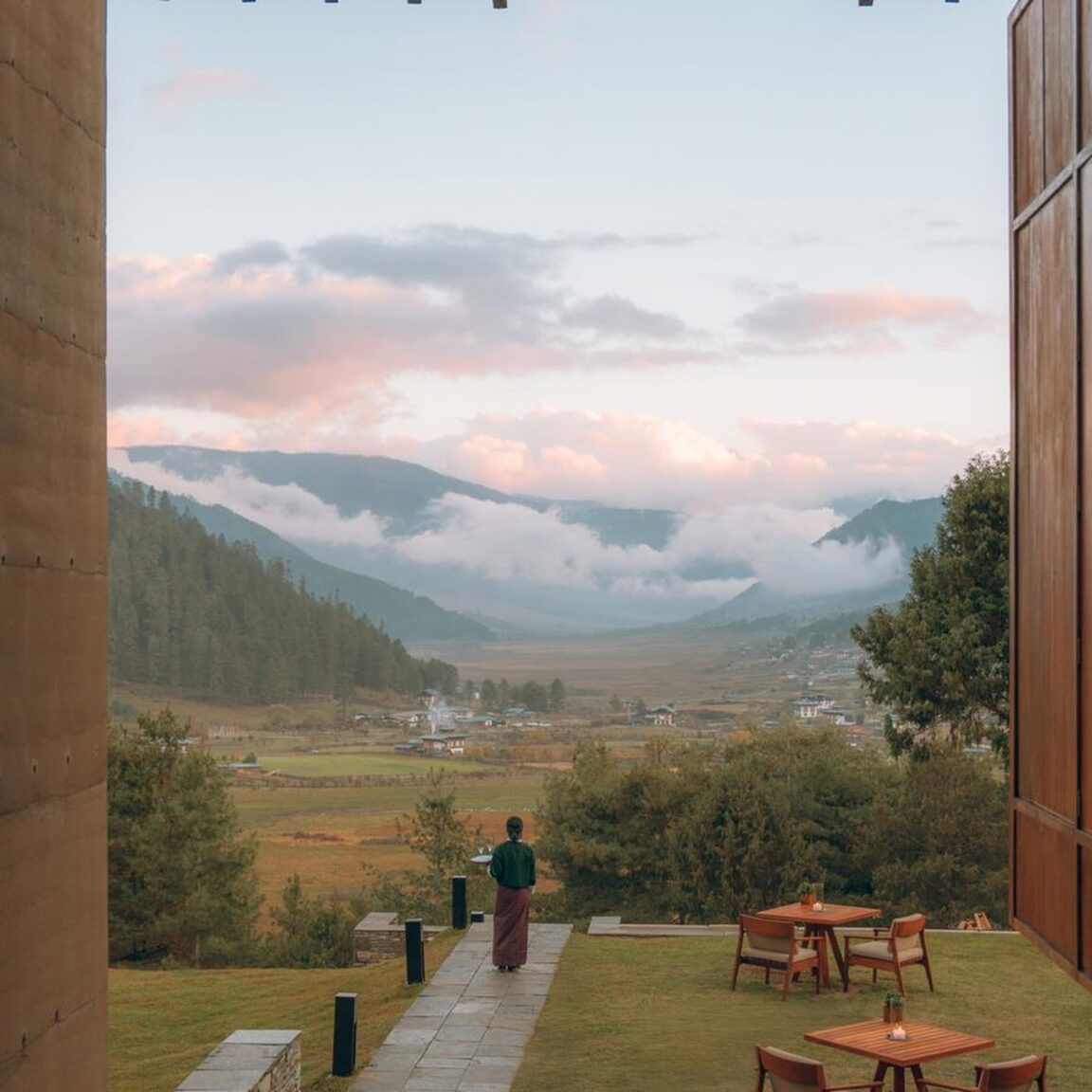
Amankora Punakha is the smallest feeling lodge on the circuit, with 8 suites arranged around a traditional Bhutanese farmhouse, reached on foot across a suspension bridge over the Mo Chhu river, with no vehicle access to the door. Punakha is the low, warm valley of the circuit, roughly 1,200 metres up against Thimphu 2,320, and the lodge holds the only swimming pool at Amankora, set among rice terraces and orange groves. Two nights here is the consensus sweet spot, covering the magnificent Punakha Dzong at the confluence of the Pho Chhu and Mo Chhu rivers and the fertility temple at Chimi Lhakhang at an unforced pace.
Gangtey: the crane valley and the quietest lodge
Amankora Gangtey has 8 suites overlooking the Gangtey Goemba monastery and the Phobjikha valley, a wide glacial bowl protected for the black necked cranes that winter there, arriving in late autumn and leaving in late winter. This is the lodge for travellers who measure luxury in silence and space: valley floor walks, the crane information centre, farmhouse dinners and some of the darkest night skies on the circuit. In crane season it is unmissable; outside it, it remains the circuit best pause.
Bumthang: the spiritual heartland, furthest east
Amankora Bumthang, with 16 suites beside the Wangdicholing Palace grounds, serves the valley cluster that Bhutanese regard as the country spiritual heartland: Jakar Dzong, the Kurjey and Jambay temples and a slower, more agricultural Bhutan of buckwheat fields and farmhouse cheese. Bumthang is the add on that separates a good western circuit from a complete one; it costs the longest drives, or a domestic flight schedule permitting, and pays back the travellers who give it two nights.
The Fee Structure Nobody Should Book Around
Every Amankora quote sits on top of Bhutan national tourism pricing, and the numbers are set by the government, not the hotel. The Sustainable Development Fee, or SDF, is US$100 per adult for each night in Bhutan, with children aged 6 to 12 at US$50 per night and younger children exempt; Indian nationals pay a separate rate in rupees. A one off visa fee of US$40 per person applies on top. The US$100 rate is the discounted level of a statutory US$200 fee and is published as running to 31 August 2027, so quotes spanning dates after that should be checked carefully. On a ten night circuit the SDF alone adds US$1,000 per adult before a single lodge night is counted, which is precisely why honest budgeting for Bhutan starts with the fee and works backwards to how many lodge nights it can support.
Aman quotes its journeys per itinerary, varying by season, lodge combination and length, and longer journeys have historically carried better nightly value than short ones. Ask any quote to separate, in writing, the lodge rate, the SDF, the visa fee and what guiding, driving, meals and activities are included, because comparisons with other Bhutan luxury circuits, including the five lodge Six Senses journey covered in our Six Senses Thimphu guide, are meaningless until the same items sit on both sides of the page.
Who Amankora Suits Best, and Who It Does Not
Amankora suits travellers taking Bhutan seriously as a once in a decade journey: couples and small groups who want the full valley arc, private guiding throughout, and a calm, consistent standard of room, food and spa across very different landscapes. It suits altitude aware pacing, because the sequence builds from Paro and Thimphu before the higher passes, and it suits festival travellers, since a private guide can shape days around tshechu dates in Paro, Thimphu or Punakha. It pairs naturally with a Himalayan journey that might begin in Nepal; readers routing that way should see our first time in Kathmandu itinerary for the contrasting, independent version of Himalayan travel.
It does not suit a short add on. Three nights split across lodges buys mostly driving; if you have under five nights in Bhutan, take one or two valleys properly instead, Paro plus Thimphu, or Paro plus Punakha. It does not suit travellers who want nightlife, choice of restaurants or a lively resort scene; evenings at Amankora are dinner, a fire and sleep, by design and by Bhutan own rhythm. And it does not suit anyone for whom the SDF plus lodge pricing crowds out everything else: Bhutan at a lower budget, in good local hotels with a licensed guide, is a genuinely fine trip, and the fee structure means the kingdom rewards honesty about that choice.
Frequently Asked Questions
How many nights does an Amankora journey need?
Seven to ten nights is the working range for the circuit. Seven nights covers four lodges at a sensible pace; ten nights reaches all five, including Bumthang, without rushing. Aman sells from 3 nights at one lodge to 16 nights across all five, but the short end works as a single valley stay, not a circuit.
What does the Bhutan Sustainable Development Fee add?
US$100 per adult per night, US$50 for children aged 6 to 12, plus a one off US$40 visa fee per person, paid to the government separately from lodge rates. The US$100 level is published to 31 August 2027. Ten nights therefore adds US$1,000 per adult in fees alone.
Which Amankora lodge is best if I can only pick two?
Paro, for the Tiger Nest and the spa, and Punakha, for the warm valley, the dzong and the only pool. Together they give the widest contrast of Bhutan landscapes and the two experiences most travellers name afterwards.
When is the best time to travel the circuit?
Spring, March to May, and autumn, late September to November, bring the clearest mountain views and the major festivals. Winter is cold in Thimphu, Gangtey and Bumthang but quiet and often clear, and it is crane season in Phobjikha. The summer monsoon months are the greenest and the least reliable for views.
Is Amankora better than Six Senses Bhutan?
They run parallel five valley circuits and the choice is one of style and quote, not quality ranking. Amankora is the original, quieter and more uniform in design; Six Senses leans harder into wellness programming. Compare itemised quotes for the same dates, valleys and inclusions before deciding.
Fee figures checked 13 November 2026 against bhutan.travel; lodge structure and suite counts against Aman published lodge information. Journey prices are quoted per itinerary by Aman and are not listed here because they vary by season and combination.