 Hana Kim
The hotel most travellers still call The Middle House, Swire Hotels design led house in Shanghai Jing’an district, has a new name: in October 2025 Swire renamed it Upper House Shanghai, uniting its former House Collective properties under the Upper House brand. The hotel itself is unchanged in the ways that matter: Piero Lissoni interiors in two rounded towers in the Dazhongli neighbourhood, 111 residential style rooms, a serious spa below ground, and three restaurants that locals use as much as guests. It suits design conscious travellers, couples and business guests who want quiet, apartment like rooms in the middle of the city shopping and business district. It does not suit travellers chasing a Bund view or old school palace hotel theatre; its luxury is calm, tactile and deliberately understated.
Quick Facts
- Name change: Opened in April 2018 as The Middle House, the fourth House Collective hotel; renamed Upper House Shanghai in October 2025 under Swire Hotels Upper House rebrand. Listings, taxis and older guides may still say The Middle House.
- Address: No. 366 Shi Men Yi Road, Jing’an District, Shanghai 200041, inside the HKRI Taikoo Hui development just off Nanjing West Road, per the hotel own site.
- Rooms: 111 guest rooms and studios from 50 to 100 square metres, plus a Gallery Suite and a 660 square metre top floor Penthouse; the separate Residences building holds 102 serviced apartments from 55 to 110 square metres.
- Design: Interiors and facade character by Milan architect and designer Piero Lissoni, reinterpreting Shanghainese and shikumen elements in a contemporary language.
- Dining: Café Gray Deluxe, the European inspired all day restaurant and terrace by chef Gray Kunz; Sui Tang Li, chef Tony Ye contemporary Chinese restaurant; and Frasca, the Italian restaurant. Sui Tang Li and Frasca are both MICHELIN Guide Shanghai selected restaurants.
- Wellness: Mi Xun Spa, a 2,600 square metre below ground wellness level with a heated indoor pool, 24 hour gym, sauna, steam room and treatment rooms.
- Recognition: The hotel holds One MICHELIN Key in the MICHELIN Guide hotel selection, announced on its own site.
What Is the Dazhongli Position Actually Like?
The name Middle was always a location joke with a history lesson inside it: Dazhongli, the historic neighbourhood the hotel stands in, can be read as a middle ground of old Shanghai, and the hotel occupies part of HKRI Taikoo Hui, the large mixed use development on Nanjing West Road in Jing’an. In practical terms that means the city best shopping street at the door, a major mall beneath and beside the hotel, the West Nanjing Road metro interchange a short walk away, and People Square and the Bund reachable by metro or a longer stroll east. Jing’an Temple, the gilded landmark that gives the district its name, stands west along the same road. It is a working, wealthy, local Shanghai base rather than a tourist enclave, and for business travellers it is close to the centre of gravity of the city offices.
The two towers, one for the hotel and one for the residences, wear Lissoni rounded aluminium louvre facades that curve and shimmer, a deliberate contrast with the stone lane houses, the shikumen, that once defined this district. The arrival sequence sets the tone: a green tiled entry and a dramatic chandelier, then spaces that lower the volume. Travellers comparing Asian design hotels should note how different the register is from the wood and sky calm of the Aman in Tokyo’s Otemachi tower, covered in our Aman Tokyo guide; where Aman abstracts Japan, this house keeps quoting Shanghai, in ceramic, bamboo pattern and lane house geometry.
What Are the Rooms and Residences Like?
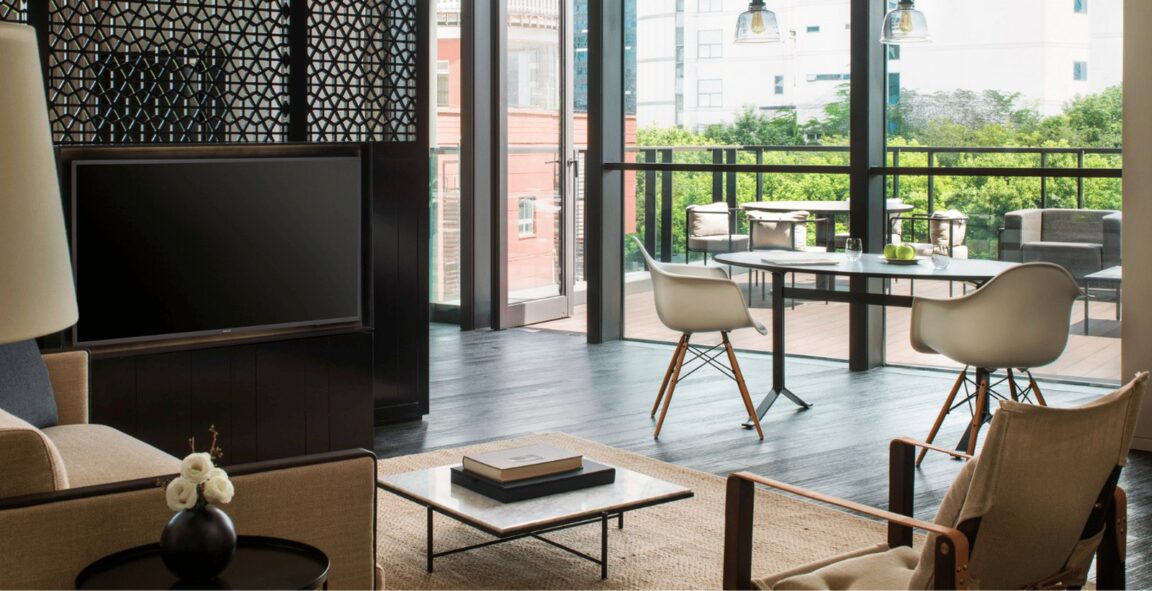
The 111 hotel rooms are sold as studios by size, Studio 50, 60, 70 and 90 among them, running from 50 to 100 square metres, which is generous by any city standard and exceptional at the entry level. Lissoni language inside is consistent: dark wood floors, floor to ceiling windows, glass walled bathrooms with oval freestanding tubs and rain showers, and furniture that reworks traditional Chinese forms, including the bench like day beds and lattice screens, in a muted modern palette. The hotel complimentary in room Maxi Bar, snacks and drinks other than wines and Champagne, is a House Collective signature and removes the small daily friction of minibar accounting. Above the studios sit a Gallery Suite in the Residences building, with its own terrace, and the Penthouse, 660 square metres across the top floor with two bedrooms, private terraces, a lounge and an event space with a private kitchen, sold as much for private occasions as for sleeping.
The Residences are the second product and the one long stay travellers should price first: 102 serviced apartments from 55 to 110 square metres in the adjoining tower, in one and two bedroom formats with a three bedroom set up available on request, with sliding wooden screens that let the living space reconfigure. Residence guests use the same restaurants and Mi Xun wellness level, so the choice between the towers is about kitchen and laundry practicality, not about two tiers of hotel. For stays beyond a week in this part of Shanghai, that apartment format is the house strongest card.
Where Should You Eat Inside the House?
Three restaurants divide the day cleanly. Café Gray Deluxe, the name chef Gray Kunz brought from Hong Kong, is the all day room on the third floor of the hotel tower: modern continental cooking with Asian influences, a cocktail lounge and one of the largest hotel terraces in this part of the city, overlooking Nanjing West Road. It is the breakfast room, the business lunch room and the afternoon tea room in one. Sui Tang Li, in the Residences building, is the serious Chinese table: chef Tony Ye cooking across Cantonese, Sichuan and Shanghainese traditions with a contemporary hand, in a dining room organised around a screen of traditional green ceramic tiles. Its lounge above, Sui Tang Shang, reached by the spiral staircase, works for private events. Both Sui Tang Li and Frasca hold MICHELIN Guide Shanghai selected status, and Sui Tang Li also carries a One Diamond Black Pearl honour, per the hotel own announcements.
Frasca, the Italian restaurant at the base of the Residences tower with its own terrace and rose garden edge, is the casual end of the trio, built on fresh pasta, wood grilled meats and the Italian habit of the long lunch. The practical pattern for a stay writes itself: Café Gray for breakfast and drinks, Frasca for the easy dinner, Sui Tang Li for the one considered Chinese meal, ideally booked ahead, because Jing’an books this house restaurants independently of the rooms above them.
What Does Mi Xun Spa Add Below Ground?
The wellness level is the surprise of the building: about 2,600 square metres below the two towers, linking them, holding the Mi Xun Spa, a heated indoor swimming pool, a 24 hour gym, sauna and steam rooms, a yoga studio and treatment rooms, finished in concrete tones and natural textures that feel carved rather than decorated. Mi Xun won Best Fitness Center and Spa of the Year at the 2025 SpaChina Awards, per the hotel own site, and the facility justifies the award on scale alone; city hotels rarely give this much square footage to wellness. For travellers arriving off long haul flights, the combination of a real pool, a proper gym at any hour and treatment rooms in the same level makes the first day recovery plan unusually simple.
Who Does This House Suit Best, and Who Should Book Elsewhere?
It suits design literate travellers who read rooms the way others read menus, couples who want space and quiet in the middle of a loud city, and business and long stay travellers for whom the Residences format, the Maxi Bar, the gym hours and the Jing’an position solve real problems. It suits Shanghai repeaters especially: a first visit often belongs on the Bund, but a second or fifth belongs here, in the local luxury district, with the metro web at the door. Travellers weighing it against Seoul corporate luxury could compare the service model in our Four Seasons Hotel Seoul guide, a grander and more formal version of the Asian city hotel.
It does not suit travellers whose Shanghai picture requires a river view, a colonial Bund facade or a ballroom scale lobby scene; this house has none of those and does not apologise for it. It also requires one practical adjustment since October 2025: search, book and give the driver the current name, Upper House Shanghai, while expecting the Middle House name to persist in older coverage, in the neighbourhood memory and in some booking channels. The address settles any confusion: No. 366 Shi Men Yi Road, Jing’an. The hotel publishes rates dynamically on its own site and no fixed tariff is listed here, because none is published to quote.
Frequently Asked Questions
Is The Middle House Shanghai still open, or did it close?
It is open, under a new name. Swire Hotels renamed The Middle House to Upper House Shanghai in October 2025, when the House Collective properties were united under the Upper House brand. The building, rooms, restaurants and Mi Xun Spa continue at the same address, No. 366 Shi Men Yi Road in Jing’an.
How big are the rooms at the Middle House, now Upper House Shanghai?
Large for a city hotel. The 111 hotel rooms and studios run from 50 to 100 square metres, and the 102 Residences apartments run from 55 to 110 square metres, per Swire Hotels published figures. Even the entry Studio 50 gives most guests more space than a standard room in a Shanghai tower hotel.
Which restaurants does the hotel have?
Three: Café Gray Deluxe for all day European inspired dining and its terrace, Sui Tang Li for contemporary Chinese cooking across Cantonese, Sichuan and Shanghainese traditions, and Frasca for Italian. Sui Tang Li and Frasca are both selected restaurants in the MICHELIN Guide Shanghai.
Is the hotel well placed for sightseeing?
For the Jing’an and former French Concession side of Shanghai, yes: Nanjing West Road shopping at the door, a major metro interchange a short walk away, Jing’an Temple along the same road, and People Square and the Bund reachable by metro. It is a local luxury district base rather than a Bund front seat, which repeat visitors usually prefer.
Details checked 13 November 2026 against Swire Hotels and the hotel own site, upperhouse.com, including its Shanghai rooms, dining and wellness pages and the October 2025 Upper House rebrand announcement. The hotel sells rates dynamically; check your dates on the official site.