 Priya Nair
Delphi works as a day trip from Athens if you protect two things: an early start, and the order you walk the site. One combined ticket, listed at 20 euros full price and 10 euros reduced in the official 2026 schedule, covers both the Sanctuary of Apollo and the Delphi Archaeological Museum, and the day runs best site first, museum second: walk the Sacred Way up through the Temple of Apollo to the theatre and stadium in the cool of the morning, then spend the early afternoon in the museum with the Charioteer of Delphi, and see the Tholos at the Sanctuary of Athena Pronaia on your way out of town. Delphi sits about 180 kilometres northwest of Athens on the slopes of Mount Parnassus, roughly three hours each way, so this is a full day, not a half day excursion. Done in this order, it is also the single best ancient day trip in mainland Greece.
Quick Facts
- The distance: About 180 kilometres northwest of Athens, around three hours by road each way.
- The ticket: One combined ticket for the archaeological site and the museum, listed in the official 2026 schedule at 20 euros full and 10 euros reduced. Prices checked 13 November 2026; confirm on the official Hellenic Heritage ticketing platform before you travel.
- Winter hours: From 1 November to 31 March, both site and museum are listed at 08:30 to 15:30. Last admission is 20 minutes before closing.
- Summer hours: From April the site opens 08:00 to 20:00, with closing times stepping earlier through September and October. The museum keeps different hours on Tuesdays in summer, listed at 10:00 to 17:00.
- The status: A UNESCO World Heritage Site since 1987, and in the ancient world the seat of the Oracle of Apollo, consulted by cities and kings from across the Greek world.
- The order that works: Sacred Way, Temple of Apollo, theatre, stadium, then the museum, then the Athena Pronaia sanctuary and its Tholos across the road.
- The transport: Direct KTEL Fokidas buses link Athens with Delphi town, and the site is a short walk east of the modern town. Driving takes about the same three hours and adds flexibility for Arachova.
Why does the order of the visit matter so much at Delphi?
Delphi is a mountainside sanctuary stacked in terraces, and it punishes improvisation in two ways. The first is physical. The Sacred Way climbs steadily from the entrance past the treasuries to the temple, the theatre sits above it, and the stadium, the best preserved in Greece, is a further climb at the very top. In summer that climb is exposed to full sun, and in winter the site closes at 15:30, which leaves no slack at all. The second is intellectual. The museum holds the offerings and sculpture that once filled the sanctuary you have just walked. See the museum first and the labels describe buildings you cannot picture. Walk the site first and every case in the museum lands on a terrace you stood on an hour earlier. If you are combining Delphi with time in the capital, our guide to visiting the Acropolis of Athens uses the same site before museum logic on a smaller hill.
What was Delphi, and why did the whole Greek world come here?
The Greeks believed Delphi was the centre of the world, the point Zeus marked by releasing two eagles from opposite ends of the earth. The sanctuary belonged to Apollo, and its fame rested on the oracle: the Pythia, Apollo’s priestess, delivered responses that were interpreted by the sanctuary’s priests and carried back to Athens, Sparta, Lydia and beyond. City states built treasuries along the Sacred Way to store their offerings and advertise their wealth, athletic victors dedicated statues, and the Pythian Games, held every four years, gave the sanctuary its stadium and its musical and athletic calendar. The oracle’s influence faded in the Roman period and ended in the 4th century AD. The ruins that remain, excavated from the 1890s after the modern village that sat on top was moved, are unusually legible. You can still read the sanctuary as a working religious city, which is exactly what the walking order below is designed to show you.
The site, step by step: what should you look at in the sanctuary?
First, the Sacred Way and the treasuries
Enter and resist the urge to sprint uphill. The Sacred Way zigzags past the bases of treasuries and monuments, and the one restored building, the Treasury of the Athenians, gives you the scale of the originals, small temple shaped strongboxes built to hold a city’s gratitude. This slope was a billboard valley. Every inscription and statue base was a city making a claim, and reading it that way makes the climb feel purposeful rather than merely steep.
Second, the Temple of Apollo and the theatre above it
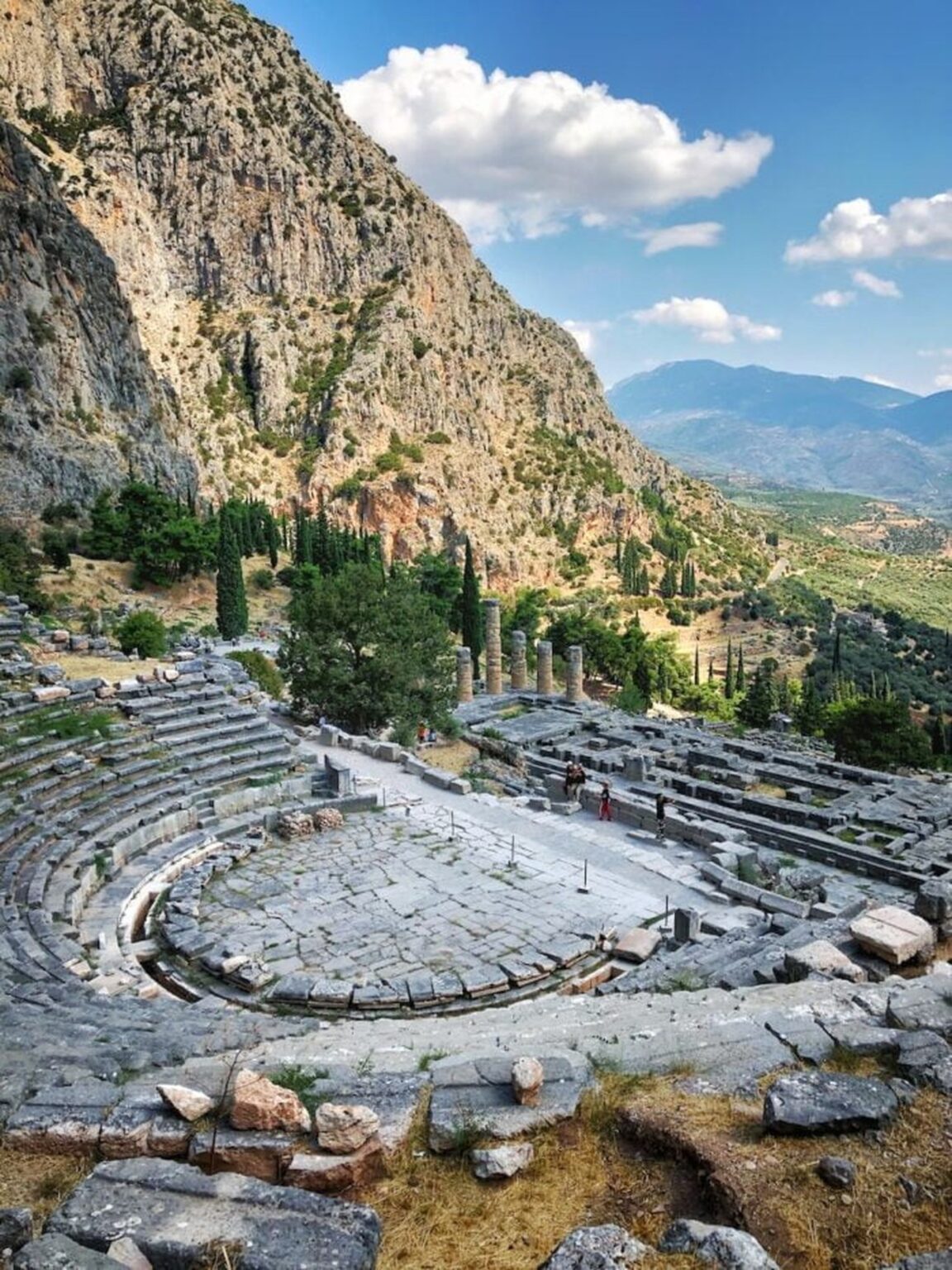
The temple terrace is the heart of the visit. Six columns of the 4th century BC temple stand re erected on the platform where the Pythia delivered the oracle from the inner chamber. Stand here and look down the Pleistos valley through the sea of olive trees to the Gulf of Corinth. That view explains the sanctuary’s siting better than any panel. Then climb one level to the theatre, which seated around 5,000 spectators for the musical contests of the Pythian Games and frames the temple and valley in a single shot. It is the best photograph on the site and the natural rest stop of the walk.
Third, the stadium at the top
Keep going. Many visitors stop at the theatre and miss the stadium entirely, which is a mistake in every season. The stadium, set into the hillside at the sanctuary’s highest point, held about 6,500 spectators and still shows its starting lines and judges’ seats. It is quieter than the lower terraces because the climb filters the crowds, and in winter it is where a short day should spend its last site minutes before heading down to the museum.
The museum: what should you look at, and in what order?
The Delphi Archaeological Museum, a few minutes from the site entrance, holds the finds in a sequence that mirrors the sanctuary’s history, and it rewards a deliberate route rather than a drift. Give it a full hour at minimum, ninety minutes if you can. Start with the archaic rooms: the Sphinx of the Naxians, a marble sphinx that once sat atop a towering column beside the temple as Naxos’s offering, and the twin kouros statues known as Kleobis and Biton. Move through the friezes and metopes that decorated the treasuries you walked past, including the Siphnian Treasury sculpture, narrative carving of a quality that explains why cities competed here. Finish in the room everyone comes for, with the Charioteer.
Why is the Charioteer of Delphi worth the whole trip?
The Charioteer is a life size bronze cast around 478 BC, part of a victory monument dedicated after a chariot win at the Pythian Games, and it survived because an earthquake buried it, protecting it from the melting pot fate of almost all ancient bronzes. The inlaid eyes, the copper lips and lashes, and the calm that sits completely at odds with a victory celebration make it one of the great survivals of classical art. Stand with it last, after the stone rooms. Bronze was the prestige material of the Greek world, and seeing how little of it survives anywhere reframes every marble you saw before it. Then take the short walk or drive down the road to the final stop.
What about the Tholos and the Sanctuary of Athena Pronaia?
Across the main road, a few hundred metres east, sits the second sanctuary, dedicated to Athena Pronaia, where arrivals in the ancient world would have stopped first. Its centrepiece is the Tholos, a circular building of about 380 BC whose three standing columns are the image on half the Delphi postcards in Greece. The Pronaia sanctuary sits outside the main ticketed enclosure described above and typically takes only 20 to 30 minutes, which is why it works as the day’s epilogue rather than its start, when it would eat your fresh morning hours on the main climb. Photograph it in afternoon light if your bus schedule allows, then walk back into Delphi town for a late lunch before the return journey.
How should you time the day trip from Athens?
Work backwards from the closing time, not forwards from breakfast. In the winter season, with the site closing at 15:30, the shape of the day is fixed: take one of the early morning KTEL Fokidas buses from Athens, plan on about three hours on the road, and aim to be through the site entrance by late morning at the latest. Walk the site for about two hours, take the museum until closing, see the Tholos, eat late in Delphi town and take a late afternoon or evening bus back. In summer the 20:00 closing relaxes everything, and the better strategy flips to heat management: enter at the 08:00 opening if you are staying locally, or arrive from Athens by late morning, museum first in the midday heat only if you must, and the sanctuary terraces in the long evening light, which is when Delphi is at its best. Drivers gain the most in both seasons, adding the mountain town of Arachova, about 10 kilometres away, for dinner on the return leg. However you travel, verify the day’s bus times and the current ticket arrangements before you set out, as both change by season. Our 3 days in Athens itinerary shows where a Delphi day fits a first visit to the capital.
Frequently Asked Questions
Can Delphi really be done as a day trip from Athens?
Yes, and thousands do it, but it is a long day: about three hours each way for roughly five to six hours at Delphi. In winter, when the site closes at 15:30, an early bus is non negotiable. Staying one night in Delphi or Arachova turns the same trip into a relaxed one and buys you the site at opening time.
How much does it cost to visit Delphi?
The official 2026 schedule lists one combined ticket for the archaeological site and the museum at 20 euros full price and 10 euros reduced, with free entry for eligible groups such as EU citizens under 25. Prices and concessions change, so check the official Hellenic Heritage platform before travelling.
What are Delphi’s opening hours?
In the winter season, 1 November to 31 March, site and museum are listed at 08:30 to 15:30. In summer the site runs 08:00 to 20:00 from April, with closing times stepping earlier through September and October, and the museum opens later on Tuesdays. Last admission is 20 minutes before closing.
Should I visit the site or the museum first?
The site first, in almost every case. Walking the Sacred Way, temple and theatre gives you the mental map that makes the museum’s sculpture and offerings meaningful, and it puts the exposed climb in the coolest part of the day.
How long do I need inside Delphi?
Plan on about two hours for the sanctuary including the stadium, 60 to 90 minutes for the museum, and 20 to 30 minutes for the Athena Pronaia sanctuary and Tholos. Anything less and you will cut the stadium or the Charioteer, the two things people remember.
Is Delphi accessible for visitors with limited mobility?
Only partly, and it is important to be honest about this. The sanctuary is a steep ancient hillside with uneven stone paths, and the upper terraces and stadium involve sustained climbing. The museum is the most accessible element. Check the official site information for current access arrangements before travelling.
Ticket prices, seasonal hours and transport patterns checked on 13 November 2026 against the Greek Ministry of Culture and Hellenic Heritage listings for Delphi and KTEL Fokidas service information. Confirm times and prices again close to your visit date, as both change seasonally.