 LeVar Thomas
Three days in Bordeaux works best as two days inside the city and one honest decision about the third. Days 1 and 2 belong to the Garonne quays, the Saint Pierre old town and the Cite du Vin, all walkable and all better taken slowly. Day 3 is the Saint Emilion call: the wine village is close enough to tempt every visitor and far enough to cost a full day. This guide gives you the framework to make that call, a day by day plan for the city itself, and the practical details, including Cite du Vin tickets and hours checked on the official site on 13 November 2026.
Quick Facts
- Best base: Saint Pierre and the quays between Place de la Bourse and Saint Michel, the flat, walkable historic core.
- Cite du Vin: 134 Quai de Bacalan; date stamped adult ticket 23 euros including the Belvedere tasting; children under 18 pay 9 euros and under 6s enter free.
- Cite du Vin winter hours: From November to early January, 10:00 to 18:00 on weekdays and Sundays, 10:00 to 19:00 on Saturdays; closed 25 December.
- Historic core status: The Port of the Moon quays and old town form a UNESCO World Heritage listed urban ensemble.
- Saint Emilion: A separate wine village east of Bordeaux, reached by regional train from Bordeaux Saint Jean; it needs most of a day, not a spare afternoon.
- Getting around: The centre is flat and walkable; trams cover the quays and the Cite du Vin, and a single city transport network runs buses, trams and the river shuttle.
Day 1: The Quays, Place de la Bourse and Saint Pierre
Start where Bordeaux explains itself: the Garonne. The 18th century quays were built for the wine and colonial trade, and the long, uniform limestone facades still run unbroken along the left bank. Walk them south from the Quinconces esplanade, one of the largest squares in Europe, past the Monument aux Girondins to Place de la Bourse, the royal square that faces the river across the Miroir d Eau. The mirror is a shallow granite slab that cycles through a thin sheet of water, a reflective stillness and a low mist; on a calm morning the Bourse facade doubles itself in it, and by afternoon it belongs to children paddling and half the city walking through the spray.
Turn inland from the Bourse into Saint Pierre, the medieval quarter of lanes around the church of Saint Pierre and Place du Parlement. This is the Bordeaux to eat and wander in: small squares, wine bars in vaulted cellars, bistros that fill at 12:30 sharp. Give the quarter the whole middle of Day 1 rather than a photo pass. Find Porte Cailhau, the flamboyant 15th century gate that once defended the river entrance, and the Grosse Cloche, the great bell gate on the old pilgrim route south. Both sit minutes apart inside the same walkable knot of streets.
Day 1 Evening: The Saint Michel Quarter and the Right Bank View
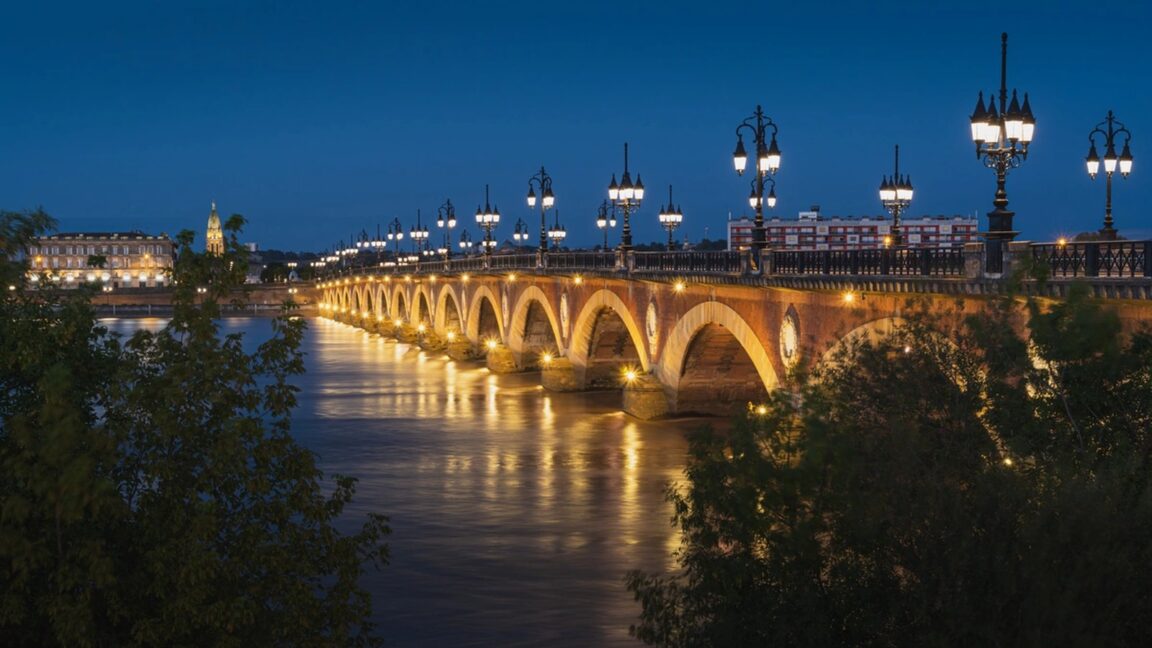
End the day south in Saint Michel, the more lived in quarter around the basilica of the same name, whose freestanding bell tower, the Fleche, is the tallest in the south of France and climbable in season. The square below runs markets and a more local evening scene than Saint Pierre. Cross the Pont de Pierre, the stone bridge ordered by Napoleon, at dusk for the classic reverse view: the whole lit facade of the quays in one line, with the Bourse at its centre. The right bank is also where the Darwin ecosystem fills a former barracks with skate parks, street art and casual food, if your evening wants energy rather than formality.
Day 2 Morning: The Cite du Vin, Done at the Right Pace
Take the tram north along the quays to Bacalan for the Cite du Vin, the decanter shaped wine culture museum that opened in 2016 at 134 Quai de Bacalan. The permanent exhibition is a self guided, multimedia circuit through world wine culture, geography, history and tasting, navigated with a handheld companion device available in nine languages including English. It is genuinely substantial: allow two and a half to three hours if you engage with the tasting and sensory spaces rather than walking through at gallery pace.
The ticket details matter, so here they are from the official site. A date stamped ticket for the permanent exhibition plus the Belvedere costs 23 euros for an adult, 28 euros as an open ticket, with children under 18 at 9 euros on the date stamped ticket and children under 6 free. Every full ticket includes the Belvedere on the eighth floor, where one glass of wine from a rotating world selection is served against a panoramic view over the Garonne and the city. From November to early January the building opens 10:00 to 18:00 on weekdays and Sundays and 10:00 to 19:00 on Saturdays, closing early on 24 December and all day on 25 December. Book a morning slot: the exhibition flows better before midday and the Belvedere light over the river is at its best before lunch.
Day 2 Afternoon: Markets, the Cathedral and the Golden Triangle
Return to the centre for the afternoon. Bordeaux Cathedral, Saint Andre, with its separate Pey Berland bell tower, anchors the western old town; climbing the tower gives the rooftop view that the flat city otherwise denies you. The Marche des Capucins, near Saint Michel, is the working food market, best in the morning but still worth an afternoon pass for cheese, oysters and charcuterie to carry to the quays. North of the cathedral, the Golden Triangle of the Cours de l Intendance, the Grand Theatre and the Place de la Comedie holds the grand 18th century Bordeaux of opera houses and luxury shopfronts, a deliberate contrast with the medieval lanes of Saint Pierre.
Food is the connective tissue of a Bordeaux day, so plan it rather than discovering it hungry. Lunch is the main restaurant meal; many kitchens close between services, and Sunday and Monday closures are common outside the centre. Bordeaux eating is not only fine dining: the city does market lunches, wine bar small plates and bakery breakfasts of chocolatines, the local name for the pastry the rest of France argues about, exceptionally well. For a comparison with the other great French food city covered in depth on this site, see what to eat in Lyon.
Day 3: The Saint Emilion Call, Made Honestly
Go to Saint Emilion if wine is the point of your trip
Saint Emilion is a medieval village built into a limestone plateau above the Dordogne valley, ringed by the vineyards of one of the most famous red wine appellations in the world, and listed by UNESCO as a cultural landscape. The village itself is small and steep: a monolithic church carved directly into the rock, cloisters, ramparts, wine merchants on every lane and views over a sea of vines. Regional trains run from Bordeaux Saint Jean station to Saint Emilion station, and the village is an uphill walk of roughly 20 minutes from the platform. Structured well, with a morning train, a prebooked cellar or chateau visit, lunch in the village and a late afternoon return, it fills a satisfying and unrepeatable day that no amount of extra time in Bordeaux can substitute.
Stay in Bordeaux if your three days are already full
The honest counter case: with only three days, the day trip costs you the Bordeaux you have not yet seen. The Musee d Aquitaine, the Bassins des Lumieres digital art centre in the wartime submarine base at Bacalan, the Chartrons antique and wine merchant quarter, and a slow second pass at Saint Pierre all compete for Day 3, without trains, timetables or the risk of a village whose wine merchants close for lunch just as you arrive. If your trip already includes vineyard time elsewhere in France, or if you are travelling outside the main season when Saint Emilion runs quiet and some chateaux close, the city day usually wins.
The deciding questions
Ask three things. First, is drinking and understanding Bordeaux wine a headline purpose of this trip, or background pleasure? Headline means go. Second, are you here in the main season, when the village and its cellars are fully open? If not, downgrade the trip. Third, have you actually finished the city: quays, Saint Pierre, Cite du Vin, cathedral quarter? If two of those remain undone, stay. Travellers continuing to Paris afterwards can also weigh the contrast with a first time Paris itinerary, where the day trip maths runs the other way.
Where to Stay in Bordeaux
Base inside the historic core, between the quays and the cathedral, in Saint Pierre or the Saint Seurin and Fondaudège streets just behind it. Bordeaux rewards walking at night, when the limestone facades are lit and the quays fill with people, and a base across the river or out by the station adds tram rides to every meal. The Chartrons quarter, north toward the Cite du Vin, suits travellers who prefer a quieter, more residential local feel and antique shop browsing, at the cost of a longer walk to Saint Pierre.
Frequently Asked Questions
How much does the Cite du Vin cost and how long do I need?
A date stamped adult ticket for the permanent exhibition and Belvedere costs 23 euros, including one glass of wine at the Belvedere; children under 18 pay 9 euros and under 6s are free. Allow two and a half to three hours. Winter hours are 10:00 to 18:00 on weekdays and Sundays and to 19:00 on Saturdays. Book ahead on the official site in busy periods.
Is Saint Emilion worth a full day from Bordeaux?
Yes if wine is a main purpose of the trip and you visit in season, prebooking at least one cellar or chateau visit. The village, its monolithic church and its vineyard landscape are unlike anything in Bordeaux city. If your city sightseeing is unfinished or you travel in the quiet season, a third Bordeaux day is usually the better use of time.
How do I get to Saint Emilion without a car?
By regional train from Bordeaux Saint Jean to Saint Emilion station, then an uphill walk of about 20 minutes into the village. Check train times the day before, because services are not metro frequent, and plan your return train before you start tasting.
What is the best area to stay in Bordeaux for three days?
Saint Pierre and the streets between the quays and the cathedral, for walkability to the quays, restaurants and tram lines. Chartrons is the quieter alternative. Avoid basing by the airport or across the river for a short sightseeing stay.
When is the Miroir d Eau working?
The water mirror at Place de la Bourse operates in the warmer part of the year and cycles through water, reflection and mist phases during the day. In winter it may be drained or inactive, which is worth knowing before you promise children, or photographers, the reflection shot.
Ticket prices and hours checked 13 November 2026 against laciteduvin.com. Train and opening details can change; confirm on the day.