 Jordan Ellis
Fredericksburg runs on a rhythm set in 1846, when German settlers built a wide Main Street of limestone houses, kept tiny Sunday Houses in town for weekend worship, and planted the orchards that still perfume the highway in summer. Plan the town in that rhythm and it coheres: a morning climb up the pink granite dome of Enchanted Rock, reserved ahead and done before the heat, then the slow afternoon work of Main Street, its stone storefronts, museum blocks and Marktplatz square, and, from mid May into summer, a stop at a roadside peach stand on the drive back in. This is a first timer’s reading of a town that rewards unhurried looking more than list ticking.
Quick Facts
- Founded: May 8, 1846, by German immigrants organised by the Adelsverein, and named for Prince Frederick of Prussia
- Main Street: A National Register historic district of 19th century limestone and Fachwerk buildings, with Marktplatz and the Vereins Kirche at its heart
- Sunday Houses: Small town cottages built by farm families who came in on Saturdays for trade and stayed for Sunday church
- Enchanted Rock: About 17 miles north on Ranch Road 965; day passes reserved up to 30 days ahead, $8 per adult, children 12 and under free, per Texas Parks and Wildlife
- Peach season: Gillespie County stands open from around mid May, with the harvest running into the summer months
- Signature museum: The National Museum of the Pacific War, in the hometown of Admiral Chester Nimitz
- Facts checked: November 23, 2026, against Texas Parks and Wildlife and Visit Fredericksburg
How did a German village end up in the Texas Hill Country?
The short version is organised migration meeting hard country. In May 1846 a wagon train of about 120 German settlers reached this valley under the Society for the Protection of German Immigrants in Texas, led in the field by John O. Meusebach, and laid out a town on the Rhine valley pattern: one long, generous main street, a central market square, and town lots backed by ten acre farm plots. Within a year Meusebach had negotiated a peace agreement with the Penateka Comanche that let the settlement farm in relative safety, an almost unique treaty in Texas history, and the settlers set about building in the material at hand, the local limestone. They held onto their language so completely that a dialect, Texas German, survived here into living memory, and onto their building habits too, which is why Fredericksburg’s streetscape reads European at a glance and Texan on inspection.
What should you look for on Main Street itself?
Stone, first of all. The oldest commercial buildings and houses are built of limestone rubble and cut stone, some in Fachwerk, the German half timber technique with stone nogging between the timbers, and the district preserves hundreds of historic structures along and behind the main drag. Partway along stands Marktplatz, the market square laid out at the town’s founding, and at its centre the Vereins Kirche, the Society Church. The original octagonal building, raised in 1847 as the town’s first public building, served every denomination at once and doubled as school and fort; the structure standing today is a faithful replica, and locals still call the shape the Coffee Mill Church. Around the square the town’s calendar turns: farmers markets, Oktoberfest, and the Christmas season, when a German style pyramid rises over the square.
Then look for the Sunday Houses, Fredericksburg’s most original contribution to American domestic architecture. Farm and ranch families living miles out built these small, steep roofed cottages on their town lots, arriving on Saturday to trade, socialise and dance, sleeping in the loft reached by an outside stair, and attending church on Sunday before riding home. Many survive as guesthouses and rentals, identifiable by their scale and their exterior stairs, and the Pioneer Museum complex on West Main preserves the Weber Sunday House among its collection of historic buildings, the best place to understand settler daily life before walking the street again with educated eyes.
Why does a small town hold a national war museum?
Because Admiral Chester W. Nimitz, commander in chief of the Pacific Fleet in the Second World War, was born in Fredericksburg in 1885 and raised in his family’s steamboat shaped hotel on Main Street. That hotel became the National Museum of the Pacific War, now a major museum complex spreading across several blocks, with the Admiral Nimitz Gallery, the George H. W. Bush Gallery and a Pacific Combat Zone with living history demonstrations. It is the town’s most substantial indoor sight, worth half a day on its own, and it changes the register of a visit: Fredericksburg is not a themed German village but a real town whose sons went to war, and whose German heritage sat in complicated tension with two world wars against Germany. Give it the morning of a second day, not a rushed hour.
How do Enchanted Rock mornings work?
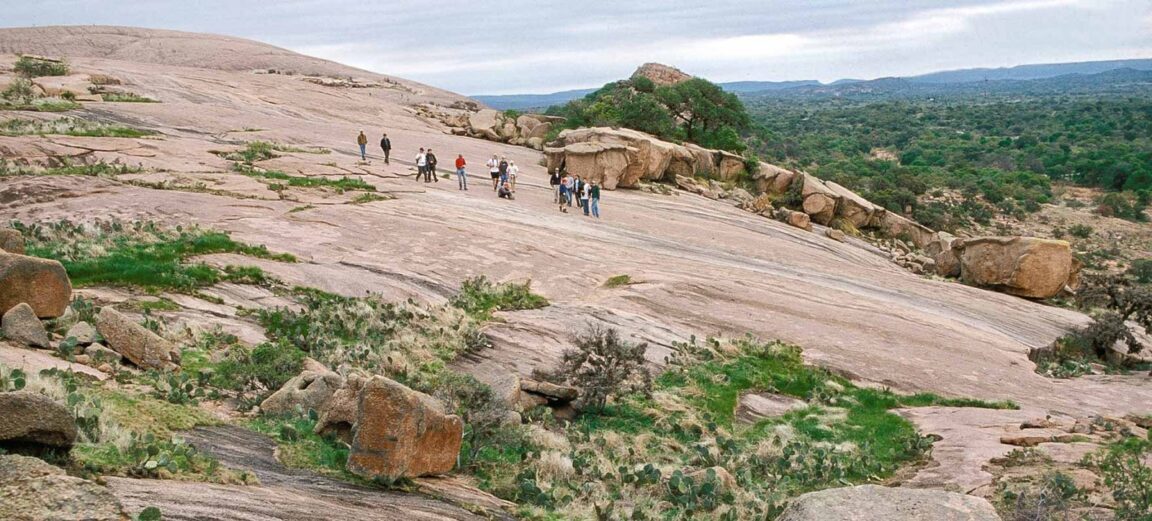
Enchanted Rock State Natural Area, about 17 miles north of town, is a pink granite dome rising about 425 feet above the Hill Country, and it is the region’s essential walk. Texas Parks and Wildlife runs it on a capacity system that first timers must respect: the park limits entry, closes its gates when full, and guarantees admission only to holders of a day pass reserved in advance, bookable up to 30 days ahead. Adult entry is $8 and children 12 and under are free. The Summit Trail climbs about 0.8 miles of bare, exposed granite to a broad top at 1,825 feet, with views across the Llano Uplift; it has no shade, closes when rain makes the rock slick, and is a morning undertaking in every season. Go at opening, carry water, wear shoes that grip smooth stone, and be back in town for lunch with the dome behind you. Our earlier guide to the county’s wine road pairs the same morning with the afternoon tasting rooms, in Fredericksburg’s Wine Road 290 and peach season guide.
When do the peach stands appear, and what else is seasonal?
Gillespie County calls itself a peach capital with justification: its orchards, many of them German family farms of long standing, send fruit to roadside stands along Highway 290 and the farm roads from around mid May, with varieties ripening in sequence into July and, in good years, August. The stands sell more than peaches in season: preserves, cobblers, ice cream and whatever else the farm is picking, and a stand stop is a ritual of the summer drive, best done on the way out of town when the car can carry boxes home. Out of peach season the calendar still turns: spring wildflowers, including the bluebonnets that fill the Willow City Loop north of town, the autumn wine harvest along Wine Road 290, where the county counts close to 100 wineries, vineyards and tasting rooms, and the Christmas markets and pyramid of December. Travellers building a small towns itinerary beyond Texas can compare this German stone town with the Lake Superior base in our Marquette, Michigan guide.
How should a first timer sequence two days?
Day one belongs to the dome and the street: Enchanted Rock at opening with a reserved pass, lunch in town, then a slow Main Street afternoon, Marktplatz, the Vereins Kirche, the Pioneer Museum and the Sunday Houses spotted along the side streets, finishing with a German dinner of schnitzel and local beer or wine. Day two belongs to depth: the National Museum of the Pacific War in the morning, a drive out Highway 290 in the afternoon for tasting rooms or, in season, peach stands, and a detour to Luckenbach, the tiny dance hall community a few miles southeast that Texas song made famous. Sleep in a Sunday House if one is available. There is no more Fredericksburg way to end the day than climbing an outside stair to a loft, in a cottage built for exactly that purpose nearly 180 years ago.
Frequently Asked Questions
Do I need to reserve Enchanted Rock in advance?
Effectively, yes. Texas Parks and Wildlife limits the park’s capacity and closes entry when it fills; a day pass reserved up to 30 days ahead is the only guarantee. Adult passes cost $8, and children 12 and under enter free.
What exactly is a Sunday House?
A small town cottage built by an outlying farm family for weekend stays: trade and socialising on Saturday, church on Sunday. The type is recognised by its compact limestone or timber construction and the outside staircase to the sleeping loft, and many now serve as guesthouses.
When is peach season in Fredericksburg?
Roadside stands typically open around mid May, and successive varieties carry the harvest through June and July and sometimes into August. Outside those months, expect preserves and baked goods rather than fresh fruit.
How much time does the National Museum of the Pacific War need?
Half a day for the main galleries, more for the full complex and the Pacific Combat Zone. It stands on Main Street in Admiral Nimitz’s hometown, in and around his family’s former hotel.
Is Fredericksburg walkable?
The historic core is. Main Street, Marktplatz, the museums and dozens of shops and restaurants sit within an easy walking grid. Enchanted Rock, the wine road and Luckenbach require a car.
Image: Walkers crossing the bare pink granite dome of Enchanted Rock, the Fredericksburg area’s signature morning climb. Photo: Texas Parks and Wildlife Department, via tpwd.texas.gov, the park’s official website, used with credit.