 Jonas Lindqvist
You can base in Interlaken and see the whole Jungfrau region without a car, and the system works like this: one valley railway forks at Interlaken Ost to Lauterbrunnen and Grindelwald, cable cars and a cliff railway do the vertical work to car-free Wengen and Murren, and the Jungfrau Travel Pass, sold for 3 to 8 consecutive days, covers the network in a single QR code. The only traps are the Jungfraujoch, which needs a paid connecting ticket on top of any pass, and the last descents down from the villages, which strand anyone who plans the evening by appetite instead of timetable.
Quick Facts
- The hub: Interlaken Ost station, where the Berner Oberland Railway forks to Lauterbrunnen in one valley and Grindelwald in the other.
- The regional pass: The Jungfrau Travel Pass gives 3 to 8 consecutive days of unlimited travel on the region’s mountain railways, cable cars, trains and boats, per Jungfrau Railways.
- Prices, 14 December 2025 to 12 December 2026: Adults pay CHF 210 for 3 days, CHF 235 for 4, CHF 270 for 5, CHF 290 for 6, CHF 310 for 7 and CHF 330 for 8; reduced fares run CHF 165 to CHF 255, and children aged 6 to 15 pay a flat CHF 30, per jungfrau.ch.
- The Jungfraujoch catch: The summit is not fully included. Pass holders buy a connecting ticket from CHF 63, rising to CHF 89 from 1 May to 31 October 2026.
- Car-free villages: Wengen is reached by the Wengernalp Railway from Lauterbrunnen; Murren by cable car from Lauterbrunnen to Grutschalp, then a narrow-gauge railway along the cliff.
- Included extras: The pass covers Grindelwald-First, the Harder Kulm funicular above Interlaken, the Schynige Platte cog railway and cruises on Lakes Thun and Brienz within their operating seasons.
The network, decoded in one paragraph
Interlaken sits between Lake Thun and Lake Brienz, and its eastern station, Interlaken Ost, is the region’s throat. From there the Berner Oberland Railway runs two branches: one south to Lauterbrunnen, the valley of waterfalls, and one southeast to Grindelwald, the village under the Eiger. Above Lauterbrunnen, the Wengernalp Railway climbs through car-free Wengen to Kleine Scheidegg, the pass beneath the Eiger, Monch and Jungfrau, and descends the other side to Grindelwald, making a full loop possible. A separate cable car leaves Lauterbrunnen for Grutschalp, where a narrow-gauge railway runs along the cliff edge through Winteregg to car-free Murren. Grindelwald adds the Eiger Express gondola to Eigergletscher, the First gondola, and the Mannlichen cable cars, which also serve Wengen. Everything in this guide hangs off that skeleton. Travellers who have already read our guide to the mistakes to avoid in Interlaken will recognise the theme: the town is a base and a junction, and the valleys are the destination.
Which pass should you actually buy?
The Jungfrau Travel Pass, and what it covers
Jungfrau Railways sells the Jungfrau Travel Pass as unlimited travel for 3 to 8 consecutive days across the region’s mountain railways, cable cars, trains and boats, delivered as a QR code on your phone. The covered highlights named by the operator include Grindelwald-First, the Harder Kulm funicular, which climbs from Interlaken to its panorama restaurant in 10 minutes, the Schynige Platte cog railway, inaugurated in 1893, the Lauterbrunnen to Murren rail and cableway link, Kleine Scheidegg, and cruises on Lakes Thun and Brienz. For a traveller based in Interlaken who will ride something mountain-bound every day, this is the default buy, and the flat CHF 30 child fare for ages 6 to 15 makes it unusually family-friendly. The reduced adult fare, CHF 165 for 3 days against CHF 210 full price, applies to holders of the Swiss Half Fare Card and similar reductions, which is the single most common money-saving combination in the region.
The alternatives, in plain terms
The Berner Oberland Pass covers a wider map, more of the Bernese Oberland’s trains, buses, boats and cable cars beyond the Jungfrau core, and suits travellers roaming as far as Bern, Lucerne or the Kander valley. The Swiss Travel Pass covers the national network and gives reductions rather than full inclusion on most mountain railways here, suiting travellers crossing the whole country with a couple of Jungfrau days inside it. The rule of thumb: if nearly all your riding is inside the Jungfrau web described above, the Jungfrau Travel Pass is the deepest coverage for the money; if your map is bigger, buy the bigger pass and accept the reductions. Whichever you choose, do the arithmetic against your actual planned rides at jungfrau.ch before paying, because pass value collapses on a lazy itinerary of one cable car in three days.
Reaching the car-free villages
Wengen: the railway village
Wengen sits on a sunny shelf above the Lauterbrunnen valley and has no road access for visitors; the Wengernalp Railway from Lauterbrunnen is the way in, climbing to the village and onward to Kleine Scheidegg. Staying in Wengen trades Interlaken’s connections for altitude, quiet and mornings under the Jungfrau, and the trade is often worth it. The Mannlichen cable car leaves from Wengen for the ridge between the two valleys, with the panorama that makes the region’s geography suddenly obvious: Grindelwald on one side, Lauterbrunnen on the other, and the great wall of the Eiger, Monch and Jungfrau closing the south.
Murren: cable car, then the cliff railway
Murren is reached in two movements: the aerial cableway from Lauterbrunnen up to Grutschalp, then the narrow-gauge railway that runs along the cliff edge through Winteregg to the village. The operator lists this Lauterbrunnen-Murren link among the pass highlights, and it is one of the great small journeys in Switzerland, fifteen minutes of cliff, forest and waterfall views ending in a car-free village facing the Eiger, Monch and Jungfrau across the valley. From Murren, further cable cars climb toward the Schilthorn; check which stages your pass covers and which need a supplement before you ride, because coverage on the upper Schilthorn stages differs from the village access stages.
The Jungfraujoch exception, stated plainly
The Jungfraujoch, the Top of Europe station at 3,454 metres, is the one headline ride no regional pass fully includes. With the Jungfrau Travel Pass you ride the included network to Eigergletscher, by the Eiger Express from Grindelwald Terminal or over Kleine Scheidegg, and then buy a connecting ticket for the final tunnel section: from CHF 63, and CHF 89 in the high season window from 1 May to 31 October 2026, per Jungfrau Railways. Budget for it, book the seat reservation the operator recommends in busy periods, and treat the weather forecast as the real ticket office: the Jungfraujoch on a whiteout day is an expensive tunnel ride, while on a clear morning it is the roof of the region. Readers who like their mountain towns with a different flavour can compare the experience with our story of Ouray, Colorado, the self-styled Switzerland of America.
The last train down: the discipline that saves evenings
Every stranding story in this region has the same plot: a long lunch in Wengen, a golden hour in Murren, and a timetable nobody checked. Mountain railways and cable cars finish earlier than valley trains, seasonal maintenance closes individual lines for weeks at a time, the operator’s own pass pages note maintenance windows on the Wengen and Grindelwald sides of Kleine Scheidegg and on the Lauterbrunnen to Murren link, and the descent from a car-free village offers no taxi fallback at any price. The discipline is threefold. Check the day’s last descent times on jungfrau.ch or the SBB app before you go up, not when you want to come down. Build the evening around the second-to-last departure, keeping the last as your reserve. And in the shoulder seasons, confirm that the specific cable car you are counting on is running at all, because First, Mannlichen and Schynige Platte all have defined operating seasons inside the pass’s broader validity.
A car-free three days, sequenced
Day one, the Lauterbrunnen valley: train from Interlaken Ost to Lauterbrunnen, the cable car and cliff railway to Murren for the morning, back down for the valley floor and its waterfalls in the afternoon, and the Harder Kulm funicular above Interlaken in the evening if the light holds. Day two, the loop: Lauterbrunnen to Wengen and up the Wengernalp Railway to Kleine Scheidegg, down the other side to Grindelwald, and home to Interlaken, with the Mannlichen ridge as the weather-dependent extra. Day three, the choice: the Jungfraujoch on the connecting ticket if the forecast is clear, or Grindelwald-First and a lake cruise on Brienz or Thun if it is not. That skeleton, ridden on a 3-day pass at CHF 210, is the arithmetic that makes the pass pay.
Frequently asked questions
How much is the Jungfrau Travel Pass in 2026?
Per Jungfrau Railways, for validity from 14 December 2025 to 12 December 2026, adults pay CHF 210 for 3 days up to CHF 330 for 8 days, reduced fares run from CHF 165 to CHF 255, and children aged 6 to 15 pay a flat CHF 30 for any duration.
Does the Jungfrau Travel Pass include the Jungfraujoch?
Not fully. It includes the network up to Eigergletscher, and the final section to the Jungfraujoch at 3,454 metres needs a connecting ticket, from CHF 63, or CHF 89 from 1 May to 31 October 2026.
How do you reach Wengen and Murren without a car?
Wengen is served by the Wengernalp Railway from Lauterbrunnen. Murren is reached by cable car from Lauterbrunnen to Grutschalp, then the narrow-gauge cliff railway through Winteregg. Both villages are car-free, so the railway is not the scenic option; it is the only option.
Which pass is best for Interlaken?
For days spent inside the Jungfrau network, the Jungfrau Travel Pass gives the deepest unlimited coverage, including First, Harder Kulm, Schynige Platte and the lake boats. Travellers roaming the wider Bernese Oberland should compare the Berner Oberland Pass, and those crossing Switzerland should compare the Swiss Travel Pass.
What is the biggest car-free mistake in the Jungfrau region?
Missing the last descent. Mountain lines finish earlier than valley trains and some close for seasonal maintenance. Check last departure times before going up, plan on the second-to-last service, and confirm seasonal lines are running.
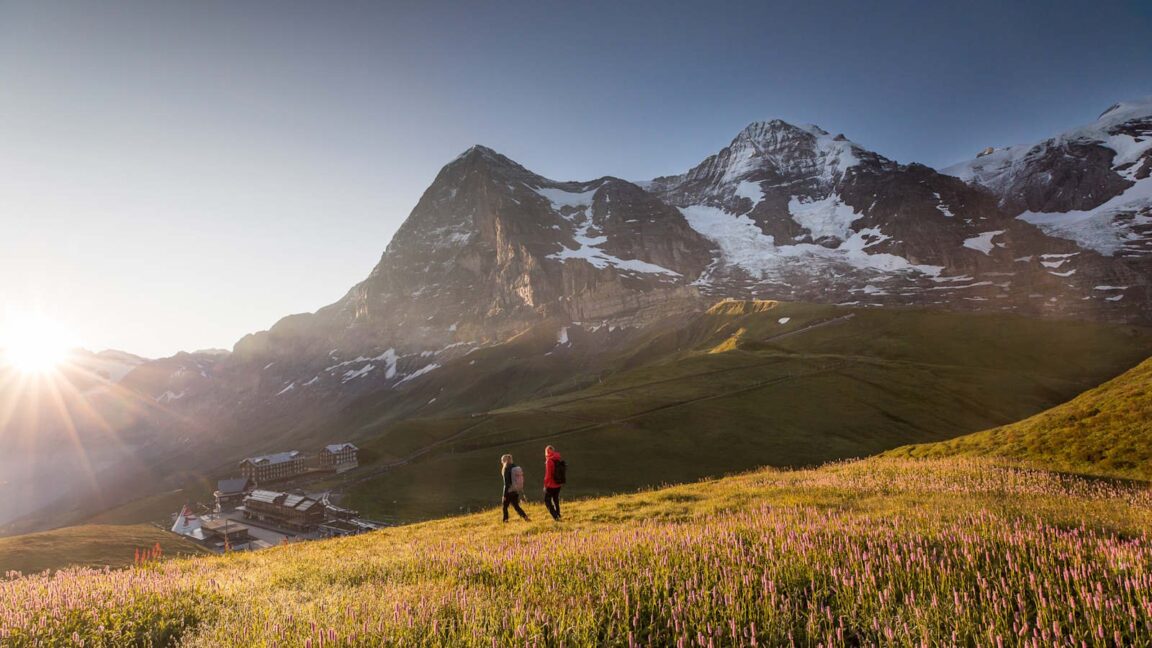
Featured image: Kleine Scheidegg station below the Eiger and Monch at sunrise, the junction at the heart of the Jungfrau railway network. Photo by Jungfrau Railways, via the operator’s official website (jungfrau.ch), used with credit.