 River Callahan
With one free day in Las Vegas, the honest answer is that both desert escapes work, but they reward different travellers. Valley of Fire State Park, about an hour northeast, is the bigger, wilder day: red Aztec sandstone, ancient petroglyphs and the striped Fire Wave, with no reservation system and a simple per vehicle fee. Red Rock Canyon, roughly 17 miles west of the Strip, is the closer, more managed day: a 13 mile one way Scenic Drive through the Calico Hills that, for most of the year, requires a timed entry reservation booked before you leave the hotel. Choose Valley of Fire for geology and space, Red Rock for a half day that fits around an evening show, and read the timing rules below before choosing either, because heat and closing times, not distance, are what catch visitors out.
Quick Facts
- Valley of Fire distance: About 50 to 55 miles northeast of the Strip via Interstate 15, exit 75, then the Valley of Fire Highway
- Valley of Fire entry: $10 per vehicle with Nevada plates, $15 per vehicle for non Nevada plates, per Nevada State Parks; no reservation needed for day use
- Red Rock distance: About 17 miles west of the Strip via Charleston Boulevard and State Route 159
- Red Rock entry: $20 per car for one day, plus a $2 timed entry reservation fee in season, booked on Recreation.gov
- Red Rock timed entry: Required October 1 to May 31 for vehicles entering the Scenic Drive between 8 a.m. and 5 p.m.
- Valley of Fire trail closures: Fire Wave and several other exposed trails close every year from May 15 to September 30 for heat safety
- Annual closure: Valley of Fire closes completely December 1 to 14 each year for maintenance
- Facts checked: November 23, 2026, against Nevada State Parks, the Bureau of Land Management and Recreation.gov
Valley of Fire or Red Rock Canyon: which day do you actually have?
The deciding question is not which park is better, because both are superb, but how much day you can give. Valley of Fire asks for a full day done properly. The drive alone is close to an hour each way, the park covers more than 40,000 acres, and its best stops are spread along two roads, the Valley of Fire Highway and White Domes Road. Visitors who rush it see the Fire Wave and leave; visitors who give it six or seven hours add the petroglyphs, the White Domes slot canyon and the CCC cabins, and understand why Nevada made this its first state park in 1935.
Red Rock Canyon asks for less and gives its best sooner. The conservation area begins almost where the suburbs end, the visitor centre sits just inside the entrance, and the Scenic Drive strings its overlooks and trailheads along a single one way loop, so a traveller can be back on the Strip for lunch after a dawn start. What Red Rock demands instead is administration: in timed entry season, the spontaneous drive out simply does not work between 8 a.m. and 5 p.m.
What does Valley of Fire give you that Red Rock does not?
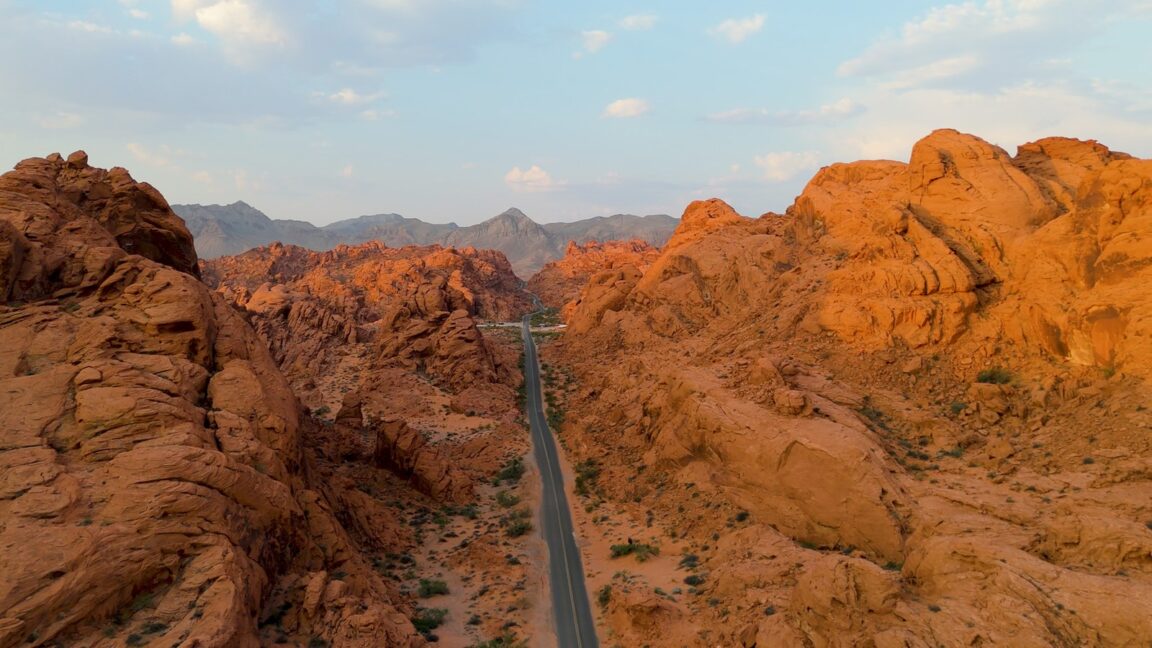
Scale and strangeness. The park’s red Aztec sandstone, the hardened remains of Jurassic sand dunes, erupts out of grey limestone hills in formations that look poured rather than carved: the Beehives’ cross bedded swirls near the west entrance, Elephant Rock’s trunk dipping toward the road by the east entrance, and whole amphitheatres of banded rock along White Domes Road. Nevada State Parks notes that people have left marks here for millennia; the petroglyphs carved into desert varnish at Atlatl Rock, reached by a metal staircase, and along the short Mouse’s Tank trail are attributed to the Basketmaker culture around 2,500 years ago and to the Early Pueblo culture that followed. Look closely, photograph freely, and never touch the panels, because skin oils damage the carvings.
The Fire Wave is the modern headline: a swirling scoop of red, pink and white striped sandstone reached by a trail of about 1.5 miles round trip from the parking area on White Domes Road. It photographs best in the softer light of morning and late afternoon, and it is one of the trails that close from mid May to the end of September, when the park shuts its exposed routes after a history of heat rescues. In the same northern cluster, the White Domes Loop threads a short slot canyon past a 1960s film set remnant, and Pastel Canyon washes pink and lavender between the two.
How do you run a Valley of Fire day, hour by hour?
Leave the Strip by 7 a.m. and the day falls into place. Stop first at the visitor centre, open daily from 9 a.m. to 4 p.m., for the geology exhibits and the day’s trail conditions, then drive White Domes Road while the light is still kind: Fire Wave first, White Domes second, and the Rainbow Vista viewpoint on the way back down. Cross to the western side of the park for Mouse’s Tank and Atlatl Rock in the middle of the day, when the petroglyph panels sit in shade, and finish at the Cabins, built by the Civilian Conservation Corps in the 1930s, and the Seven Sisters picnic rocks as the stone turns the colour the park is named for. The park is open from sunrise to sunset for day visitors, so sunset is your hard deadline, and there is no fuel, food or reliable rideshare pickup inside the park. Nevada State Parks warns plainly that arriving by rideshare can leave visitors stranded, because a return ride often cannot be found. Drive yourself, carry water for everyone, and download maps before the signal fades.
What does Red Rock Canyon give you that Valley of Fire does not?
Proximity and a perfect short loop. The 13 mile Scenic Drive, one way and paved, climbs from the visitor centre past the Calico Hills, where red and cream sandstone collide in banded walls that climbers regard as world class, then rounds the Wilson Cliffs and drops past the Spring Mountain Ranch turnoff toward the exit. Every stop is signed, most trails run from under a mile to a few miles, and a traveller with three hours can drive the loop with stops at the Calico Hills viewpoint, the High Point Overlook and one short trail and feel the day was well spent. The visitor centre’s outdoor exhibits explain the Mojave Desert ecology that Valley of Fire leaves you to puzzle out alone, which makes Red Rock the better choice for families and first time desert visitors.
How does Red Rock timed entry actually work?
From October 1 through May 31, a vehicle entering the Scenic Drive between 8 a.m. and 5 p.m. needs a timed entry reservation made on Recreation.gov, on top of the $20 one day car fee; the reservation itself carries a $2 fee. You book a one hour arrival window, released up to 30 days ahead with a second release two days ahead, and once inside you may stay until the drive closes. Arriving through the fee station before 8 a.m. avoids the reservation requirement entirely, which is why experienced visitors treat Red Rock as a dawn trip in season. The drive opens at 6 a.m. all year; closing runs to 5 p.m. from November to February, 7 p.m. in March and October and 8 p.m. in the summer months. From June 1 to September 30 no timed entry is required, but by then the desert heat, not the booking system, is the limiting factor. Re-entry after leaving requires a new reservation, so plan the loop in order and do not pop out for lunch.
What about heat, and when should each park be avoided?
Both parks sit in the Mojave Desert and both punish summer carelessness, but they signal it differently. Valley of Fire formalises the danger: its exposed trails, including Fire Wave, White Domes and Pastel Canyon, close from May 15 to September 30, and the park also closes entirely from December 1 to 14 for annual maintenance, a fortnight that surprises December visitors every year. Red Rock stays open through summer but shifts its rhythm to dawn and evening, with the Scenic Drive running to 8 p.m. In late November, the season this guide is written in, both parks are in their prime: cool mornings, low sun that sets the sandstone alight, and, at Red Rock, timed entry firmly in force. Carry more water than feels reasonable, wear a hat even in winter, and treat any trail that feels longer than its listed distance as normal, because Valley of Fire’s own guidance warns that its terrain makes trails feel longer than they measure.
Can you do both parks in one day?
Technically yes, enjoyably no. The two parks sit on opposite sides of the city, roughly two hours apart by road in traffic, so a combined day means four hours of driving and the shallowest version of each. If the trip allows only one desert day and a second Vegas day exists, give Valley of Fire the full day and take Red Rock at dawn on the other morning, entering before 8 a.m. to skip the reservation queue and finishing with breakfast back in the city. Travellers building a wider desert loop can pair these choices with the park bases in our guide to Joshua Tree in winter, and with the red rock country covered in our Sedona hiking and wellness guide.
Frequently Asked Questions
Do I need a reservation for Valley of Fire State Park?
No. Nevada State Parks does not require reservations for day use. You pay the per vehicle entry fee, $10 with Nevada plates or $15 without, at the entrance. Camping is a different matter: the park’s two campgrounds, 72 sites in total, are booked by reservation.
Does the America the Beautiful pass cover either park?
It covers Red Rock Canyon, a federal Bureau of Land Management site, although the $2 timed entry reservation fee still applies in season. It does not cover Valley of Fire, which is a Nevada state park with its own fee and its own state parks annual pass.
When is the Fire Wave closed?
The Fire Wave trail closes every year from May 15 to September 30, along with White Domes, Pastel Canyon and several other exposed trails, because of extreme heat. It is open through the cooler months, including late November.
How long does the Red Rock Scenic Drive take?
The 13 mile one way loop takes about 30 minutes with no stops and two to three hours with overlooks and one short trail. Once you exit, re-entry in timed entry season needs a new reservation, so take the stops in order.
Which park is better for a half day?
Red Rock Canyon, comfortably. It is about 17 miles from the Strip, its sights line a single loop road, and a dawn start beats both the crowds and the reservation window. Valley of Fire deserves, and needs, a full day.
Can I visit Valley of Fire in December?
Yes, except during the annual maintenance closure from December 1 to 14, when the park shuts to all visitors including walkers. Either side of that fortnight, December brings some of the year’s best hiking weather.
Image: The Valley of Fire Highway threading the red Aztec sandstone of Valley of Fire State Park. Photo: Nevada Division of State Parks, via parks.nv.gov, the park’s official website, used with credit.