 Jordan Ellis
Sitka is three towns stacked on one small waterfront: a Tlingit town thousands of years old, the former capital of Russian America with onion domes and a bishop’s log house, and a working Alaska fishing port whose spring calendar still turns on the herring spawn in Sitka Sound. Read it in that order and the place makes sense. Start in Sitka National Historical Park, where Haida and Tlingit totem poles line a rainforest trail to the site of the 1804 battle, walk back through town past St Michael’s Cathedral and the Russian Bishop’s House of 1843, and, if the visit falls in March or April, watch the sound fill with boats, whales and birds as the herring arrive. No road reaches Sitka; the ferry or the plane is part of the point.
Quick Facts
- Setting: On Baranof Island in Southeast Alaska, reached only by air or by the Alaska Marine Highway ferry; there is no road connection
- The park: Sitka National Historical Park covers about 113 acres, a half mile from downtown, and preserves the 1804 battle site between Kiks.ádi Tlingit and Russian forces
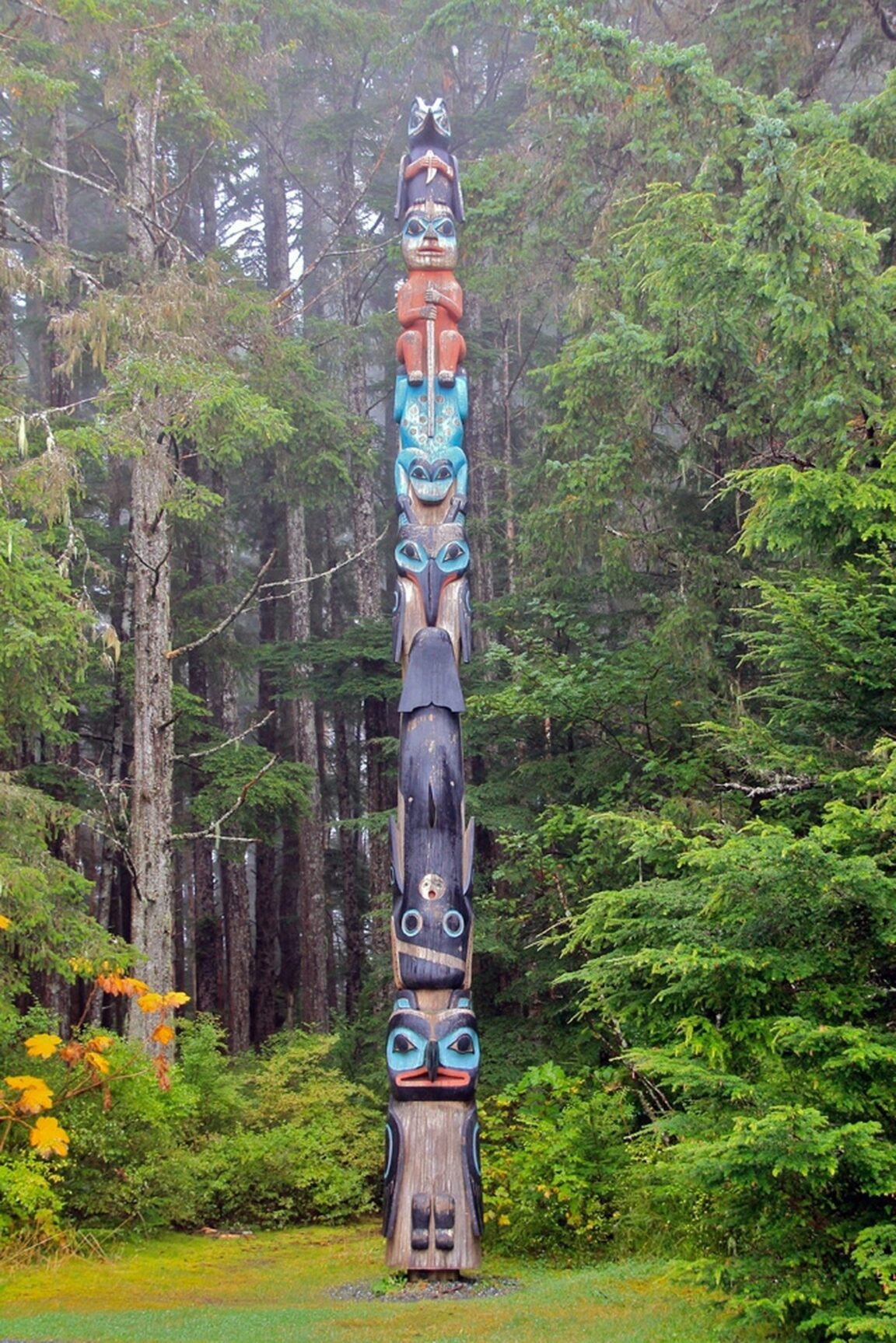
- Totem Trail: A rainforest loop of 30 to 90 minutes lined with Tlingit and Haida totem poles, per the National Park Service
- Russian Bishop’s House: Completed in 1843, one of only four surviving examples of Russian colonial architecture in North America, per the NPS
- Herring season: The Sitka Sound sac roe fishery and spawn run in March and early April, managed by the Alaska Department of Fish and Game
- Park entry: No entrance fee for the park grounds and trails
- Facts checked: November 23, 2026, against the National Park Service and the Alaska Department of Fish and Game
Why does the totem park come first?
Because the oldest story here is Tlingit, and the park tells it on Tlingit ground. The site at the mouth of the Indian River was a Kiks.ádi Tlingit fort in 1804, when Russian forces under Alexander Baranov attacked to retake the settlement Russians had founded and Tlingit fighters had destroyed two years earlier. The battle, and the Tlingit strategic withdrawal that followed, is commemorated where it happened, in a park first protected by the federal government in 1890 and now Alaska’s oldest national park unit. From the visitor centre, the Totem Trail winds through towering Sitka spruce and hemlock rainforest, past a collection of totem poles from Tlingit and Haida villages, originals and replicas carved across more than a century, each pole a crest record of clan histories rather than decoration. The National Park Service allows 30 to 90 minutes for the trail; take the longer end, read the poles slowly, and continue to the battlefield site at the river mouth, where the forest gives way to the shore of Sitka Sound.
Inside the visitor centre, the Southeast Alaska Indian Cultural Center keeps the tradition active rather than archived: Native artists demonstrate carving, weaving and other arts in season, and the museum displays Tlingit artifacts, many loaned by Tlingit clans themselves. That loan detail matters. Sitka’s poles and regalia are not a vanished culture’s remains but a living community’s property, and the park’s interpretation, shaped with the Sheet’ká Kwáan Sitka Tribe, treats them that way.
What remains of Russian Sitka?
More than anywhere else in North America, and it stands within a short walk of the park. Sitka, as New Archangel, was the capital of Russian America from 1808 until the Alaska Purchase of 1867, when the transfer ceremony took place on Castle Hill above the harbour, now a state historic site with the view that explains why a capital was planted here. The Russian Bishop’s House, completed in 1843 from Sitka spruce, was the residence of Bishop Innocent, later canonised as Saint Innocent, and the administrative centre of a diocese that stretched across the North Pacific. The National Park Service, which restored the house over 16 years to its 1853 appearance, counts it as one of only four surviving examples of Russian colonial architecture in North America. The ground floor holds a museum of Russian American history; upstairs, shown on ranger tours in season, the bishop’s restored quarters and private chapel hold icons and the furnished rooms of a frontier prelate.
A few streets away, St Michael’s Cathedral raises the town’s signature silhouette, its green onion dome and cross visible from the harbour. The first cathedral on this site was consecrated in 1848, also under Bishop Innocent; fire destroyed it in 1966, and Sitkans rebuilt it from the original plans, rescuing many of its icons from the flames, including the celebrated Sitka Madonna. It remains an active Orthodox parish, and visitors should treat it as a church first and a landmark second. Together, cathedral, bishop’s house and Castle Hill give Sitka a Russian layer no other American town can match, all of it walkable in an hour.
What is the herring run, and when does it time the town?
Sitka’s third calendar belongs to the sea. Each spring, Pacific herring return to Sitka Sound in vast numbers to spawn, turning sheltered shorelines milky and laying eggs on kelp and rock, and the event organises the town’s March and April. The Alaska Department of Fish and Game manages the commercial sac roe fishery, in which seiners harvest herring for their roe under a quota set from biomass surveys; in 2026 the fishery opened on March 27 and the department mapped 35.7 nautical miles of spawned shoreline across the season. Alongside the commercial fleet, Tlingit families harvest herring eggs on hemlock branches in a subsistence tradition far older than the town, centred on a core area closed to commercial fishing.
For a visitor, the spawn is a wildlife spectacle that needs no ticket. The herring draw humpback and grey whales, sea lions, seals and thousands of eagles and seabirds into the sound, visible from the harbour, the road out to the ferry terminal and the park’s shoreline trail. Time a spring trip for late March or early April, follow the Fish and Game aerial survey reports that locals follow, and understand that exact dates belong to the fish, not the calendar. The rest of the year has its own order: cruise ships and king salmon in summer, the Alaska Day Festival each October marking the 1867 transfer, and a quiet, rainy winter that belongs to residents.
How do you get there, and how long do you need?
Sitka sits on the outer coast of Baranof Island with no road in or out. Alaska Airlines jets connect Sitka Airport, on Japonski Island across the bridge from downtown, with Juneau and Seattle, and the Alaska Marine Highway ferry threads the Inside Passage to the terminal north of town, a slower arrival that suits the place. Cruise passengers get a day; independent travellers should give the town two full days at minimum, one for the park and the Russian sites on foot, one for the water, whether that means a wildlife boat tour into the sound, the raptor centre’s eagles, or simply the harbour at working hours. The town pairs naturally with the other great small port histories of the northern coasts; travellers who enjoy this layered reading of a place can compare it with the Lake Superior shore in our first timer guide to Pictured Rocks and the river town history in our Harpers Ferry story.
Frequently Asked Questions
How do you get to Sitka without a car ferry road?
By air or by sea only. Alaska Airlines flies to Sitka from Juneau and Seattle, and the Alaska Marine Highway ferry serves the town on its Inside Passage routes. There is no road connection to the rest of Alaska.
Is Sitka National Historical Park free?
Yes. The National Park Service charges no entrance fee for the park, its trails or the visitor centre. Ranger led tours of the Russian Bishop’s House run in the warmer months and are the park’s principal programmed activity.
When is the Sitka herring spawn?
In March and early April, with the exact peak set by the fish. In 2026 the Alaska Department of Fish and Game first recorded spawn on March 30 and mapped 35.7 nautical miles of it; the commercial sac roe fishery opened March 27 that year.
What is the Russian Bishop’s House?
A log house completed in 1843 for Bishop Innocent, restored by the National Park Service to its 1853 appearance. It is one of only four surviving examples of Russian colonial architecture in North America, with a museum below and the bishop’s chapel and quarters above.
How long is the Totem Trail?
The National Park Service allows 30 to 90 minutes for the trail, a mostly level rainforest loop past the park’s Tlingit and Haida totem poles to the 1804 battlefield site on the Indian River.
Image: The Gaanax.ádi Raven Crest Pole standing in the temperate rainforest of Sitka National Historical Park, a replica of a pole from the Tlingit village of Tuxekan. Photo: National Park Service, via npgallery.nps.gov, used with credit.