 Sofia Rossi
The fastest way to understand Venice Carnival is to skip the costume crowds in Piazza San Marco and walk into a working mask atelier, where a mascarero builds a mask the slow way: a clay model, a plaster mould, layers of paper and glue pressed by hand, then days of drying, cutting, sanding and painting. The makers, called mascareri since the trade was recognised in the 15th century, are the festival supply chain and its memory, and Dorsoduro, the art district across the Accademia Bridge, is where several of the surviving workshops still work in public view.
Quick Facts
- The makers: Mascareri, the artisan mask makers of Venice, a trade documented since 1436
- The material: Cartapesta, papier mache built from paper, glue and a plaster mould taken from a clay original
- The classic forms: Bauta, volto, colombina, moretta and the beaked medico della peste
- The district: Dorsoduro, around Campo San Barnaba and the streets toward the Zattere, with other historic ateliers across the centre
- The test of the real thing: Light, slightly irregular, painted by hand, with the maker working on site
- Carnival timing: The festival runs in the weeks before Lent, ending on Shrove Tuesday
How is a Venetian mask actually made?
Every handmade mask in a serious atelier starts as sculpture. The mascarero models the face in clay, because clay forgives revision, and takes a plaster mould from the finished model. Into that mould go strips and pulp of paper soaked in glue, pressed layer by layer into every curve of nose, brow and cheek, a technique Italians call cartapesta. The shell dries, is lifted from the mould, and then the slow finishing begins: eye holes cut, edges trimmed, the surface sanded smooth, a base of white gesso style coating applied, and only then decoration, paint, gold leaf, fabric, feathers or lace, according to the design.
The process explains both the price and the feel of a real mask. Papier mache done this way is astonishingly light and slightly warm to the touch, with tiny irregularities that catch light unevenly. Hold a mask up and look at its inside: a handmade piece shows the layered, matte reverse of the cartapesta, often signed or stamped by the atelier. A moulded plastic import, by contrast, is uniformly glossy, heavier for its size, sharp at the edges and identical to the fifty masks hanging beside it. Venice shopfronts are full of both, and the inside of the mask is where the truth sits.
Who were the mascareri?
Mask making in Venice is not a folk hobby that tourism invented. Workshop sources date the mascareri as a recognised body of makers to 1436, when masks were already everyday civic equipment rather than festival novelties. In the long Carnival seasons of the Republic, which could stretch for weeks, masks let Venetians move through the city with identity suspended, and the law itself recognised specific mask forms for specific settings. The trade survived the fall of the Republic in 1797 only in fragments, because Carnival itself was suppressed, and it revived with the modern festival from 1979 onward.
That revival is why the atelier map matters. The number of workshops that genuinely design and build masks in Venice, as opposed to retailing imported stock, is small, and their own trade descriptions make the distinction bluntly: many sellers, few mascareri. When you buy from a working atelier you are paying for the mould library, the hand finishing and the fitting, and you are keeping one of the few production workshops alive in a city that otherwise risks becoming a showroom for goods made elsewhere.
What do the classic mask forms mean?
The bauta is the most Venetian of all: a white full face mask with a jutting, squared chin and no mouth opening, shaped so the wearer could eat, drink and speak without removing it. It was worn with a black tricorn and a wide black cloak, by men and women alike, and it was the standard mask of anonymity in public life, not only at Carnival. The volto, also called the larva, is the plain, serene white full face, ghostly and neutral. The colombina is the decorated half mask associated with the commedia dell arte maid, often gilded and feathered, held on with ribbons or a stick.
Two forms carry stranger histories. The moretta is a small oval of black velvet with no mouth at all: it stayed on the face only because the wearer held an interior button between the teeth, which made speech impossible, a silence that was part of its social meaning. The medico della peste, the long beaked mask now sold everywhere as a Carnival icon, began as protective equipment for plague doctors, the beak packed with aromatic substances as a filter. A good atelier will tell you these stories accurately, including which forms are historical and which are modern inventions for the tourist market, and that honesty is itself a quality signal.
Our broader Venice Carnival festival guide covers the Flight of the Angel and the crowd peaks, and our explainer on the Venice day tripper entry fee handles the access rules that shape a Carnival day trip.
How does a fitting work, and what should you ask?
A mask that will be worn for hours must be fitted, and fitting is the service imports cannot offer. In an atelier the maker checks the mask against your face, adjusts the eye line, pads or trims where it presses, and ties ribbons at the right tension. Papier mache can be gently reshaped and re finished; plastic cannot. If you wear glasses, say so early, because some forms sit badly over frames and a good maker will steer you to a shape that works rather than sell you the famous one that does not.
Ask three questions. Where is this mask made, and can you see the workshop? What is it made from? And who decorated it? In a real atelier the answers are immediate and often come with a demonstration, because mask workshops across Dorsoduro and the historic centre also run short decoration courses where visitors paint a blank mask under supervision. Those courses are commercial, but they teach your hands the material in twenty minutes: once you have pressed and painted cartapesta yourself, you will never mistake the imported version again.
What is the etiquette of wearing a mask?
Carnival etiquette is mostly consideration wearing a costume. A full mask anonymises you, which historically was the point, but it also muffles speech and narrows vision, so wearers owe the crowd extra care on bridges, in vaporetti queues and on the stepped lanes where everyone is photographing everyone else. Ask before close up portraits of costumed strangers, accept that the elaborately dressed figures near San Marco expect to be photographed at a distance and approached politely, and remember that masks come off indoors in churches and at most restaurant tables, both by rule and by practicality.
Finally, buy the mask you will wear, not the one that photographs largest. The volto and bauta read as austere because they are: traditional Venetian taste runs plainer and more monochrome than the glittered export style. A hand built white mask, fitted in a Dorsoduro workshop and worn with plain dark clothing, is closer to the historical Carnival than any feathered import, and it will still be hanging on your wall, signed inside by its maker, long after the festival ends.
Frequently Asked Questions
How can I tell a handmade Venetian mask from an imported one?
Turn it over. A handmade mask is papier mache: light, matte and slightly irregular inside, often signed by the atelier. Imports are moulded plastic or resin, glossy, uniform and identical to their neighbours on the shelf.
What is a mascarero?
A mascarero, plural mascareri, is a Venetian artisan who designs and builds masks from the clay model to the final decoration. The trade has been documented in Venice since 1436, and only a small number of true production workshops remain.
Can visitors make or decorate a mask in Venice?
Yes. Several working ateliers in Dorsoduro and elsewhere in the centre run short courses where you decorate, and in some cases build, a papier mache mask with the makers. Booking ahead is wise during Carnival itself.
Which mask is best for a first time Carnival visitor?
A fitted colombina or a plain volto in papier mache. Both are light, comfortable for hours and historically grounded. Choose by fit, especially if you wear glasses, and let the atelier adjust ribbons and padding.
Are the plague doctor masks authentic Carnival masks?
The beaked medico della peste began as a plague doctor protective mask and was later adopted into Carnival imagery. Ateliers sell it, but its origin is medical equipment, not festival dress, and a good maker will tell you so.
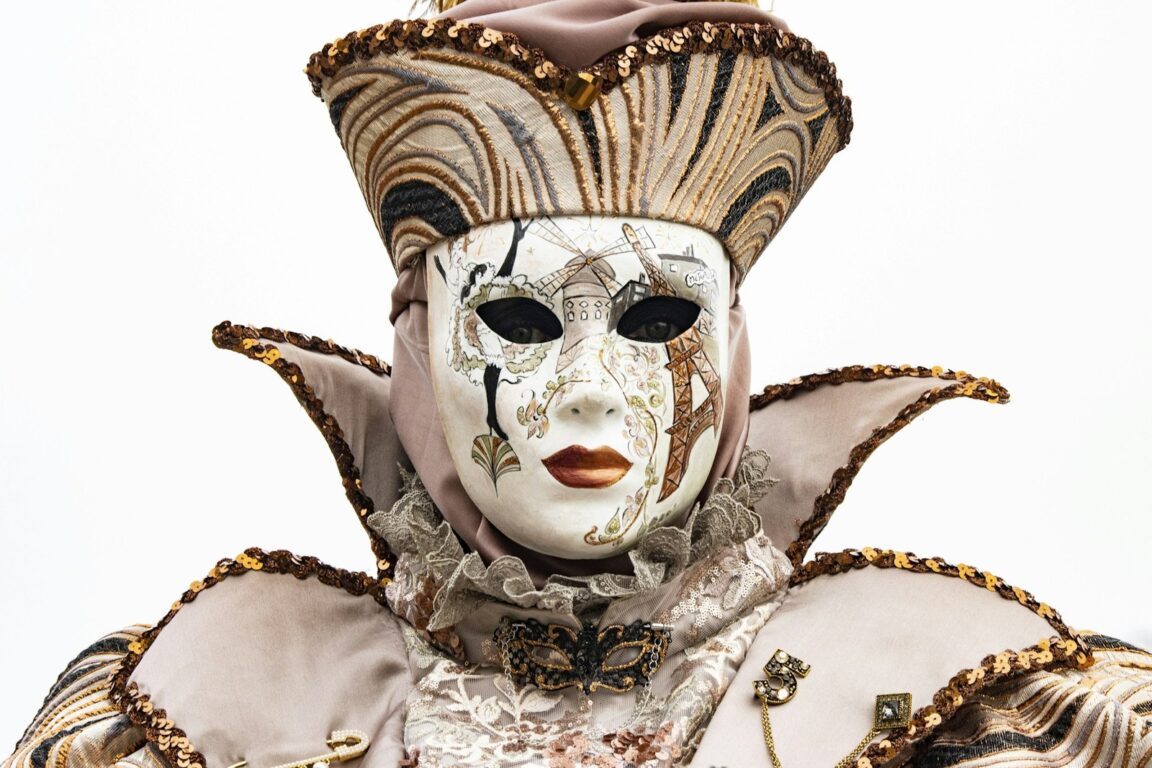
Image credit: A hand painted Venetian Carnival volto mask in an elaborate costume, photographed at Venice Carnival. Photo by Angelo Casto, via Unsplash (hosted copy via Pixidia), Unsplash License, used with credit.