 Sofia Rossi
Tortellini in brodo is judged in Bologna by three simple tests: the tortellino should be small enough that five fit on a soup spoon, the broth should be clear enough to see the bottom of the bowl, and the dish should arrive as a first course in a modest portion, never as a heaped main. Learn those three tests and you can walk into any lunch counter around Piazza San Petronio and know within one spoonful whether the kitchen respects the dish.
Quick Facts
- Dish: Tortellini in brodo, tiny meat filled pasta rings served in hot broth
- The size rule: A classic tortellino weighs about 5 grams cooked, cut from a pasta square of roughly 4 to 4.5 centimetres
- The filling: Pork loin, prosciutto crudo, mortadella di Bologna, Parmigiano Reggiano, egg and a hint of nutmeg, registered in 1974
- The broth: Capon or hen with beef, simmered gently and skimmed so it stays clear and golden
- Course: A primo, a first course, in Bologna. Ordering it as your whole lunch marks you out instantly
- Where: Historic centre trattorias and pasta shop counters within a short walk of Piazza San Petronio and the Quadrilatero market streets
Why does size matter so much in a tortellino?
Bologna protects this dish the way other cities protect monuments. The Dotta Confraternita del Tortellino, the learned brotherhood that guards the recipe, registered the official filling in 1974 at the Bologna Chamber of Commerce, and the pasta sheet and its dimensions were codified later. The point of the paperwork is not bureaucracy for its own sake. A tortellino is a balance problem. The pasta must be thin enough to taste delicate, the filling assertive enough to season the broth around it, and the whole ring small enough that pasta, filling and broth arrive in the mouth in one proportioned bite.
The spoon test is the traveller version of the rule. Five tortellini on one spoon is the shorthand local guides repeat, and it works because it is really a test of the pasta sheet. A kitchen cutting generous squares cannot fold them tightly enough to stay that small once cooked. A kitchen cutting them correctly produces rings that look almost too small in the bowl, until you taste how much flavour each one carries. The board intent for this piece called the rule thumb sized and navel sized, and both images circulate in Bologna: the ring is folded around a fingertip, and legend links its curve to the navel of Venus. Treat the legend as table talk. Treat the size as law.
What should the filling taste like?
The registered filling is a short, closed list: pork loin gently cooked, prosciutto crudo, authentic mortadella di Bologna, Parmigiano Reggiano aged at least 24 months, egg and nutmeg. Nothing else is permitted in the canonical version, and that restraint is the flavour. Mortadella brings the soft, peppery fat. Prosciutto brings salt and depth. The Parmigiano, used at roughly one and a half times the weight of any single meat in the deposited proportions, binds the mixture and gives it its savoury backbone.
At the table, a correct filling tastes seasoned before you reach for anything. If a bowl needs black pepper, chilli or a snowstorm of extra cheese to wake it up, the filling was under seasoned or the proportions drifted. A second tell is texture. The filling should be fine and cohesive, never coarse or greasy, and the pasta seal should hold through the whole bowl. Burst rings leaking grey filling into the broth mean the fold was rushed, which in a city of professional pasta makers, the sfogline who roll sheets by hand with long rolling pins, is the one sin everyone notices.
For a wider map of the city table before you specialise, our earlier guide to what to eat in Bologna walks the full pasta circuit, from tagliatelle al ragù to the portico food shops.
How do you judge the broth?
Broth clarity is the second test, and it is a technique test. The deposited broth tradition starts the meats in cold water, brings the pot up slowly, skims the surface impurities as they rise, and simmers gently for hours rather than boiling. The classic build pairs capon, traditionally at least five months old, with a fatty beef cut such as doppione, plus carrot, celery, a browned onion and, in the recently deposited broth recipe, half a tomato and a rind of 24 month Parmigiano Reggiano. The result should be golden, transparent and intensely savoury, with a clean finish.
Cloudiness is not a crime against flavour, but in Bologna it reads as carelessness, because the whole point of the long, gentle simmer is that the broth stays clear while it concentrates. Fat is the other fault. A properly rested and skimmed broth carries a sheen, not slick pools. When the bowl arrives, look down before you stir. If you can see tortellini resting on the bottom through the liquid, the kitchen did the slow work. If the surface looks like an oil spill, it did not.
Temperature matters too. Tortellini are cooked directly in the broth and served in it immediately, so the bowl should be steaming and the pasta tender with a slight bite, the product of a sheet rolled thin but not fragile. Lukewarm broth usually means the bowl waited, and this dish does not forgive waiting.
Where around San Petronio should you eat it?
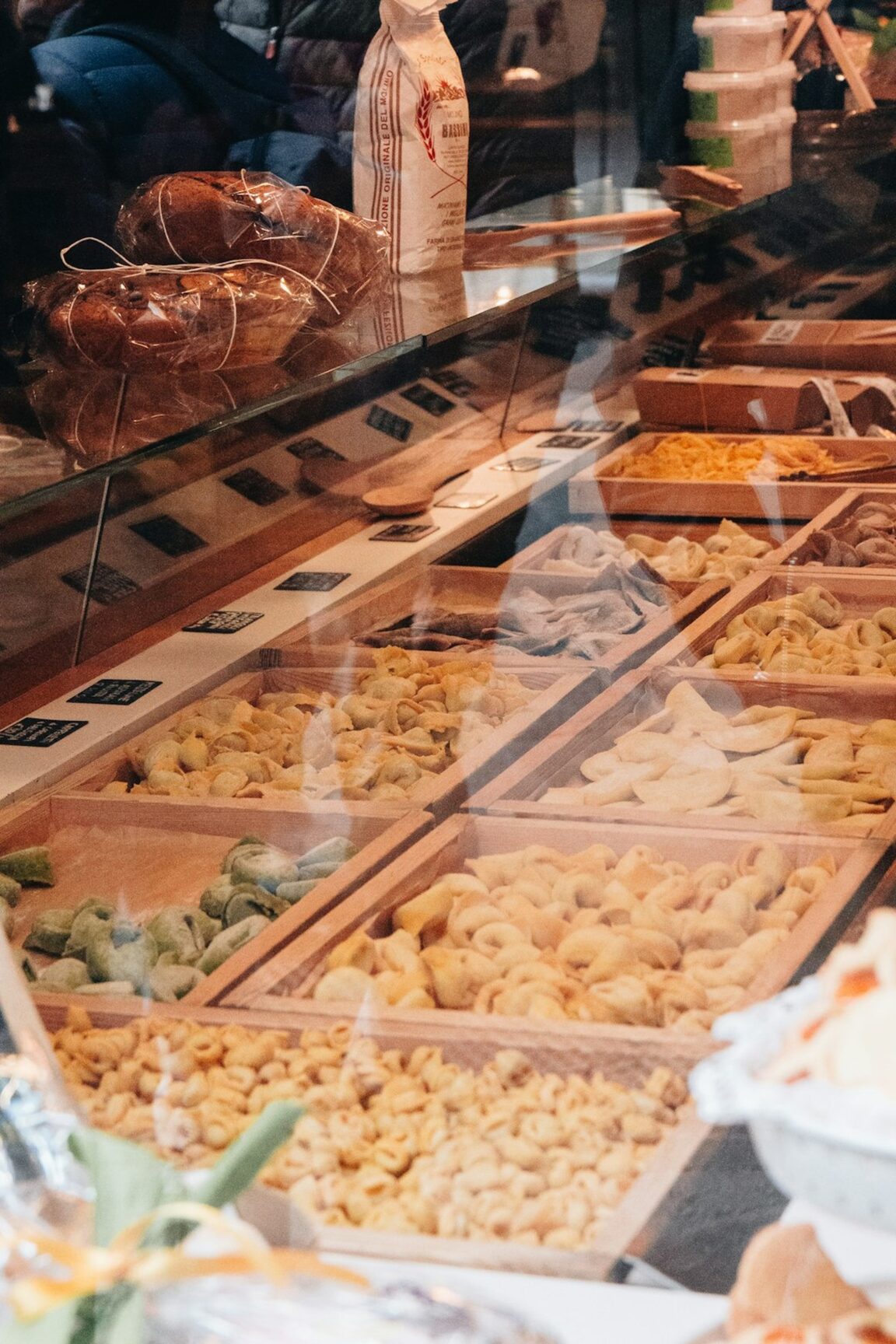
The historic centre concentrates the safest orders. The streets under and around the Basilica di San Petronio, the unfinished giant on Piazza Maggiore, and the Quadrilatero lanes just east of it are dense with trattorias, fresh pasta shops with a few tables, and lunch counters where tortellini in brodo is the default first course rather than a special. The pasta shop format deserves special attention from travellers: trays of hand folded tortellini sit in the window, as in our photograph, and the same shop will often cook a portion for you at a small counter. That is the closest a visitor gets to the dish in its natural habitat, made metres from where it is eaten.
Order like the room does. At lunch, tortellini in brodo is a primo. Follow it with a secondo if you are hungry, or accept the small bowl as the elegant light lunch it is designed to be and save room for the afternoon. Asking for it as a main course portion, or with cream, will be politely accommodated in tourist facing rooms and quietly judged in traditional ones. In Bologna the cream version, tortellini con panna, exists, but brodo is the canonical form and the one this city measures itself by.
Pricing follows the format rather than a fixed rule, and menus change, so check the board outside each room on the day. What should not change is the portion logic: a first course bowl is deliberately modest, and a suspiciously enormous serving at a bargain price is usually a warning about frozen product rather than generosity.
How does tortellini differ from tortelloni?
Confusing the two is the most common ordering error. Tortelloni are the larger cousins, typically filled with ricotta and herbs or pumpkin and served with butter and sage or a sauce, never in broth. Tortellini are the small meat filled rings, and in Bologna they belong in brodo. If a menu offers giant tortellini in broth, it has already failed the size test before the bowl reaches you. Size, filling and broth are one system, and the system is the dish.
Travellers continuing south through Italy can compare how another historic city guards its food identity in our guide to Matera and its cave city, where bread and cave dwellings carry the same weight of tradition.
Frequently Asked Questions
Is tortellini in brodo a starter or a main course?
In Bologna it is a primo, a first course, served in a modest bowl before the main course. Portions are deliberately small because the dish is rich and because lunch traditionally continues.
What meat is inside a traditional Bolognese tortellino?
The registered filling combines pork loin, prosciutto crudo and mortadella di Bologna with Parmigiano Reggiano, egg and nutmeg. Recipes using only cheese or other meats are different dishes wearing the same name.
Why is the broth supposed to be clear?
Clarity proves the technique: meats started in cold water, a gentle simmer and repeated skimming. A clear, golden broth that you can see through to the bottom of the bowl is the recognised standard.
Can I buy fresh tortellini to cook myself in Bologna?
Yes. Fresh pasta shops across the historic centre sell tortellini by weight from window trays, and many will also cook a portion in broth for you at a small counter, which is the best value way to taste them.
When is tortellini in brodo traditionally eaten?
It is the classic festive dish of Emilia Romagna, central to Christmas lunch, but in Bologna it is an everyday menu item all year. Lunch counters serve it daily, and the morning only logic of other cities does not apply here.
Image credit: Fresh tortellini trays in a pasta shop window. Photo by Kristijan Arsov, via Unsplash (hosted copy via Love to Visit Italy), Unsplash License, used with credit.