 River Callahan
Walking Tasmania’s Overland Track in season starts with a booking, not with the walk itself. From 1 October to 31 May, the Parks and Wildlife Service Tasmania requires every walker to hold a booked departure and an Overland Track Pass, priced at A$312 for adults and A$272 for children aged 17 and under and for concession holders, and to walk north to south only, from Cradle Mountain to Lake St Clair. No more than 34 independent walkers may depart on any given day, bookings open on the first Tuesday in July each year, and the public huts cannot be booked, which is why every walker must carry a tent. The walk itself is 65 kilometres one way, usually completed in six days, graded Grade 4, and passes through the heart of Cradle Mountain-Lake St Clair National Park, part of the Tasmanian Wilderness World Heritage Area. Plan the paperwork first and the track will reward you. Ignore it and there is no walk at all.
Quick Facts
- Route: 65 km one way, Ronny Creek at Cradle Mountain to Lake St Clair, usually six days, Grade 4, per Parks Tasmania
- Booking season: 1 October to 31 May inclusive, north to south only, with a booked departure required
- Pass fee: A$312 adult, A$272 child (17 and under) and A$272 concession, reviewed annually in line with CPI, per Parks Tasmania
- Daily limit: A maximum of 34 independent walkers depart on any given day in the booking season
- Bookings open: The first Tuesday in July each year, at 9am AEST, with an online waiting room from 8am
- Huts: Public huts cannot be booked, so a tent is compulsory even for walkers planning to use huts
- Winter: 1 June to 23 September, registration instead of the pass fee, and a valid parks pass is required
- Facts checked: November 23, 2026, against parks.tas.gov.au, the Parks and Wildlife Service Tasmania official website
How does the booking system actually work?
Bookings for each walking season open on the first Tuesday in July, and Parks Tasmania’s own frequently asked questions describe an opening day built for demand. From 8am to 9am AEST you can enter an online waiting room via the link posted on the Parks website, bookings open at 9am, and payment is by Visa or Mastercard, with no phone bookings available on opening day. You book a departure date, for a maximum of 8 people per booking, and you will need the first and last name, date of birth, state and nationality of every walker in your group. There is no waitlist. If your preferred date sells out, cancellations reappear on the booking site in real time, so checking back is the official remedy. Treat opening day as the deadline rather than the starting gun for thought: decide your date, your group and your transport before July, because the popular summer departures go to walkers who did.
What does the pass cover, and do you need a parks pass as well?
The Overland Track fee includes park entry for the duration of your walk during the booking season, and the shuttle bus from the Cradle Mountain Visitor Centre to the departure point at Ronny Creek is included as part of the booking fee. Transport to Cradle Mountain and from Lake St Clair is not included, and neither is the Lake St Clair ferry. A valid parks pass is required to walk between June and September, outside the booking season, and walkers spending extra days around Cradle Mountain or Lake St Clair before or after the track should check the pass rules for those days separately. On departure day you collect your Overland Track Pass at the Cradle Mountain Visitor Centre, presenting your booking confirmation, identification and any concession cards, completing a Walker Safety Checklist and attending a walker briefing of about 30 minutes. Passes must be collected by 1:30pm on the day of departure, or from 3pm the day before, and in April and May the deadline moves earlier, to 12:30pm.
Why must you walk north to south, and why carry a tent?
The direction rule is a flow control, not a preference. With up to 34 independent walkers starting each day in season, one way traffic keeps the track, the huts and the tent platforms working at their designed capacity, and it means every group you meet is walking your walk rather than passing against you. The tent rule follows from the hut rule. Huts cannot be booked and there may not be space for all walkers, so Parks Tasmania is explicit that you must carry a tent, and that you can expect to use your tent some nights and share hut space on others. A tent is also your emergency shelter if weather, injury or a slow day stops you short of the next hut, which on an exposed alpine track is a safety matter rather than a comfort one. Walkers who have planned hut to hut trips in other ranges, where a booked bunk waits each night, need to reset that assumption completely before packing for this one. The contrast with a road based park trip, such as the desert day trips in our Las Vegas day trips guide, is total: here, your shelter travels on your back.
What does the six day walk actually cross?
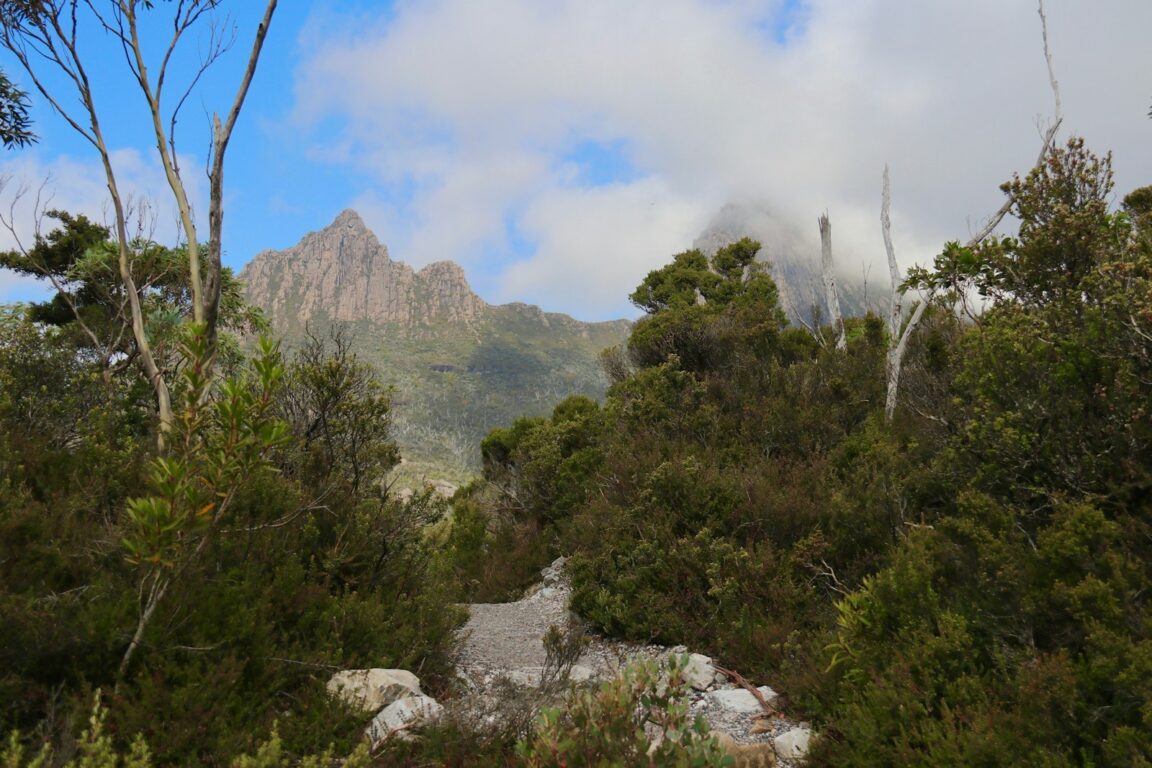
Parks Tasmania describes a track passing through expansive glacial valleys, ancient rainforests, eucalypt forest, buttongrass plains and alpine meadows, with almost half of the track above 1,000 metres in elevation on exposed plateaus in a remote area. The walk starts with the shuttle to Ronny Creek, where you sign in at the Walker Registration booth, and climbs past Crater Lake to Marions Lookout, the viewpoint in the Parks photograph that opens its official track page, with Cradle Mountain and Dove Lake behind the walkers. Optional side trips lead to waterfalls and mountain summits, including Mount Ossa at 1,617 metres, Tasmania’s highest peak. Most walkers finish at Narcissus Hut, at the northern end of Lake St Clair, and take the ferry across the lake to the Lake St Clair Visitor Centre, a ferry booking that must be made before you start walking. The alternative is to walk the 17.5 kilometres along the lake to the visitor centre, adding an extra day. Set your own pace honestly: Parks notes most walkers complete the track in six days, but rest days and side trips are built into the system for walkers who allow them.
How serious is Cradle Mountain weather, really?
Serious enough that Parks Tasmania leads its track page with a warning, not a welcome. The service states that the weather can change quickly, that severe cold, wet and windy conditions can happen at any time of year, even summer, and that deaths have occurred, including in summer, when walkers were not properly prepared. The track is a serious walk for well prepared, fit walkers with experience in remote alpine areas, and it is not recommended for children under 8 years of age. Your gear should fit into a 75 litre pack and weigh approximately 18 kilograms, including at least 2 litres of water, for days of up to 7 hours. Personal locator beacons can be hired from Service Tasmania shops in Hobart, Launceston, Burnie and Devonport, and in limited, unreservable numbers from the Cradle Mountain and Lake St Clair visitor centres. Check the Bureau of Meteorology forecast before departure and heed bushwalker weather warnings. None of this is boilerplate. On a plateau at over 1,000 metres, a summer cold front is a winter event by lowland standards, and the walkers who enjoy this track are the ones who packed for that fact. The floodplain forests in our Congaree National Park guide run on river time; the Overland runs on alpine time, which changes faster.
What changes in winter?
Winter, from 1 June to 23 September, is a different undertaking under different rules. There is no Overland Track Pass fee in winter; instead walkers register, and a valid parks pass is required. Parks Tasmania notes that winter registrations for 2027 reopen in April 2027, and the winter walk is aimed at very experienced walkers only, in a season of short days, snow and the track at its emptiest and hardest. Walkers considering a winter crossing should read the Parks winter material in full rather than extrapolating from summer accounts, and should treat the absence of a booking fee as an administrative detail, not as a sign that the walk is easier or less controlled.
How should you sequence the logistics at each end?
Work backwards from the two fixed points. At the start, you must be at the Cradle Mountain Visitor Centre in time for briefing and pass collection, by 1:30pm or 12:30pm in April and May, so most walkers plan a spare day for transport and logistics on either side of the departure date, as Parks itself suggests. Bus transport to and from the Cradle Mountain and Lake St Clair visitor centres runs all year from Hobart, Launceston and Devonport, through operators listed on the Parks plan your trip page. At the finish, the Lake St Clair ferry must be booked before you commence the walk, because there is no road at Narcissus and no way to improvise one at the end of day six. Carry all your food and equipment for the entire journey: once you start walking, Parks notes, the next road and commercial centre is the one you reach at the end of the track, six days later. Stow food in sealed, preferably double bagged form inside your pack inside your tent, because brush tailed possums at the campsites have learned to open zips and rip fabric to reach food.
Who should walk the Overland Track, and who should wait?
Walk it if you are a fit, experienced bushwalker who wants Australia’s premier alpine walk at its proper scale: six days, one direction, no resupply, and a booking system that keeps the track uncrowded by design. Walk it in season for the full hut and shuttle system and the longest days. Wait, or choose a shorter Cradle Mountain walk instead, if you have no remote alpine experience, if you cannot carry an 18 kilogram pack for up to 7 hours a day, or if your dates cannot flex around the July booking opening and the daily departure limit. The track rewards preparation at every stage, which is precisely its character. Book the date, carry the tent, respect the weather, and the six days between Cradle Mountain and Lake St Clair will justify every form you filled in.
Frequently Asked Questions
How much does the Overland Track Pass cost?
A$312 for adults and A$272 for children aged 17 and under and for concession holders, applying from 1 October to 31 May inclusive, per Parks Tasmania. The fees are reviewed annually in line with CPI, and all fees go towards services and maintenance of the track.
When do Overland Track bookings open?
On the first Tuesday in July each year, at 9am AEST, with an online waiting room open from 8am. There is no waitlist, but cancellations update on the booking site in real time.
Can you walk the Overland Track south to north?
Not in the booking season. From 1 October to 31 May, up to 34 independent walkers depart each day walking north to south only, from Cradle Mountain to Lake St Clair.
Do you need a tent if you plan to use the huts?
Yes. Huts cannot be booked and there may not be space for all walkers, so Parks Tasmania requires every walker to carry a tent. Expect a mix of hut nights and tent nights.
How long is the Overland Track and how many days does it take?
65 kilometres one way, usually completed in six days, graded Grade 4. Most walkers finish at Narcissus Hut and take the pre booked ferry across Lake St Clair, or walk the extra 17.5 kilometres along the lake, adding a day.
Is a parks pass included in the booking season fee?
The Overland Track fee includes park entry for the duration of your walk during the booking season. A valid parks pass is required to walk between June and September.
Image: The Overland Track at Cradle Mountain, Tasmania, the gravel track running through alpine scrub towards the dolerite peaks of Cradle Mountain in cloud. Photo: Christian Bass, via Unsplash, Unsplash License, used with credit.