 Elena Vasquez
Las Fallas is planned around two fixed points every March: at 14:00 each day from March 1 to 19, the mascletà shakes the Plaza del Ayuntamiento, and on the night of March 19 the cremà burns the monuments the city has spent a year building. Between those poles, Valencia runs on gunpowder, flowers and street art: around 800 fallas monuments rise in streets and squares, judges award prizes by section, and the whole festival, inscribed by UNESCO in 2016 on the Representative List of the Intangible Cultural Heritage of Humanity, ends in fire on the feast of Saint Joseph. This guide follows the programme the way residents live it, day by day.
Quick Facts
- The festival: Las Fallas, Valencia, inscribed by UNESCO in 2016 as Intangible Cultural Heritage of Humanity
- The daily anchor: The mascletà, a rhythmic daytime fireworks display at 14:00 in the Plaza del Ayuntamiento, every day from March 1 to 19, 19 in total, per Visit Valencia
- The monuments: Around 800 fallas, large and children versions combined, built by neighbourhood commissions and planted in streets and squares, per Visit Valencia
- The plantà: Children fallas are ready on March 15 and the large fallas on March 16
- The offering: The Ofrenda de Flores, March 17 and 18, when thousands of falleros carry flowers to the Virgin of the Forsaken in the Plaza de la Virgen
- The ending: The cremà on the night of March 19, children fallas first and the municipal falla in the Plaza del Ayuntamiento last
- Facts checked: November 23, 2026, against UNESCO, Visit Valencia and the Comunitat Valenciana official Fallas programme
What exactly is a falla, and who builds it?
A falla is both the festival and the monument. UNESCO describes the centrepiece as a giant structure made of ninots, caricature figures created by local artists and craftspeople, which provides a commentary on current social issues. Each monument belongs to a neighbourhood commission, a casal, which raises money all year, hires an artista fallero and builds in the warehouses of the Ciudad del Artista Fallero, the Fallas artists district. The satire is the point: politicians, celebrities and the year scandals are modelled in wood and papier mache at monumental scale, judged in public, and then destroyed. Visit Valencia counts around 800 monuments across the city during the festivities, half of them children fallas, smaller works designed for the youngest commissions. Nothing about the scale is spontaneous. Commissions work to a calendar that starts the morning after the last cremà, which is why residents talk about Fallas as a way of life rather than an event.
Why does the mascletà at 14:00 matter more than the fireworks?
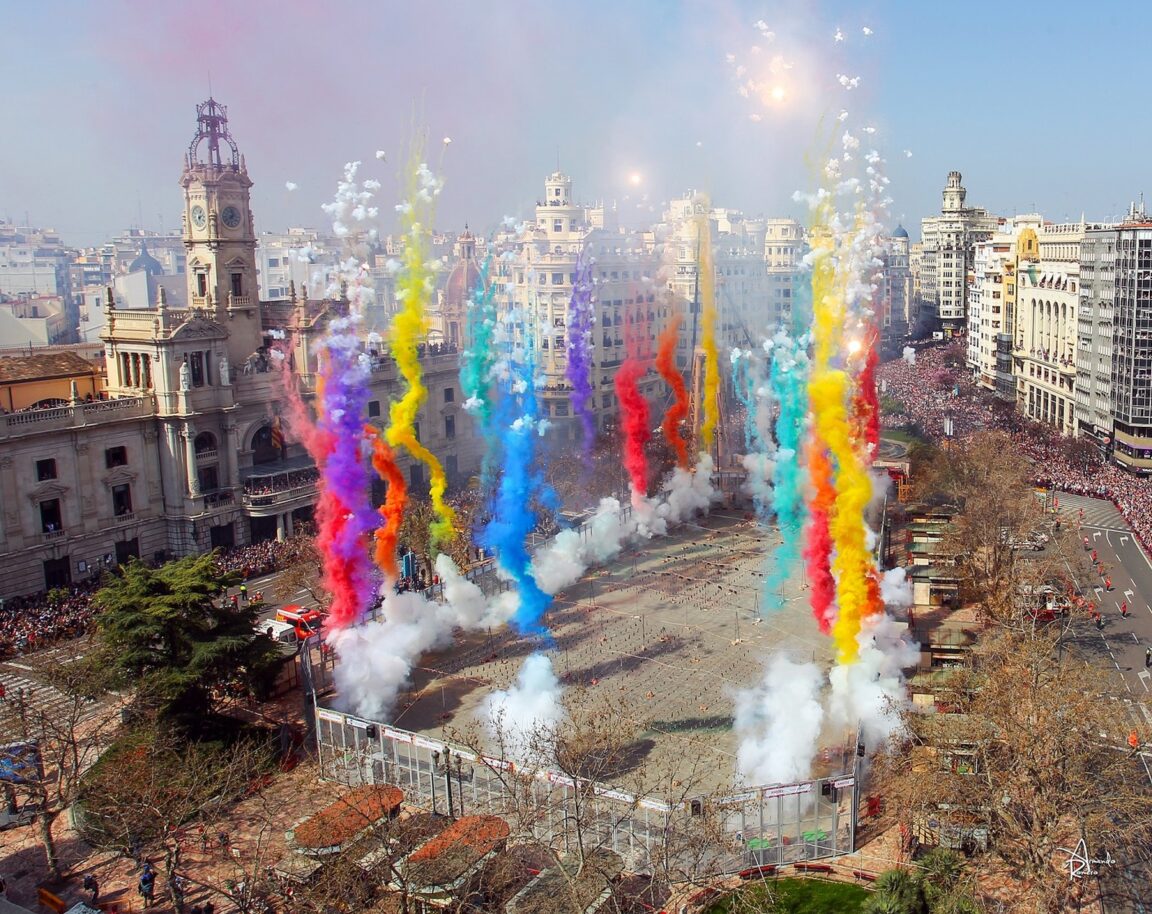
Because it is heard in the chest, not seen in the sky. Visit Valencia defines the mascletà as a firework display like no other: a few intense minutes of explosions whose rhythm and volume build progressively, making the ground and the crowd tremble, fired daily at 14:00 from March 1 to 19 in the City Hall square, with the falleras mayores signalling the start from the City Hall balcony. There are 19 mascletàs in a full Fallas, one for each day, each fired by a different pyrotechnic company competing on rhythm rather than colour. The coloured daytime mascletà in the photograph above is the exception that proves the rule: the classic version is white smoke and concussion. Practical craft matters here. Crowds gather up to an hour ahead on the big days, March 15 to 19. Stand inside the square rather than in a side street, keep your mouth slightly open as locals advise for the pressure waves, and do not plan a quiet lunch anywhere near the centre at 13:30. Neighbourhood commissions fire their own mascletàs after the main one, at around 14:30 and 15:00, so the concussion rolls across the city in sequence.
How does the plantà turn streets into a museum?
Over two nights. The plantà is the raising of the monuments: children fallas must be ready for visits on March 15 and the large fallas on March 16, when cranes and crews work through the night to set the biggest structures in place. From March 16 to 19 the city is an open air gallery with a closing date. This is the window to walk, and the strategy is sectional. The official competition judges fallas in categories by size and investment, with prizes granted at the Town Hall stand on March 17, per the official programme published by the Comunitat Valenciana. The first prize in the Special Section, the Seccion Especial, marks the monuments considered the best, and Visit Valencia notes they are usually the most visited. See those first, early in the morning, then work outward into the neighbourhoods, where smaller fallas carry the sharper local jokes. One figure from every monument escapes the fire by design: at the Ninot Exhibition, held at the Science Museum from February 7 to March 15 in the current programme, each commission shows one ninot, visitors vote, and the pardoned ninot, the ninot indultat, is saved for the Fallas Museum, which keeps the pardoned figures from every edition since 1934.
What happens at the Ofrenda, and why do residents call it the emotional centre?
For two days, March 17 and 18, the festival stops joking. Thousands of falleros and falleras in traditional Valencian dress parade from 15:30 each day to the Plaza de la Virgen, carrying bouquets to a gigantic image of the Virgin of the Forsaken, the patron of Valencia. The flowers are woven into the mantle of the image, whose design changes every year, and the fallera mayor makes the final offering after midnight on March 18, completing the mantle. Visit Valencia calls the parade impressive in itself for the costumes and the bands that accompany each commission. For a visitor, the Ofrenda is the clearest sight of what Fallas actually is: not a show staged for tourists, but a city filing past its patron in its best clothes, commission by commission, grandmother to grandchild. Stand on Calle de la Paz or Calle de San Vicente, the two approach routes, and let it come to you. Arrive before the first commissions pass, because the best position is simply the one held patiently while the bands, the banners and the flower baskets stream past for hours.
How does the cremà work, and where should you stand on March 19?
In sequence, and from a distance the firefighters set. March 19 is Saint Joseph day, honouring the patron saint of carpenters, whose guild stands behind the festival oldest traditions. The day runs from a morning mascletà and solemn Mass at the Cathedral to the fire parade at 19:00, and then the burning begins. Visit Valencia gives the current pattern: the cremà is staggered between 20:00 and 23:00, children fallas first at 20:00, their first prize winner at 20:30 and the children falla of the Plaza del Ayuntamiento at 21:00, then all the fallas of Valencia at 22:00, the first prize winner at 22:30, and the municipal falla in the Plaza del Ayuntamiento last, at 23:00. The night before, March 18, the Nit del Foc, the Night of Fire, fires the festival biggest fireworks display. Standing safely at a cremà means standing where the crowd is held: behind the barriers, upwind of the smoke, close enough to feel the heat arrive in a wave when the structure catches. Fire crews hose the surrounding facades as each monument burns. Choose two or three fallas in one neighbourhood and walk the sequence rather than chasing the municipal burning across a packed centre. For the wider Spanish festival circuit, compare the mask makers of Ronda in Andalusia for the quiet end of Spanish tradition, and read the Spain telework visa guide if Fallas persuades you to stay in Spain for a season rather than a week.
Frequently Asked Questions
When is Las Fallas held?
Every March. Festive events open with the Crida on the last Sunday of February, mascletàs run daily from March 1 to 19, and the main days are March 15 to 19, ending with the cremà on March 19, Saint Joseph day.
What is a mascletà?
A daytime pyrotechnic display built on rhythm and concussion rather than colour, fired at 14:00 in Valencia Plaza del Ayuntamiento every day from March 1 to 19. There are 19 in a full festival, per Visit Valencia.
How many fallas monuments are there?
Around 800 monuments are set up in Valencia streets and squares during the festivities, according to Visit Valencia, split between large fallas and children fallas.
What is the ninot indultat?
The pardoned figure. One ninot from the Ninot Exhibition is saved from the flames by popular vote each year, and the pardoned ninots since 1934 are kept in the Fallas Museum.
When do the fallas burn?
On the night of March 19. Visit Valencia lists the children fallas from 20:00, all fallas at 22:00, and the Plaza del Ayuntamiento falla last at 23:00.
Is Las Fallas recognised by UNESCO?
Yes. UNESCO inscribed the Valencia Fallas festivity in 2016 on the Representative List of the Intangible Cultural Heritage of Humanity.