 Sofia Rossi
Plitvice Lakes rarely disappoints anyone, but it routinely wastes their afternoon, and almost every wasted hour traces back to the same handful of structural mistakes. The park is a one way system in practice: two main entrances, a chain of upper and lower lakes linked by boardwalks, an electric boat across Lake Kozjak and a panorama train that decides how a visit ends. Choose the wrong entrance for the route in mind and the day starts against the flow of every tour group in Croatia. Arrive at midday in summer and the lower lakes boardwalks become a slow single file. Miss the logic of the last boat and train connections and the exit turns into a long walk back. None of this requires bad luck, only a ticket bought without a plan. The park’s own 2026 price list, checked for this guide on November 23, 2026, underlines why planning matters: an adult day ticket costs 10 euros in winter, 23 euros in the shoulder months and 40 euros in summer, so the expensive summer day is exactly the day the mistakes cost most.
Quick Facts
- Park: Plitvice Lakes National Park, Croatia’s oldest and largest national park, declared in 1949 and UNESCO listed since 1979, per the park authority
- Adult day ticket 2026: 10 euros from January to March and November to December, 23 euros in April, May and October, 40 euros June to September, with a 25 euro afternoon rate in summer, per the official price list
- Children and students: Children 7 to 18 pay 4, 6 or 15 euros by season; students 6, 14 or 25 euros; children under 7 enter free
- Included: The ticket covers the electric boat and the panorama train within the chosen programme, visitor insurance and taxes
- Entrances: Entrance 1 by the lower lakes, Entrance 2 by Lake Kozjak and the park hotels, plus the auxiliary Flora entrance near Entrance 2
- Trails: About 22 kilometres of trails through the lake system and 36 kilometres of hiking trails, per the park authority
- Facts checked: November 23, 2026, against np-plitvicka-jezera.hr, the park’s official website
Why is Entrance 1 the wrong start for most full day visits?
Entrance 1, at the northern end by the lower lakes, is the famous start: the big viewpoint over the lower lakes canyon and the Great Waterfall, Veliki Slap, arrive within minutes. That is precisely the problem. Most day trip coaches start there too, so a visitor entering at Entrance 1 at mid morning joins the densest crowd in the park at its narrowest boardwalks, then walks the lower lakes in the same direction as everyone else, at the group’s pace, all the way to the boat. Entrance 2, near Lake Kozjak and the park hotels, reverses the geometry. Starting there puts the upper lakes first, in the quieter hours, and brings a visitor down to the lower lakes later, when the coach groups are leaving. The exception is the short visit: a traveller with two or three hours who mainly wants the Great Waterfall and the lower lakes canyon should use Entrance 1 and a short lower lakes programme, and accept the company. The mistake is not Entrance 1 itself; it is using Entrance 1 by default, because it is first on the road from Zagreb, for a full day that would flow better from Entrance 2. Drivers should also note that the two entrances have separate car parks a few kilometres apart, so the entrance chosen at booking is the entrance the day is built around. Tickets bought online are validated at the entrance selected during purchase, within the booked time window, and the park treats visitors found in the visitation zone without a valid ticket as ticketless, per its official guidance.
Why does the midday boardwalk jam happen, and how is it avoided?
The lower lakes are a limestone canyon threaded by boardwalks that are, in places, barely two people wide, with the best waterfall viewpoints acting as natural stopping points. Between roughly 10:00 and 15:00 in summer, the canyon carries the combined flow of coach groups, day trippers from the coast and overnight guests who started late, and the boardwalk becomes a conveyor: too crowded to stop for photographs, too slow to feel like walking. The fix is sequencing, not speed. The park’s signposted programmes are built as loops combining walking, the boat and the train, and the four to six hour full programmes that cover both lake systems are the sweet spot for a first visit. Walked early from Entrance 2, the upper lakes are calm in the morning, the boat crossing of Kozjak lands a visitor at the lower lakes as the first wave thins, and the Great Waterfall is reached in the afternoon, when its viewpoint has space again. Walked the other way at midday, the same route is the jam. Season helps those who can choose it: the park is at its fullest in July and August, quieter in May and October when the adult ticket also falls to 23 euros, and quietest in winter at 10 euros, when some boat and train services run reduced hours and parts of the upper lakes can close in severe weather, a trade the park’s winter pages state plainly. Travellers who enjoy boardwalk parks will find the same crowd logic, at a gentler scale, in our guide to Congaree National Park and its Boardwalk Loop.
How does the boat queue eat an afternoon?
Lake Kozjak, the largest lake, is the hinge of every full programme, and the electric boat across it is included in the ticket. The mistake is treating the boat as a casual hop. At peak hours the queue for the crossing builds, and a visitor who reaches the dock at the wrong moment can lose the better part of an hour standing in it, then feel forced to cut the far side short. The deeper trap is directional: visitors who walk the lower lakes first, drift, and then queue for the boat late in the day discover that the remaining upper lakes section no longer fits before the last panorama train back toward their entrance, and the train, not the walking, sets the real closing time of a visit. The park publishes boat and train timetables by season, with reduced winter hours, and the last departures of the day are the ones to plan around. The working rule is to cross Kozjak deliberately, either early as part of an Entrance 2 start or immediately on reaching the dock rather than after a long lunch beside it, and to keep the last train time in view from mid afternoon onward. Anyone whose plan depends on a tight exit, a bus connection or a drive to the coast, should build the day backwards from that last train, the same way timed entry parks elsewhere reward travellers who read the return leg first, as our Las Vegas day trips guide shows for Red Rock Canyon’s scenic loop.
What other mistakes quietly ruin a Plitvice day?
Four smaller errors recur. The first is buying the wrong ticket product: two day tickets exist, at 15 euros in winter, 39 euros in the shoulder months and 60 euros in summer for adults, and they are the right buy for anyone sleeping by the park who wants an early start on day two, yet day trippers sometimes buy them by mistake, while overnight guests sometimes buy single days twice and pay more. Hotel guests at the park’s Hotel Jezero can extend a one day ticket at reception, a detail worth knowing before buying a second day at the gate. The second error is footwear: boardwalks over water are slippery in rain and spray, and the park’s own guidance expects visitors on trails to hold valid tickets and stay equipped for rapidly changing mountain weather. The third is assuming swimming is possible somewhere in the lakes; it is not, and the turquoise water is protected, not a bathing spot. The fourth is skipping the upper lakes entirely on a full day ticket. The upper lakes, set on dolomite and spread wider than the canyon lakes, carry fewer people per viewpoint and hold some of the park’s finest cascades; a visit that ends at the boat dock has paid the full 40 euros for half the park. Dogs, for those travelling with one, are permitted only on a leash, including on the boats and trains, per the park’s official remarks.
What does a well built Plitvice day look like?
Book online in advance for a morning entry, choosing Entrance 2 for a full day or Entrance 1 for a short lower lakes visit, and keep the ticket on a phone or printed, ready for validation at the chosen entrance. Start walking at entry, upper lakes first from Entrance 2, and take the Kozjak boat crossing when first reached rather than after a pause. Eat early or late, not at the midday peak beside the dock. Reach the lower lakes and the Great Waterfall in the afternoon light, and note the last panorama train time before the final section, not during it. In summer, the afternoon ticket rate, 25 euros for adults after 16:00 from June to August and after 15:00 in September, suits a deliberate late visit of a few hours, but it is a trap for anyone hoping to see both lake systems before dark. In winter, check the park’s conditions line before setting out, expect reduced boat and train hours, and treat frozen waterfalls as the compensation for the cold. Built that way, Plitvice becomes what its UNESCO listing promises: sixteen lakes stepping down through travertine barriers in sequence, read in the right order, at a walking pace.
Frequently Asked Questions
Which entrance is better at Plitvice, Entrance 1 or Entrance 2?
Entrance 2 suits most full day visits because it starts with the quieter upper lakes and reaches the lower lakes as crowds thin. Entrance 1 suits short visits focused on the lower lakes and the Great Waterfall. Tickets are validated at the entrance chosen during purchase.
How much are Plitvice tickets in 2026?
The official 2026 price list sets adult day tickets at 10 euros from January to March and November to December, 23 euros in April, May and October, and 40 euros from June to September, with a 25 euro summer afternoon rate. Two day adult tickets cost 15, 39 or 60 euros by season.
What does a Plitvice ticket include?
The park states that the entrance ticket includes transport with the electric boat and panorama train within the selected sightseeing programme, visitor insurance and value added tax, plus access to about 22 kilometres of lake trails.
How long does a Plitvice visit take?
Short lower lakes programmes take two to three hours, the popular full programmes covering both lake systems take four to six hours, and the full walking circuit takes six to eight hours. The last boat and panorama train times, which vary by season, set the practical end of the day.
Can you swim in Plitvice Lakes?
No. Swimming is not permitted in the lakes; the water system is the protected core of a UNESCO listed national park. The visit is a walking, boat and train experience.
Is Plitvice worth visiting in winter?
Yes, with expectations set: the adult ticket falls to 10 euros, crowds largely vanish and waterfalls can freeze, but the park runs reduced boat and train hours and some sections can close in severe weather, so check conditions on the official site before travelling.
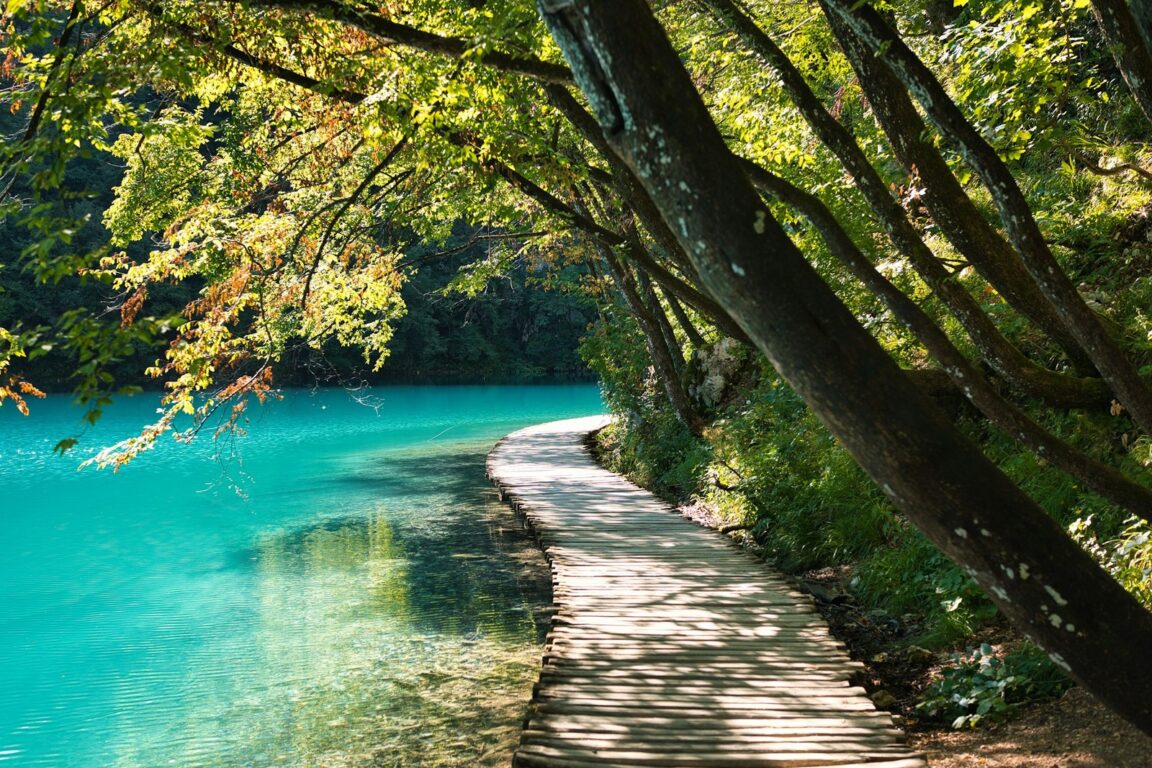
Image: A wooden boardwalk curving along a turquoise Plitvice lake under leaning trees in dappled light. Photo: Maksim Shutov, via Unsplash, hosted copy via travelplitvice.com, used with credit.