 Maya Chen
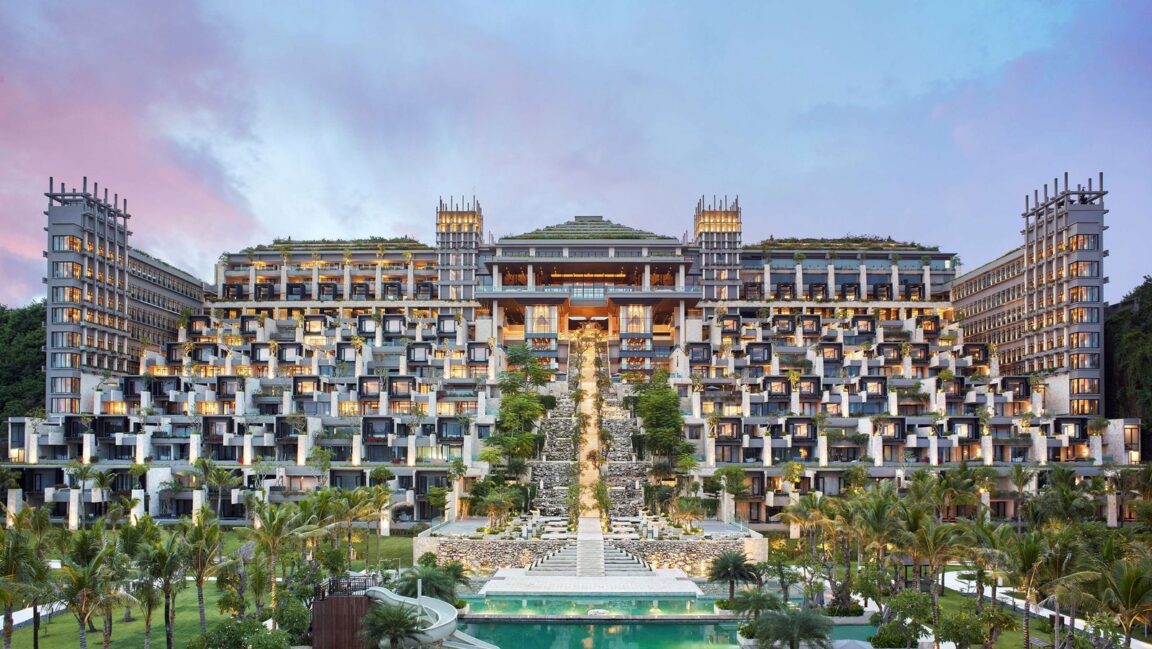
The Apurva Kempinski Bali should be read as architecture first, because architecture is what it is selling: a 465 room resort in Nusa Dua designed as a majestic open air theatre, cascading down its cliff in terraces modelled on Bali’s rice paddies, with a 250 step Grand Staircase at its centre inspired by the Pura Besakih temple. Kempinski’s own description leads with that staircase, the pendopo style lobby and the Majapahit inspired detailing, and the resort, opened on February 1, 2019, still has no Balinese rival at this scale of cultural set design. Travellers choosing a Bali splurge outside Ubud are really choosing between this theatrical cliff palace and the island’s smaller boutique norm, and the honest answer depends on whether scale reads to them as spectacle or as crowd.
Quick Facts
- Opened: February 1, 2019, in Nusa Dua, on Bali’s southern Bukit coast
- Size: 465 rooms, suites and villas, per Kempinski’s current official listing (475 keys at opening)
- Centrepiece: A 250 step Grand Staircase inspired by Pura Besakih, flanked by waterfalls, running through the resort’s centre
- Lobby: A pendopo style open hall with a soaring tiered roof and hand carved Javanese gebyok partitions referencing the Majapahit kingdom
- Design: Architect Budiman Hendropurnomo of Denton Corker Marshall; interiors by Rudy Dodo of Trivium Design Group
- Pools: Tiered reef facing pools descending toward the beach, plus private plunge pools in cliff suites and villas
- Airport: About 15 minutes from Ngurah Rai International Airport, per Kempinski at opening
- Facts checked: November 23, 2026, against kempinski.com, the property’s official website
What does the Grand Staircase actually organise?
Almost everything. The resort is built as terraces stepping down the Nusa Dua cliff, in a deliberate echo of Bali’s subak rice terraces, and the Grand Staircase is the spine that connects them: 250 steps, modelled on the stairway of Pura Besakih, Bali’s mother temple on Mount Agung, with tumbling waterfalls emerging from the planting on either side. Kempinski describes the staircase as a stage for nightly rituals, and that is the right word; the whole resort is arranged as an amphitheatre facing the Indian Ocean, with the lobby at the crown, room terraces as the seating tiers and the pools and beach as the stage floor. The practical consequence is a lot of vertical movement, handled by lifts and buggies, and a constant sense of procession. Guests who enjoy a resort with a ceremonial rhythm will find the design exhilarating. Guests who want to drift anonymously from room to beach in ninety seconds should note that here the journey is the design’s point.
How does the Majapahit theme run through the interiors?
The Majapahit kingdom, the great Hindu Javanese empire of the 13th to 16th centuries, is the resort’s chosen golden age, and the detailing follows it seriously rather than decoratively. The lobby is modelled on a royal pendopo, the open Javanese reception hall, covering some 2,000 square metres with a roof rising about 14 metres, divided by hand carved teak gebyok partitions made by Indonesian artisans. Kempinski and the design team’s published accounts describe craftspeople drawn from across the archipelago, so the resort doubles as a survey of Indonesian craft: carved wood, stone work, textiles and motifs from beyond Bali alone. Even small touches are placed, such as the angkringan food cart in the Selasar Deli, a reference to Javanese street food culture in the middle of a five star lobby level. In the rooms, Kempinski lists generous bathrooms with rain showers and deep soaking tubs and a personalised pillow menu as standard, with local woods and fabrics carrying the theme at a quieter volume.
How do the rooms, cliff suites and villas stack up?
The entry Grand Deluxe rooms start at about 65 square metres, large by any standard, with garden or ocean court outlooks. The signature step up is the Cliff Private Pool Ocean Junior Suite, at about 100 square metres, with its own plunge pool set into the cliff face and open ocean views; these are the rooms that deliver the resort’s postcard promise at private scale. Above them sit larger suites and the villas, running to over 1,000 square metres at the top in the Nusantara Presidential Villa class, with villa guests given their own lounge, separate from the Cliff Lounge that serves suite guests with breakfast into the late morning, afternoon tea and evening cocktails on Kempinski’s published pattern. Travellers should book the tier by the pool question: if a private plunge pool matters, the cliff suites are the value point of the whole property; if it does not, the Grand Deluxe rooms give the same architecture and grounds for considerably less.
What happens at the pools and the beach?
The public water is arranged as the staircase’s destination: tiered pools descending through gardens toward the beach, so a pool day still feels connected to the resort’s central composition rather than parked at its edge. The beach at Nusa Dua is calm, reef sheltered water, better for swimming and floating than for surf, which sits on Bali’s west and Bukit surf coasts instead. Dining is a major part of the offer, with Kempinski positioning the resort’s restaurants as a culinary journey in their own right, and the scale that might worry a boutique traveller becomes an asset here: multiple venues mean a week need not repeat a table. The spa draws on indigenous Indonesian treatments. Compare the model with Bali’s intimate end in our coverage of Amandari above the Ayung Gorge, and with the other great template setting resort in our Amanpuri review from Phuket.
Who should choose the Apurva over a boutique Bali stay?
Choose the Apurva if you want Bali’s culture performed at monumental scale, a room that starts at 65 square metres, resort depth in dining and pools, and Nusa Dua’s calm beach and convention coast convenience, including an airport run Kempinski puts at about 15 minutes. It is an especially strong choice for multigenerational groups and celebration trips, where its ballrooms, chapels and villa range exist precisely for gatherings. Choose the boutique alternative if your Bali is Ubud’s jungle, walkable local warungs and a twelve key hideaway; the Apurva’s theatre will feel like a cruise ship on land to travellers in that mood. Neither judgement is a quality verdict. The Apurva is the island’s grandest argument that a large resort can still be a cultural object, and on its own terms it wins the argument most days.
Frequently Asked Questions
How many rooms does The Apurva Kempinski Bali have?
Kempinski’s current official listing gives 465 rooms, suites and villas. At its February 2019 opening the resort was announced with 475 guestrooms, suites and villas.
What inspired the Grand Staircase at the Apurva Kempinski?
Pura Besakih, Bali’s sacred mother temple. The 250 step staircase runs through the centre of the resort, flanked by waterfalls, in a design that also echoes Bali’s terraced rice paddies.
Who designed The Apurva Kempinski Bali?
Architect Budiman Hendropurnomo of Denton Corker Marshall, with interiors by Rudy Dodo of Trivium Design Group, drawing on Majapahit era references and Indonesian craft from across the archipelago.
Do rooms at the Apurva Kempinski have private pools?
The Cliff Private Pool Ocean Junior Suites and the villas do, with plunge pools facing the ocean. Grand Deluxe rooms do not, but start at about 65 square metres with garden or ocean court views.
How far is the Apurva Kempinski from Bali airport?
About 15 minutes from Ngurah Rai International Airport, per Kempinski. The resort stands on the cliff at Nusa Dua, Jalan Raya Nusa Dua Selatan.
Image: The Apurva Kempinski Bali at dusk, its terraced wings stepping down the cliff either side of the illuminated Grand Staircase, with palms and pools in the foreground. Photo: Kempinski, via kempinski.com, the property’s official website, used with credit.