 Rafael Santos
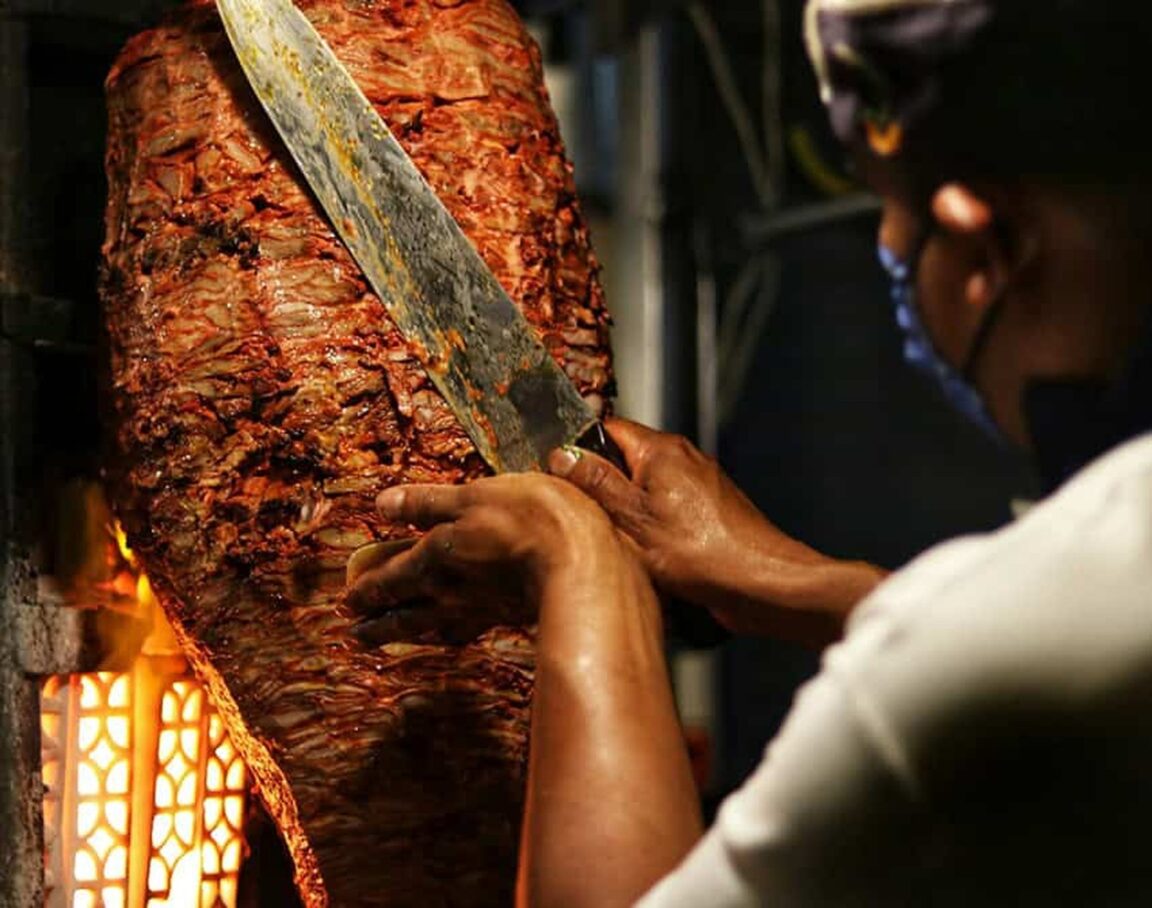
To eat tacos al pastor well in Mexico City, learn to read the trompo before you order: the tall vertical spit of chile stained pork, crowned with a pineapple, turning beside its flame in the taqueria window. That one object explains the dish’s whole history. Lebanese immigrants brought shawarma technique to Mexico in the late 19th and early 20th centuries; cooks in Puebla turned it into tacos arabes, and Mexico City completed the transformation in the mid 20th century by swapping lamb for pork, pita for small corn tortillas and shawarma spices for a dried chile and achiote adobo. What the taquero then does with a long knife, shaving crisped edges onto a tortilla and flicking a slice of pineapple down onto the meat, is the order, the sauce logic and the price structure of the capital’s most democratic meal.
Quick Facts
- The trompo: Thin slices of adobo marinated pork stacked on a vertical spit, named for its spinning top shape, crowned with a whole pineapple
- The marinade: Dried chiles such as guajillo and ancho with achiote, garlic, spices and vinegar or pineapple juice; achiote gives the meat its orange red colour
- The serve: Meat shaved directly onto small corn tortillas, usually doubled, with raw onion, fresh cilantro and a sliver of pineapple
- The lineage: Lebanese shawarma, via Puebla’s tacos arabes of the 1930s, to Mexico City al pastor by the late 1950s and 1960s
- Claimed birthplaces: El Huequito in the Centro, founded in 1959, and El Tizoncito in Condesa, claiming creation in 1966
- Recognition: El Califa de Leon, a Mexico City taqueria, received a Michelin star in 2024, the guide’s first for a taco stand
- Facts checked: November 23, 2026, against the Michelin Guide and published histories of the dish
How did Lebanese shawarma become a Mexican taco?
Through three documented steps, not a single invention. First, Lebanese migrants arriving in Mexico in the late 19th and early 20th centuries brought the vertical spit and shawarma, lamb roasted on a rotating skewer and served in pita. Many settled in Puebla, where by the 1930s the bridge dish appeared: tacos arabes, spit roasted meat served in a flour tortilla style bread, still a Puebla signature today. Second, the meat and marinade Mexicanised. Pork, cheaper and more widely eaten than lamb, replaced it, and the seasoning shifted from Middle Eastern spice toward a Mexican adobo of rehydrated dried chiles, achiote, garlic and acid. Third, in the Mexico City taco boom of the late 1950s and 1960s, the serve shrank to the small corn tortilla, the pineapple went on top of the spit, and the name al pastor, shepherd style, stuck. Food historians treat the dish as a collective, gradual creation, which is why two famous taquerias can both claim it: El Huequito, opened in 1959 in the Centro, and El Tizoncito, opened in 1966 in Condesa, each with a serious case.
What should you watch the taquero do?
Everything that matters happens in about five seconds, and it is the quality check a traveller can actually perform. The taquero works the trompo’s outer layer, which crisps against the flame while the inside stays juicy, shaving thin ribbons with a long knife so they fall directly onto a warm tortilla held in the other hand. Then comes the signature move: a slice cut from the pineapple crowning the spit, flicked through the air and caught on the taco. A proper pastor therefore arrives with three textures, crisped edges, tender inner meat and the pineapple’s sweet acid, plus raw onion and cilantro added at the counter. Warning signs are equally legible: a trompo standing unlit and pre sliced meat reheated on a flat top, meat cut thick and pale with no crisped surface, or pineapple served from a can on the side. In a good taqueria the spit is the kitchen, and the queue moves at the speed of the knife. Our wider Latin American food coverage, from Lima’s Nikkei cuisine to New Orleans’ Vietnamese east, returns often to this same immigrant adaptation pattern.
How is a proper order counted, sauced and priced?
Al pastor is ordered by the taco, in rounds, and nobody in Mexico City orders one. A standard first order is three to five tacos, eaten standing at the counter, with further rounds ordered as appetite and the trompo dictate; the small tortilla is sized for exactly this rhythm. Prices at street and neighbourhood taquerias remain a fraction of sit down restaurant prices, typically a modest per taco charge that rises with the room’s fame, which is why the dish feeds every income level in the same queue. Saucing is the eater’s job: taquerias set out at least two salsas, usually a green tomatillo and a red chile salsa, often with a hotter option, plus lime wedges. The local discipline is to taste the first taco with lime and a little salsa before drowning the batch, because the adobo and pineapple already carry the seasoning. Ask for con todo, with everything, to get onion and cilantro, or specify sin cebolla if you want the onion left off. A gringa, pastor meat with cheese in a flour tortilla, is the standard upgrade order, and a campechano mixes pastor with other meats for regulars varying a long evening.
Which taquerias anchor the story?
El Huequito, on Ayuntamiento in the Centro Historico, is the elder claimant, a small hole in the wall operation founded in 1959 and still focused on al pastor, now with branches across the city. El Tizoncito, on Tamaulipas in Condesa, claims the 1966 creation and serves its pastor with a theatrical counter service that has made it the version most visitors meet first. El Vilsito, in Narvarte, is a car repair shop by day and one of the city’s most loved taquerias by night, its trompos lit for the evening crowd, a useful reminder that in Mexico City the best pastor often keeps late hours. El Califa de Leon, in San Rafael, entered a different register in 2024 when the Michelin Guide awarded it a star, the first for a taco stand, for a tiny menu executed with total consistency; expect a queue and no ceremony. A traveller with one evening should pick one elder claimant and one neighbourhood favourite rather than attempting a crawl, because pastor is best eaten in rounds at a single counter while the trompo is in its prime.
When is al pastor at its best?
In the evening, when turnover is fastest. A trompo improves with demand: constant shaving keeps exposing new surface to the flame, so the meat stays in the crisp outside, juicy inside balance that defines the dish. At quiet midday hours a slow trompo can dry at the edges, which is why famous pastor addresses fill after dark and why the night taqueria is a Mexico City institution rather than a compromise. Order in small rounds, watch the knife, and finish with the pineapple heavy last taco. That is the whole technique, and it has not needed improving in sixty years.
Frequently Asked Questions
What does al pastor mean?
Shepherd style, in Spanish. The name references the dish’s origin in the shawarma brought by Lebanese immigrants, adapted in Mexico with pork, chile adobo and corn tortillas.
What is a trompo?
The vertical spit of stacked, marinated pork slices, named for its resemblance to a spinning top. It turns beside a flame, is crowned with a pineapple, and the taquero shaves the crisped outer layer to order.
Why is there pineapple on tacos al pastor?
The pineapple crowns the trompo, its juices running over the meat as it roasts, and the taquero flicks a slice onto each taco. Its sweetness and acidity balance the rich, chile seasoned pork.
How many tacos al pastor should you order?
Locals order in rounds of three to five, eaten standing at the counter, and reorder while the trompo is turning well. The small corn tortillas are sized for that rhythm.
Which Mexico City taqueria has a Michelin star?
El Califa de Leon in San Rafael received a Michelin star in 2024, the guide’s first star for a taco stand. El Huequito (1959) and El Tizoncito (1966) are the two historic claimants to the dish’s invention.
Image: A taquero shaving crisped pork from a trompo with a long knife beside the flame. Photo: Francisco de Legarreta, via Unsplash, used with credit.