 Maya Chen
Nikkei is not fusion invented for a tasting menu. It is the cooking of Peru’s Japanese community, built over more than a century since Japanese immigration to Peru began in 1899, and its clearest single dish is the tiradito: raw fish sliced thin as sashimi and dressed at the moment of serving, where ceviche cubes its fish and bathes it in lime. Maido, Mitsuharu Tsumura’s Miraflores restaurant, named number one on the World’s 50 Best Restaurants list in 2025, is where that lineage reaches its most formal expression, but the neighbourhood cevicherias and Nikkei counters of Lima were cooking it long before the awards.
Quick Facts
- The word: Nikkei names people of Japanese descent living abroad, and in Peru, the cuisine their community created from Japanese technique and Peruvian ingredients.
- The start: Japanese immigration to Peru began in 1899, first to coastal farms and plantations, then to Lima’s shops, restaurants and fish counters.
- Tiradito versus ceviche: Tiradito is sliced thin like sashimi and sauced at serving, so the fish stays raw; ceviche is cut in cubes and marinated in lime juice, which firms and opaques it.
- Maido: Calle San Martin 399, Miraflores, Lima. Opened in October 2009 by chef Mitsuharu “Micha” Tsumura; named the World’s Best Restaurant in 2025.
- The menu: Experiencia Maido, a tasting menu of 13 steps, priced on the restaurant’s own site at S/1,295 per person without pairing, S/1,985 with the Maido pairing, S/2,525 with the Tokujou pairing and S/1,659 with the non alcoholic pairing, taxes and service charge included.
- Hours and booking: Monday to Saturday, 1:00 p.m. to 10:00 p.m., closed Sunday. Reservations open two months ahead, on the first day of each month, per the restaurant.
Where did Nikkei cooking actually come from?
It came from substitution under pressure. The Japanese arrivals of 1899 and the decades after brought knife skills, a raw fish culture and pantry staples such as soy sauce, miso and ginger to a country whose Pacific coast held superb fish that Peruvian cooking of the time largely cooked rather than served raw. What they could not find, they replaced: local limes for Japanese citrus, aji chillies for heat, Peruvian potatoes and corn where Japanese staples would have gone. Over generations, in home kitchens and then in the community’s own restaurants, that improvisation hardened into a cuisine with its own canon.
That history matters to how a traveller should eat it. Nikkei is not Peruvian food with Japanese garnish, and it is not Japanese food with Peruvian garnish. It is a third thing, cooked by Peruvians of Japanese descent, and Lima is its capital. Travellers continuing south after Lima can taste how different Peru’s regional kitchens are from the capital’s in Arequipa, the white city under El Misti, where the tradition runs to rocoto peppers and chupe rather than raw fish.
What exactly is a tiradito?
A tiradito begins where sashimi begins: a fillet of very fresh fish, sliced thin and laid out flat on a cold plate. There the resemblance to ceviche ends. Ceviche’s fish is cubed and left in lime juice, salt, onion and aji until the citrus firms it, and it arrives swimming in that marinade, the leche de tigre. A tiradito’s fish is dressed at the last moment with a sauce, often built on lime and aji amarillo or rocoto, sometimes with soy or sesame in the Nikkei manner, so the slice keeps the texture and taste of raw fish under a Peruvian seasoning.
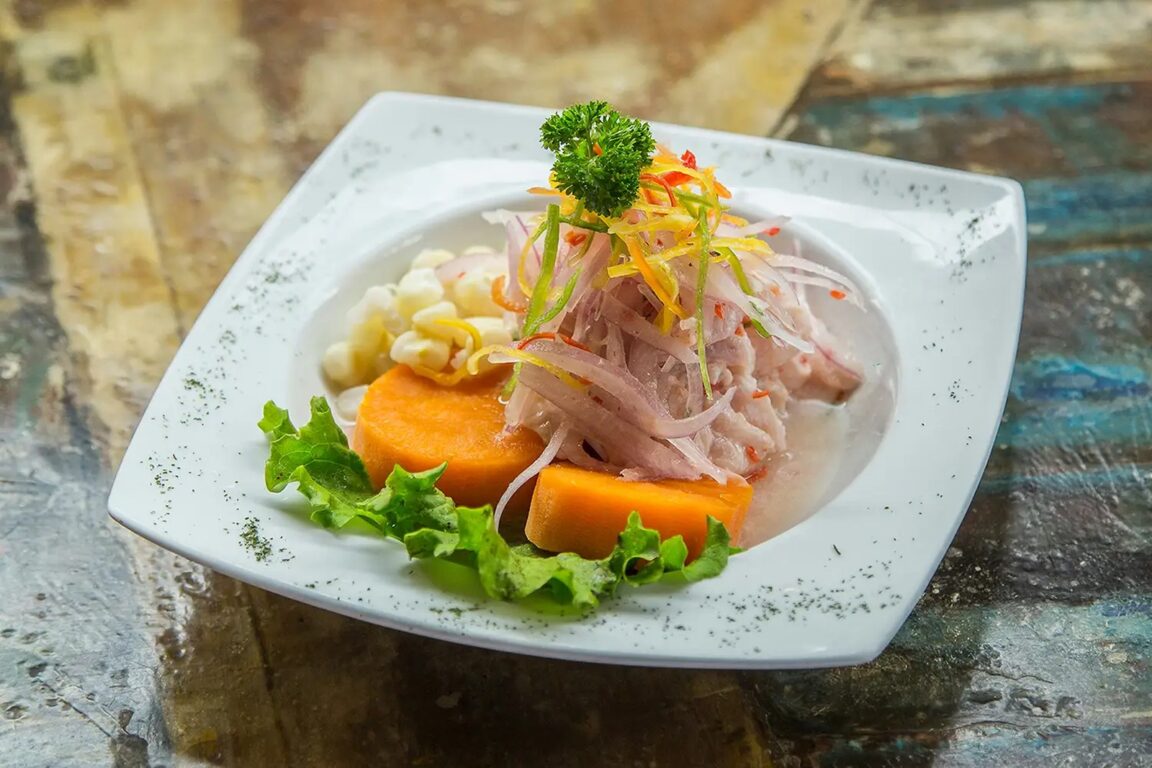
Order both dishes side by side once and the distinction stops being academic. The ceviche is bright, wet and assertive, eaten with sweet potato and corn. The tiradito is quieter and more precise, a test of the knife and the fish itself. Nikkei cooks also turned the form toward nigiri topped with Peruvian sauces, maki rolls built on local fish, and hot dishes where Japanese technique meets Andean and Amazonian produce, but the tiradito remains the plate that explains the whole cuisine in one bite.
How does Maido build its tasting menu?
Maido’s Experiencia is a set sequence of 13 steps, served Monday to Saturday at Calle San Martin 399 in Miraflores, and its logic is geographic as much as culinary: the menu travels Peru’s coast, Andes and Amazon through a Japanese technical lens. Dishes cited in the World’s 50 Best’s own description of the restaurant include squid ramen with Amazonian chorizo, sea snails with yellow chilli foam, and Tsumura’s signature short rib, braised for more than two days, or 50 hours in the restaurant’s own telling, until it can be eaten with a spoon.
The practical frame is strict. There is one menu, at four published prices depending on pairing: S/1,295 without drinks, S/1,659 with the non alcoholic pairing built on native fruits and teas, S/1,985 with the Maido pairing of New World wines and sake, and S/2,525 with the Tokujou pairing of Old World wines and sake, all including taxes and the consumption charge, per the restaurant’s official site. Reservations open two months in advance on the first day of the month, and since the 2025 number one ranking, the sensible assumption is that the book fills fast. The restaurant is closed on Sundays, which catches out travellers who save their big Lima dinner for the end of the week.
Where else does Lima’s Nikkei lineage show?
Maido is the summit, not the whole mountain. Lima’s Nikkei cooking lives at every level of the city: in long running Nikkei restaurants that served the community decades before international lists arrived, in cevicherias where tiradito sits on the menu beside ceviche as a matter of course, and in sushi counters where the maki is built with Peruvian sauces and local catch. Eating one neighbourhood tiradito before or after the Maido experience is not slumming it; it is how the dish reads in its everyday form, priced for lunch rather than for an occasion.
The comparison also sharpens what Maido is doing. The techniques are the same inheritance; the difference is range and finish, Amazonian ingredients carried into a formal sequence, a short rib given two days, a dining room built around a single menu. Travellers who enjoy watching one ingredient culture refracted through another city entirely can compare Lima’s story with Penang’s Nyonya kuih stalls in George Town, another cuisine born when a migrant community cooked its memory into local ingredients.
How should a first timer order beyond Maido?
Start at lunch, because Lima’s raw fish culture is a daytime culture and the catch is at its best early. Order ceviche and tiradito together once, to learn the difference with your own palate, then follow the tiradito through its variations: aji amarillo for warmth, rocoto for real heat, and Nikkei versions where soy and sesame enter the dressing. Add a hot Nikkei plate, a nigiri or two, and the meal covers the cuisine’s full arc from the community’s home cooking to its restaurant form. If Maido is the trip’s one splurge, book it the day reservations open for your dates, and keep the neighbourhood meals unplanned around it.
Frequently Asked Questions
What is the difference between tiradito and ceviche?
Tiradito is raw fish sliced thin like sashimi and sauced at the moment of serving, so it stays raw. Ceviche is fish cut in cubes and marinated in lime juice, which firms and opaques it before it reaches the table.
How much does the Maido tasting menu cost?
On the restaurant’s official site, the Experiencia Maido costs S/1,295 per person without pairing, S/1,659 with the non alcoholic pairing, S/1,985 with the Maido pairing and S/2,525 with the Tokujou pairing, with taxes and service charge included.
When did Japanese immigration to Peru begin?
In 1899. The community that formed over the following decades created Nikkei cuisine by applying Japanese technique, especially raw fish preparation, to Peru’s coastal catch and produce.
Is Maido open on Sundays?
No. Maido serves Monday to Saturday, 1:00 p.m. to 10:00 p.m., and is closed on Sunday. Reservations open two months ahead, on the first day of each month.
What is Maido’s signature dish?
Its short rib, braised for 50 hours until it can be cut with a spoon, is the most cited. The World’s 50 Best also highlights its squid ramen with Amazonian chorizo and sea snails with yellow chilli foam.
Photo: A Peruvian ceviche of raw fish, red onion and aji with sweet potato and corn, the parent dish of the Nikkei tiradito. Credit: Pirata Studio Film, via Unsplash (Unsplash License), hosted copy via Inca Expert.