 Omar Haddad
Konya in December is not a show town, and that is the point. From 7 to 17 December 2026 the city marks Seb-i Arus, the 753rd anniversary of the death of Mevlana Jalaluddin Rumi, with ticketed sema ceremonies in the Sema Hall of the Mevlana Cultural Center, while the Mevlana Museum, Rumi’s tomb beneath its green dome, stays free and open every day. Come for the ceremony in its home setting, visit the tomb in the quiet of a morning, and expect a commemoration, hushed, formal and unhurried, rather than a performance staged for visitors.
Quick Facts
- Seb-i Arus 2026: 7 to 17 December 2026 in Konya, the 753rd anniversary of Rumi’s death on 17 December 1273.
- Venue: The Sema Hall of the Mevlana Cultural Center in Karatay, Konya. The ceremonies are not held inside the Mevlana Museum.
- Tickets: Sold online through Biletinial, the channel named by Konya’s Provincial Directorate of Culture and Tourism; 2026 sales opened on 9 October 2026.
- Session pattern: Most evenings at 20:00, the opening day at 19:00, two sessions at 14:00 and 20:00 on 12 and 13 December, and a single 14:00 session on 17 December.
- Mevlana Museum: Free entry, open every day 09:00 to 17:00, with the box office closing at 16:30 and a 10:00 opening on Mondays, per the Turkish Ministry of Culture and Tourism.
- Year-round alternative: Outside the festival, the Konya ensemble performs Saturday sema ceremonies at 19:00 in the same hall for much of the year.
What does Seb-i Arus actually mean?
Seb-i Arus translates as the wedding night. Rumi, who died in Konya on 17 December 1273, taught his followers not to mourn his death, because he understood it as union with the divine, a wedding rather than a loss. The commemoration built around that anniversary keeps the tone: this is a celebration conducted with the gravity of a religious rite, because for the Mevlevi order it is one. The programme runs for eleven days, with the sema ceremonies as its heart and conferences, recitations and concerts around them, and it closes on the anniversary day itself, 17 December, with an afternoon session rather than an evening one.
The distinction matters for how you behave in the hall. Visitors used to Istanbul’s shorter dervish performances, often staged in cultural centres and railway-station halls for tourist audiences, will find the Konya ceremony longer, more formal and less mediated. There is no narration aimed at the audience and no applause culture. UNESCO, which inscribed the Mevlevi Sema Ceremony on its Representative List of the Intangible Cultural Heritage of Humanity in 2008, after proclaiming it a Masterpiece in 2005, has itself noted that many ceremonies are now performed outside their traditional context and shortened for commercial audiences. Konya in December is the traditional context.
What happens inside a sema ceremony?
The ceremony follows a fixed order. It opens with the Naat-i Serif, a eulogy to the Prophet Muhammad, followed by a solo improvisation on the ney, the reed flute whose sound Rumi used as an image of the soul separated from its source. A prelude and the Devr-i Veledi, a processional circuit of the hall, lead into the heart of the rite: four turning sections called selams, each with its own musical character, before the ceremony closes in prayer and recitation.
Every visible element carries an assigned meaning, which is why the turning reads as meditation rather than dance. The tall felt hat, the sikke, represents the tombstone of the ego. The black cloak worn at the start stands for the grave, and the dervishes remove it before turning, as a sign of rebirth. The white robe beneath, the tennure, is the shroud, and it bells outward as the semazen turns. The right palm turns upward to receive, the left downward to give to the earth. None of this is explained from the stage in Konya. Read it beforehand, and the hour in the hall becomes legible.
How do the museum and the ceremony fit together?
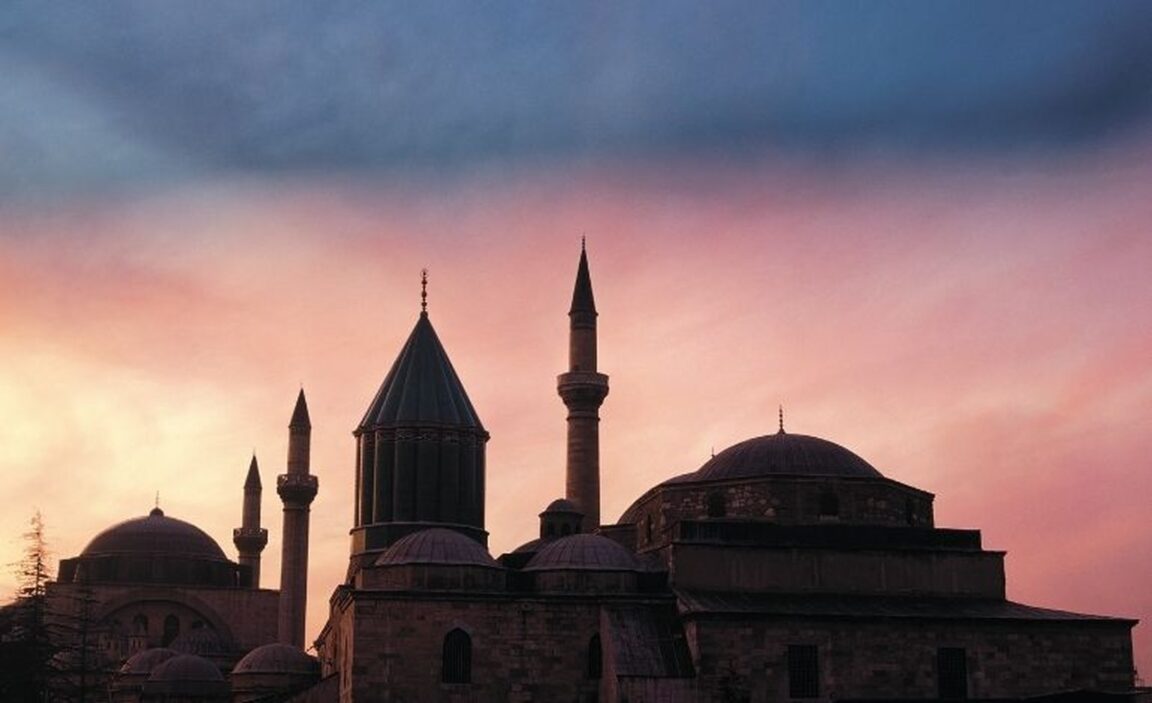
Keep the two buildings separate in your planning, because visitors regularly confuse them. The Mevlana Museum is the former dervish lodge built around Rumi’s tomb. Its core, the shrine itself, was constructed in 1274, and the Semahane where the rite was historically performed, the mosque, the dervish cells, the kitchen and the fountain court were added in the 16th century, according to the Ministry of Culture and Tourism. The museum is where you go to understand the order: the tomb chamber under the green dome, manuscripts, instruments and the cells where dervishes trained.
The ceremonies happen across the district at the Mevlana Cultural Center, a modern complex with a purpose-built sema hall. The museum visit is free, unticketed and best done in the morning before tour groups arrive; the ceremony is ticketed, seated and fixed to its session time. A well-built Konya day runs museum first, then the Seljuk monuments of the centre, the Karatay tile museum and the Ince Minare, then an early dinner and the evening ceremony. Travellers building a wider Turkey or festival itinerary can compare the discipline of this commemoration with Provence’s very different living ritual in the Fete de la Transhumance in Saint-Remy, or with the Rif Mountain walking that anchors a Morocco trip in Chefchaouen beyond the blue lanes.
How do tickets work, and what if December is sold out?
Tickets for the Seb-i Arus ceremonies are sold online through Biletinial, the only channel named by Konya’s Provincial Directorate of Culture and Tourism, and demand is the defining practical fact of the festival. For 2026, sales opened on 9 October, and reporting on the official listing showed all 13 sessions sold out within days, with returned seats possible when buyers cancel up to 48 hours before a session. The working strategy is to book the moment sales open, choose a midweek session if you have flexibility, and recheck the listing for cancellations in the final week rather than arriving in Konya on hope.
If December defeats you, Konya is not a one-week town for the sema. The state ensemble performs Saturday ceremonies at 19:00 in the same Cultural Center hall through much of the year, listed on Biletinial at far lower prices than the festival sessions command, and the experience in the same hall, with the same order of ceremony, is the honest substitute. What you lose is the anniversary itself and the city full of pilgrims; what you keep is the rite in its home.
What etiquette does the hall expect?
Dress as for a place of worship, because the audience around you treats it as one: covered shoulders and legs, and a headscarf for women is a respectful choice in the museum’s tomb chamber, where modest dress is expected. Arrive before the session time, silence phones completely, and do not photograph during the ceremony unless the venue explicitly permits it; the museum prohibits photography inside the tomb chamber itself. Children are welcome at the museum, but a full ceremony is long, still and silent, and families should judge honestly whether a young child can sit it out. Conversation, applause and coming and going mid-ceremony all break the room’s contract, so take your seat intending to stay for the whole rite.
Why is Rumi’s tomb inside a museum, not a lodge?
Because the lodge was closed by law. The complex around the tomb grew over centuries from the shrine built in 1274 into a working Mevlevi lodge, with the Semahane, mosque, dervish cells, kitchen and fountain court added in the 16th century, and it functioned as the order’s mother house until Turkey closed the dervish lodges in 1925. The building reopened as a museum in 1926 and took its present name, the Mevlana Museum, in 1954, according to the Ministry of Culture and Tourism. That history explains the building’s double character today: visitors move through a museum’s displays, manuscripts, instruments and tiled sarcophagi, in rooms that were arranged for a living religious community, and the tomb chamber still draws pilgrims who come to pray rather than to tour. During Seb-i Arus week the balance tips visibly towards pilgrimage, which is precisely what makes a December visit different from a summer one.
Frequently Asked Questions
When is Seb-i Arus in 2026?
The commemorations run from 7 to 17 December 2026, the 753rd anniversary of Rumi’s death, with ceremonies at the Mevlana Cultural Center in Konya. Most sessions start at 20:00; the final day, 17 December, has a single session at 14:00.
Is the Mevlana Museum where the dervishes perform?
No. The museum holds Rumi’s tomb and the historic lodge, including its own historic Semahane, but the festival ceremonies take place in the Sema Hall of the separate Mevlana Cultural Center. Visit the museum by day and the ceremony by ticket.
How much does the Mevlana Museum cost?
Entry is free. The Ministry of Culture and Tourism lists the museum as open every day from 09:00 to 17:00, with the box office closing at 16:30 and opening at 10:00 on Mondays.
Where do I buy ceremony tickets?
Online through Biletinial, the seller named by Konya’s Provincial Directorate of Culture and Tourism. Festival sessions sell out quickly after sales open; cancelled seats can reappear up to 48 hours before a session.
Is the sema a UNESCO-listed tradition?
Yes. UNESCO proclaimed the Mevlevi Sema Ceremony a Masterpiece of the Oral and Intangible Heritage of Humanity in 2005 and inscribed it on the Representative List of the Intangible Cultural Heritage of Humanity in 2008.
Photo: The Mevlana Museum in Konya at sunset, its green dome rising over the former dervish lodge. Credit: Turkish Ministry of Culture and Tourism, via muze.gov.tr, the museum’s official page.